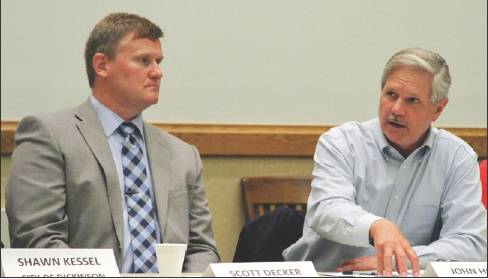
Dickinson City Leaders, Sen. Hoeven Talk Drug Crime

Dickinson leaders told U.S. Sen. John Hoeven on Wednesday that a federal law enforcement presence in the city may be necessary to help address the state’s growing opioid epidemic.

Drug crime has become increasingly more complex and organized in western North Dakota in the past three years, Dickinson Mayor Scott Decker said, relaying information Southwest Narcotics Task Force leaders told the Dickinson City Commission on Monday at their regular meeting.

“For us, what would be nice is to have that federal presence,” Decker said. “A lot of this stuff is going to end up in federal jurisdiction.”

Task Force members said Monday that the city has become “the stop” for drug runners coming out of Denver, Chicago and as far away as Mexico.

Methamphetamine and heroin laced with fentanyl, a synthetic opioid shipped to the U.S. from countries like China, are the top concerns of drug task force leaders in western North Dakota.

Hoeven, a North Dakota Republican, said this week he introduced new legislation that would close a loophole that currently allows synthetic drugs to enter the U.S.

The Illegal Synthetic Drug Safety Act of 2016, which Hoeven co-sponsored with Sen. Chris Coons, D-Del., would change a law that allows overseas companies to sell the drugs in the U.S. by labeling the products as “not safe for human consumption.”

Hoeven said the legislation has been endorsed by the National Law Enforcement Association and drug companies.

“Our laws have to catch up with the new types of drugs that are out there on the market,” he said.

Decker also pressed for more law enforcement funding, and spoke about the Southwest Narcotics Task Force’s worries that their agents will become overworked by the continuing rise in in-depth narcotics investigations during the roundtable.

“One of their biggest issues is the funding and getting the level of law enforcement they need — the experienced law enforcement they need to combat this type of sale,” Decker said. “They need a certain type of person — a certain type of agent with the right experience.”

Dickinson City Administrator Shawn Kessel pointed to the perceived decrease in narcotics seizures and arrests by the Southwest Narcotics Task Force agents this year, saying instead of arresting low-level drug offenders, the agents are effectively triaging their caseload and focusing on high-profile cases.

“If you look at a simple statistical way of measuring success, it’s going to look like we have less of a problem,” Kessel said. “That couldn’t be further from the truth.”

Airport officials ask for Hoeven’s support

Officials from the Dickinson Theodore Roosevelt Regional Airport reiterated their need for Hoeven’s support at the federal level as they try to continue providing commercial air service after United Airlines announced in June its intention to ends its flights into Dickinson.

Hoeven said he has requested that the U.S. Department of Transportation expedite approval of the airport’s Essential Air Service designation to ensure commercial service to the airport.

When United announced it wanted to pull out, the airport was under the impression the airline would apply for federal EAS designation, which would federally fund its flights into Dickinson. It has yet to do that.

“We’ve done this before,” Hoeven said. “We don’t want to go work to approve someone for air service that doesn’t fit what you want.”

Airport manager Kelly Braun said he has been “working diligently” to try and get both United and other airlines to submit proposals for EAS to the DOT.

“Any help we can get from your office to persuade airlines to give proposals to the DOT would be helpful,” Braun told Hoeven.

Braun said United was issued a stay order to continue providing service to the airport past the Sept. 30 date for an EAS provider to be in place.

“They have a stay order that’ll prevent them from pulling out of the market until an EAS provider is selected,” he said.

The airport is also seeking to rebuild its runway by 2020 due to its inability to accommodate the 50-passenger planes that currently fly into the airport.

Along with that, Dickinson Airport Authority Chairman Jon Frantsvog said more airlines — including any that would serve Dickinson through the EAS program — are discontinuing their use of 50-seaters in favor of 70-passenger jets. That’ll only further deteriorate the runway, he said.

“The key is to get the FAA dialed in,” Hoeven said, adding the Federal Aviation Administration has been traditionally open to providing financial support for runway upgrade projects. “… We’ll make the case based on aircraft, saying we’ve got to get this runway transitioned as the airlines transition to 70-passenger aircraft.”

Law Enforcement Center Remodel Bids Get OK

The cost to remodel the Dickinson Law Enforcement Center will be much less than the Stark County Commission anticipated at just less than $1 million, commissioners learned at their monthly meeting Tuesday.

Rob Remark of JLG Architects told commissioners that bids for the project came in lower than expected, even with a high contingency percentage on the project — due to possible unforeseen “surprises” that contractors could find hiding behind walls and in the ceilings of the building, which was built in the 1980s.

Remark said the project will only cost around $663,000 in contracting, electrical and mechanical fees. However, he said there will be a 15 percent contingency on the costs.

With contingencies and soft costs added in, the total cost of the project is about $992,000.

“It’s a small project, a small scale,” Remark said. “It’s a remodel to an existing building. We know there’s going to be some surprises when the ceilings and the walls come out. There’s surprises that the design team made the decision … to plan for rather than make assumptions for.”

Nonetheless, commissioners accepted the bids and were pleased with the price tag.

“This project came in under what we assumed it was going to cost by about $500,000,” Commissioner Jay Elkin said.

Commissioner Pete Kuntz added that early in the process, the commission expected the remodel to cost around $1.4 million.

The Law Enforcement Center is home to the Stark County Sheriff’s Office and formerly also housed the Dickinson Police Department, which moved into the Public Safety Center last year.

Stark County Sheriff Terry Oestreich said some of the soft costs will be to update technology and safety aspects of the building, including adding new interrogation room hardware and software to match what the police department uses.

“What’s happening is the city, in their building, they have interview rooms that run with this system,” Oestreich said. “But actually our interview rooms there are going to be utilized more because they’re in the same building as our jail. So we wanted to try and have the same system for ease of operation so that there will be less chance of error in those recordings.”

Oestreich jokingly referred to the current recording system as being “off the shelf, from Walmart,” but noted more seriously that it’s “not very reliable.”

Remark said it’s unlikely the contingency costs would be that high, nor would the soft costs, meaning the project will likely come in at a lower budget.

  • Scull Construction informed the commission that the Stark County Courthouse building project began Tuesday and that the west end of the courthouse parking lot will be closed beginning today.
  • Representatives of the Waters Edge Subdivision southwest of Dickinson along Patterson Lake and the Heart River Golf Course approached the commission about the potential of paving a gravel road into the subdivision. County road superintendent Al Heiser will work with the homeowners assocation on creating a proposal.

KLJ Admits Error in Water Tower Design

A new water tower built in east Dickinson is too tall and must be shortened, representatives from the engineering firm KLJ told the city commissioners on Monday.

KLJ engineers admitted during the regular meeting that the 150-foot tower was built 78 feet too tall because of an error that happened early in the engineering process. The firm intends to completely absorb the cost of its error.

“It did not meet our level of expectations and we let you down,” KLJ Chief Production Officer Barry Schuchard said. “We’re going to work very hard to make sure we get it corrected and I want to assure you that we’re going to take responsibility for this. There’ll be no additional cost to the city.”

The city approved a change order at KLJ’s request that would allow the firm to pursue re-engineering the tower to be only 72 feet.

The tower, which has already been constructed near the city’s Public Works Building, was engineered with specifications from the wrong city water zone, said Barry Synhorst, KLJ’s division leader.

“With the water in the existing water distribution system, we can’t get the water up to the level that it needs to be in the water tower,” Synhorst said. “Even if we could get the water up that high, because of the elevation difference, the pressures coming out of that water tower would be too great.”

Schuchard said the firm has been intensively working with city staff and its contractor to come up with a variety of options for fixing the mistake.

One option KLJ explored was to install a pump system that would lift the water up the existing tower to the elevation it needs to be at to create enough pressure.

Synhorst said KLJ consulted with a variety of peers and other municipalities — including some in Montana, where there are often challenges with pumping water because of differences in elevation — but could not come to a consensus on whether or not that idea would work.

Commissioners and engineers agreed that shortening the water tower was the most effective way to assure the project is completed by year’s end.

“I think this is the right choice too,” City Commission President Scott Decker said. “If you put a bunch of pumps into play, you have a lot of valves and moving parts that can fail.”

Kessel said the city has asked KLJ to review other projects it’s working on for the city to ensure there are no other engineering flaws.

“The city staff took this issue very seriously and have asked them to go beyond the scope of this water tower and make sure other work has been done accurately. I know they’ve also had to approach other engineering firms to verify some of those things,” Kessel said. “It’s a humbling experience for KLJ, but I do think they’ve taken the right steps to correct them.”


  • Public Works Director Gary Zuroff and Aaron Praus, the city’s solid waste manager, gave a presentation about implementing a city-wide recycling program. Commissioners voiced their agreement that the city needs a recycling program but made decision on the matter, other than to continue moving forward with researching the best ways to put the plans into motion.
  • Mike Lefor was sworn in as the fifth member of the city commission. Lefor, a lifelong Dickinson resident, owns DCI Credit Services and is a Republican in the state House of Representatives. He’ll serve on the commission through November, and will not seek the position that is open in the general election.
  • The commission approved a 30-day contract extension for city attorney services with Mackoff Kellogg law firm. Kessel called it a short-term solution as the city continues to deal with human resources issues stemming from its dismissal of former city attorney Jennifer Gooss.
  • The commission unanimously approved the creation of a new corporal position with the Dickinson Police Department to help provide more leadership within the department. The corporal position is a second-in-command position at the squad level and has some supervisory duties.
  • The city accepted a bid of $323,480 from Edling Electric to install new traffic signals at the intersections of 21st Street West and Third Avenue West, and at 21st Street West and State Avenue.

Parts of Southwest N.D. on Cusp of Grain Harvest

Kelly Herberholz made the first cut of this year’s harvest a week ago.

Since then, he and his father, Joe, have slowly been chipping away at their crop throughout central and western Hettinger County. Kelly estimates they have at least 300 acres done and that much of their spring wheat is running between 35 and 45 bushels an acre.

“We need more than that though,” he said with a short laugh.

Southwest North Dakota farmers are on the verge of what appears to be an above-average small grains harvest in a year where prices are well below average.

“There’s some good-looking crop out there. Now if we could just get a price for it,” CHS Southwest Grain General Manager Delane Thom said Friday. “A 50-bushel spring wheat crop is barely a break-even number.”

On Friday, 14 protein spring wheat closed at $3.85 a bushel at the Southwest Grain terminal near Taylor. Milling quality durum was $5.90.

As farmers like Herberholz are quietly chipping away at their spring wheat crop in Hettinger County — where the wheat is furthest along — he and others say and are awaiting higher temperatures this weekend that could turn a crop nearly ready to cut into one that’s falling into the hoppers of combines throughout the area.

“If the sun would come out, I think we’d all go,” Herberholz said.

This weekend — with temperatures forecast in the high 80s and low 90s, with a chance of thunderstorms on Sunday evening — could go a long way toward getting farmers in the field.

Tom Snell, who runs Snell Harvesting of Ellinwood, Kan., has 18 combines in Regent ready to go whenever the wheat is. He said they took a couple of their John Deere harvesters out north of the small town on Friday to try areas for one client.

Snell said he has seen some good crops throughout the Great Plains this summer and while this year’s North Dakota crop isn’t going to be a “bin buster,” he believes it’ll be a good one. And he wants to help get it off the field and into those bins as soon as possible.

“When it’s getting this close we’re no different than a farmer,” Snell said. “As quick as you can, you want to get going.”

Thom said he recently drove through much of southwest North Dakota.

He said crops didn’t fare well along the Highway 12 corridor between Bowman and Lemmon, S.D.

“It’s extremely dry down in that country,” Thom said. “A lot of that crop was rolled up for hay because the hay crop was short. The further north you get of that line, the better it looks.”

He estimates that five major hail events during the summer took out anywhere between 30,000 to 50,000 acres of cropland throughout the area, all the way from Scranton to Glen Ullin and, of course, north to Killdeer, where a devastating storm ripped through the Dunn County city and surrounding countryside on July 10.

Thom said crops north of Interstate 94 are at least three weeks away from being ready to harvest.

“Where it hailed it out, it hailed it out,” he said.

Thom said that in recent weeks, many farmers have been selling year-old wheat at his elevator in what he says is effort to clear storage space.

“There has been a fair amount of old crop movement, of wheat specifically,” he said. “That’s kind of an indicator that there’s got to be a pretty normal crop out there.”

Farmers aren’t the only ones preparing for harvest, however.

Mick Lewton, store manager of West Plains Implement in Dickinson, said his business has done about all it can do to prepare for one of the busiest parts of its year. He said the Case IH ProHarvest support team is also mobilized at the shop.

“It takes a little while to prepare for, but we’re about as good as we’re going to get right now,” Lewton said.