Quality-of-life factors determine if people choose to live in Dickinson

James Kramer told a group of Dickinson city leaders Tuesday that “individual factors” such as recreation, tourism, arts and culture are becoming the main influences in where people choose to live their lives.

The city’s Parks and Recreation director said he sees it almost daily when business leaders and Dickinson State University recruiters bring potential employees and students, respectively, to the West River Community Center in an effort to convince them to work, learn and live in Dickinson.

“In olden days, people moved to a place where there are job opportunities,” he said. “Nowadays, people may have two or three different employment opportunities, and they’re going to go look at those and base their decision on different individual factors. Does that community have what I’m looking for to live?”

Kramer’s comments kicked off the Quality of Life luncheon hosted by the Dickinson Area Chamber of Commerce at Lady J’s.

The luncheon featured short presentations on areas the influence Dickinson’s well-being by Terri Thiel, executive director of the Dickinson Convention and Visitor’s Bureau; Jim Kelly, interim CEO of the Theodore Roosevelt Presidential Library Foundation, and Ty Orton, executive director of the DSU Heritage Foundation.

Kramer said the parks department is turning its focus to improving long-neglected areas of its portfolio, such as the city’s trail system as well as possible improvements around the Patterson Lake Recreation Area.

He said trails are “an area where we’re lacking.”

“We definitely need to take a look at our trail system and expand it,” Kramer said. “We have begun working with the city to create a master plan and create some new opportunities in that area. We look forward to doing that in the future.”

He said opportunities exist for expansion of recreational opportunities near Patterson Lake, and pointed to the two-mile Crooked Crane Trail project that will be completed this summer as an example of that.

Like Kramer, Kelly also gave a taste of quality-of-life improvements that could be in Dickinson’s future.

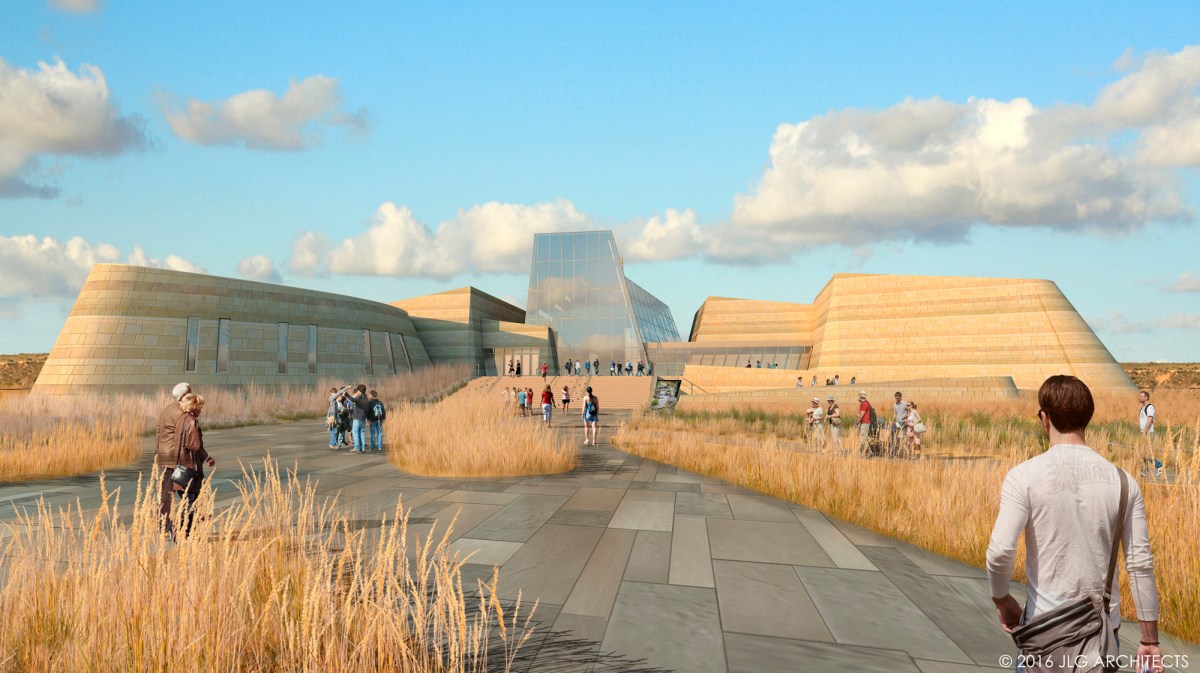
Kelly spoke about the Theodore Roosevelt Presidential Library project on DSU’s campus and showed renderings of what the library would look like when completed. The project is likely to begin construction on the DSU rodeo grounds near the corner of State Avenue and Fairway Street this summer.

The first project, a replica of Roosevelt’s Elkhorn Ranch cabin made out of cottonwood trees found in the Badlands, could begin construction this summer after the final Roughrider Days Rodeo held in June.

The library — which renderings showed would be a large, sweeping structure complete with an all-glass great hall — would be years in the making and Kelly said would require “significant site preparation” as plans require vast landscaping improvements to the 26-acre site.

“As you go by the site now, it’s sort of flat as a pancake and as flat as the top or your table,” he said. “That’ll change significantly as we get into the building of the facility.”

If the library comes to fruition as planned, Thiel said Dickinson has more than enough hotels to give visitors a place to stay. She said the city has 1,773 rooms available at 21 lodging properties — a 135 percent increase from 2004.

However, the city’s hotel occupancy rate dropped 32.5 percent from 2014 to 2015 because of the decrease in the area’s oil activity. With that in mind, Thiel said the CVB’s advertising push in print, online and social media has been to promote Dickinson’s hotel availability.

“We really try to educate people in the state about that,” she said.

Orton, who closed the speeches by talking about the progress the new Heritage Foundation is making, said part of maintaining Dickinson’s quality of life is for the university to find and retain students who want to stay in the city after they graduate.

“We have students there right now that have stayed through some very hard times,” Orton said. “They stayed because of their true love of DSU and this city. They chose to stay in Dickinson because of their love for the community, because of the quality of life. Those are the people we need to make sure they can stay around, they can continue to build this community 20, 30, 40 years from now.”

Southwest North Dakota Meets Doug Burgum

Doug Burgum spent the past two days introducing himself to southwest North Dakotans, and left with an endorsement from a longtime area leader.

The Fargo-based tech millionaire and Republican candidate for governor wrapped up his trip Wednesday by receiving an endorsement from Dennis Johnson, Dickinson’s former mayor and president of TMI Systems Design Corp. — one of the city’s largest businesses.

“He’s one of the smartest guys I’ve ever met and I think he has what North Dakota needs right now,” said Johnson, who introduced Burgum to a crowd of a few dozen gathered at the B2 Lounge in downtown Dickinson. “We need to continue diversifying the economy and he knows all about that.”

Burgum and his lieutenant governor candidate, Watford City Mayor Brent Sanford, spent Tuesday visiting Bowman, Scranton and Hettinger. They then went to Beach and Medora on Wednesday before returning to Dickinson. Burgum is facing state Attorney General Wayne Stenehjem and architect Paul Sorum in the June 14 primary.

Though he owns a ranch in southwest North Dakota, Burgum has made few appearances in the area since announcing his candidacy in January. He and Sanford, who joined the campaign during the North Dakota Republican convention in March, tried to make up for that this week.

The duo said they mostly heard from voters concerned about property taxes, infrastructure needs and declining sales in the wake of the oil industry’s downturn.

They claimed very few southwest North Dakotans pushed them on Burgum’s social leanings — both he and Stenehjem are on record supporting gay marriage and have been quiet on most other social issues — and said he saw this as a sign of what voters are truly concerned about.

“We’re not running on social issues,” Burgum said. “We’re running because we believe we can get conservative business leaders into the office — people who can help set the state on the right track, relative to our fiscal things. It (social issues) doesn’t come up. We don’t talk about it and they don’t bring it up, because I don’t think it’s the thing that’s leading on voter’s minds right now.”

Burgum was behind both Stenehjem and state Rep. Rick Becker in the state convention delegate voting, receiving just 15 percent of the vote on the first ballot and 10 percent on the second ballot.

However, earlier this month, his campaign released internal polling showing him trailing Stenehjem by just 4 percent

— 44 to 40 percent with 15 percent undecided and 1 percent backing Sorum, who joined the race after the convention. He reiterated that he doesn’t plan to release details of how his campaign came to those numbers.

“We’re very confident in the accuracy of the polling data and we’re very confident in how it was done,” Burgum said. “It is the same numbers we’re making decisions off of. I’m a guy who is data-driven. I’m not going to make decisions off of some pumped-up set of data.”

Several Dickinson business leaders listened to Burgum give his pitch for office during the meet and greet.

He said in a separate interview that, if elected, he’d push for more local “empowerment.” He used Sanford — who, in addition to being Watford City’s mayor, owns an automotive dealership — as an example of someone spent a good chunk of time during oil boom years lobbying for legislative funding as his city’s population and needs boomed.

“I want to make sure we’re the most empowered state we can possible be,” he said. “… If a mayor of a city has to spend half of their year, every other year, coming to Bismarck to try and get some dollars to come back to their community versus actually being in their community and driving ideas and making things happen, we’re taking them away from a productive role and making them come to the center to actually get an allocation.”

Scott Decker, who is running for mayor of Dickinson, attended the Wednesday evening meet and greet but didn’t say whether or not he was supporting Burgum for governor.

Decker, instead, said he used the opportunity to get “on my soapbox,” and tell the candidate about issues bothering him

— including the amount of energy-related funding that was allocated to non-Oil Patch areas in previous legislative sessions.

“I think he’s hearing different things from a lot of people,” Decker said.

Burgum spoke about his ownership in a cattle operation with the Hanson family of Slope County, though he laughed and said he’s “not pretending to be a real rancher.”

In his speech to the group, Burgum’s voice broke when speaking about Robert Hanson, a longtime Slope County rancher who Burgum said “really filled an important hole in my life” in the years following his own father’s death.

John Hanson, Robert’s son who became friends with Burgum while they were attending North Dakota State University, called him a “man who has particular skills — rare skills.”

“He has a huge amount of energy, he has a huge amount of passion, he is completely sincere about his desire to serve the people of the state and, in every way thus far, he has proven himself,” Hanson said. “He’s a leader. He’s exceptional. He’s an uncommon man.”

Burgum said he was pleased with what he learned on his trip to the southwest corner of the state, and, after visiting with many people affected by the energy industry’s downturn, leaves convinced he has a chance at winning the June primary.

“You can’t go to one of those places and go, ‘It’s never been a better time to be a North Dakotan,’” he said.

Better Aesthetics Would Help Downtown Dickinson

Whenever I go downtown for various reasons, I always like to look to see what’s new.

In case you don’t know, much has changed in downtown Dickinson over the past few years.

There always seems to be a new business to check out and street art has made once-dirty alleyways and the sides of buildings a sight to see.

Of course, there’s also First On First, the popular summer street fair and concert series formerly known as Alive at Five that draws crowds too.

Good things are happening in downtown Dickinson, and the city has leaders and stakeholders happily leading the charge to ensure this.

That said, I want to both send my admiration and give some advice to the hardworking folks who have taken on the task of revitalizing downtown Dickinson.

For all the work that’s being done, I can’t help but see how far downtown has to go. And while there are some empty storefronts, my big gripe is in the aesthetics. For every downtown Dickinson building with a beautiful or classic exterior, there’s one that needs work. And some of them need lots of work.

Now, the Downtown Dickinson Association’s efforts have been key to improving the neighborhood and making sure that for every business that leaves, there’s another ready to take its place.

The time is coming for the association and city leaders to start encouraging businesses and building owners in this renaissance zone to look the part of being the vibrant downtown they so strive to be.

Look at Bernie’s Esquire Club, for example. It’s still the same bar as it has been, but a facelift to its exterior last summer has made downtown Dickinson a nicer-looking place, plain and simple.

While many of the buildings are perfect just the way they are, there are others who need to follow Bernie’s lead and invest in adding a little curb appeal.

While Dickinson’s economy is much slower than it has been in recent years, it isn’t so slow that businesses can’t afford to pay for some new siding or a sign. Dickinson has grand designs for downtown.

The public square idea for the corner of Sims and Villard Street is something I can get behind, but only if the rest of downtown follows suit. Some of the best downtowns in the country — and especially those right here in North Dakota — have made exterior renovations a key piece of their revitalization efforts.

Fargo, Bismarck and now even Williston are the best examples. All those cities learned that making their downtowns look just a little bit nicer goes a long way to ensuring people want to be there.

Downtown Dickinson has a lot of things going for it. Even as some of its key storefronts on Villard sit empty, there is potential. If the oil industry bounces back, there may not be much time or many resources available to make the improvements downtown leaders hope to make. Now is the time to push forward on beautifying downtown.

Richardton Ethanol Plant Looks to Future After Debt Is Paid

RICHARDTON — The Red Trail Energy ethanol plant is heading into the 2016 farming season free of debt and with its sights on the future.

The nine-year-old investor-led company, which crushed corn into more than 54 million gallons of ethanol last year, informed investors at the company’s annual meeting March 17 that it had paid off its final $5.5 million in debt. “I think it was a surprise for them,” Red Trail Energy CEO Gerald Bachmeier said. “I don’t think it was expected.”

According to the company’s SEC filings, Red Trail Energy was scheduled to be paid off over the next three years.

“With our bank debt and our cash position, the board made the position to pay it off,” Bachmeier said.

On top of that, Board Chairman Sid Mauch said Red Trail Energy investors were also “really pleased to hear” they’d still be receiving yearly dividend payments despite paying off the debt.

“We struggled for years because the industry was at negative margins,” Mauch said. “Through good management and paying attention to detail and trying to squeeze every little bit of margin that we could out of this plant, we could survive this. That’s the main thing, was to be able to survive the economic impact of the industry, so that when the better times do come back, we’re still here. We’re fortunate to say that we got here. We got that done.”

Bachmeier said since January 2011, Red Trail Energy has reduced its debt by around $50 million, added $13 million in capital and distributed more than $20 million to its investors.

Changing from running the plant on coal to natural gas in 2014 was a big step in the right direction, Bachmeier added.

“That has increased our capacity close to over 10 million gallons of production per year,” he said.

Bachmeier said he foresees the plant producing close to a record 65 million gallons of ethanol this year, and noted that while recent corn prices may not make farmers too happy, they’ve been good for the ethanol industry.

“I think there’s a balance that will find its way. It always does,” he said. “We’re looking forward to continuing to serve the corn farmers in southwestern North Dakota.”

North Dakota farmers planted an estimated 2.75 million acres of corn in 2015, with all but around 7 percent of that being harvested.

Though corn acreage is down from the state’s all-time high of 3.85 million acres in 2013, Bachmeier said he’s optimistic about this year. Despite a dry spring, he said producers are telling him they’re still set on planting a good amount of corn.

“Some of them are actually increasing (corn) acres this year,” he said.

Though it’s impossible to forecast what the future will hold for the agriculture industry, let alone Red Trail Energy, Bachmeier said he believes the company is positioned well financially to continue improving the plant.

“With the efficiency and everything that we have in the plant, I think we’re going to be here for a long time to come,” he said.

In lean times for oil industry, salespeople bear down

Joe Zayden, the Bakken region operations manager for Flow Data, had a booth Thursday, April 15, 2016, at the Bakken Oil Product & Service Show at the West River Ice Center in Dickinson. He said his company is weathering the slowdown by “basically just trying to maintain what we have.” Dustin Monke / Forum News Service

Charnel Zetsch came to Dickinson State University on a softball scholarship seven years ago.

She arrived in the early days of the oil boom and eventually found herself working in the energy industry.

Today, she’s a district sales manager for Magid Glove & Safety and is among several industry salespeople who are asking questions like this: “Why are you paying for a $10 glove when you could be buying a $2 glove?”

After all, with oil prices hovering around $40 a barrel at best, these truly are lean times in the North Dakota energy industry.

That point was drilled home at the Bakken Oil Product & Service Show this week in Dickinson. The trade show drew far fewer exhibitors than it did last year and, aside from some peak traffic moments, was considerably slower — just like the western North Dakota oil and gas industry.

Zetsch, who didn’t have an exhibit at the show, spent much of Thursday walking the West River Ice Center interacting with other oilfield industry salespeople to get a sense of how their businesses are doing.

“It’s tough right now,” she said. “We’re all kind of feeling this pressure. I think what most people are doing right now is really just ramping up and going back and looking at standard operational procedures. Whether it be inventory or the service side of things, they’re really trying to figure out where they were shorthanded and where they were super heavy-handed and try to balance the two.”

Tim Liston, who works in business development for Industrial Measurement and Control, said his company is looking at alternative ways to increase business. He said he made some good leads at the show and his booth drew attention because his company showed off its customized lease automatic custody transfer unit — a device that accurately measures oil.

As expected, Liston said business on the oil and gas production side has dropped off considerably. However, he said midstream companies — those who work with pipelines, refining or trucking — “are still spending money.”

“We’re looking for companies who still have project money available and they’re still going ahead with projects,” Liston said. “… That’s where I’m spending my time.”

The same was true for Winters Instruments sales representative Peter Chronis, who stood behind a table stocked with pressure gauges of all sizes and tried to make some connections.

The company, which has nine offices around the world, sells pressure instruments on every end of the oil production process. But, because the production is slower than a year ago, Chronis said he’s taking the opportunity to “lock in” to current customers who are still spending money, just not as much as they did during the boom years.

“It’s a double-edged sword, depending on which side of the market share pendulum you’re covering,” he said.

Joe Zayden spent two days at the trade show and called it “the slowest one I’ve been to in a couple years now.”

Zayden is the Bakken region operations manager for Flow Data, a Colorado-based company that manufactures and engineers products for wellhead automation. Though oil production in North Dakota hasn’t dropped off much in spite of the drilling drawback, Zayden said his company is weathering the slowdown by “basically just trying to maintain what we have.”

Zayden said his company is positioned well enough to pick up business from smaller wellhead service companies that are folding in the wake of the drop in oil prices.

And like most of the oil industry workers at the show, he remained confident that business will eventually pick up.

“We ain’t going anywhere,” Zayden said. “We’re not shutting down. We’re staying here.”