Cole Frenzel is getting his first-hand look at the New York Mets.
Frenzel, 21, was drafted by the Mets in the seventh round of the MLB draft in early June and was at Citi Field on Friday for the team’s game against the New York Yankees.
Frenzel is a 2008 Dickinson High School graduate and was an all-Pac 10 Conference selection this spring as a sophomore first baseman at the University of Arizona.
While he hasn’t signed a contract with the Mets, Frenzel said via text message Friday that he did a physical with the team so that, if he does sign, he will be able to play immediately.
Frenzel posted a picture of himself in the Mets’ locker room with David Wright, the team’s all-star third baseman, on his Facebook page Friday morning.
Frenzel told The Dickinson Press last week the Mets have indicated that if he signs, he would likely be sent to their short-season Class A club, the Brooklyn Cyclones.
The Dickinson native has told the New York Mets what his contract demands are, and now he has to wait for Major League Baseball to approve the amount of money he is asking for.
Frenzel, a first baseman for the University of Arizona, was a seventh-round draft pick of the Mets earlier this month. He said Thursday that the amount of money he was asking for is above the MLB’s level for seventh-round picks.
However, Frenzel added this is a common problem for early round draft picks to encounter and that the MLB can approve or disapprove of his demands. But first, he has to wait for all the draft picks ahead of him who are also asking for more money than is allowed at their spot.
The deadline for signing a drafted player is Aug. 15. Frenzel said the MLB and Mets could agree to his contract demands in two days or two weeks. He has no way of determining that.
Until then, he’ll play the waiting game.
If the Mets deal falls apart, he could still head to Hyannis, Mass., and play for a quick stint in the Cape Cod Summer League. He could also return to Tucson, Ariz., and resume training for his junior season.
Whatever the case, Frenzel said he has to be in Dickinson the second weekend of July because he’s in the wedding of his former teammate and current Dickinson High assistant baseball coach Andy Tomanek.
Bully Pulpit Golf Course professional Dave Solga was kind of enough to post the video of the flooding on the course to YouTube. Here is the video. It is pretty ridiculous.
Trevor Willis was about to be ripped into by Dickinson State head football coach Hank Biesiot.
The sophomore safety had missed a potential tackle and been, as he put it, “earholed,” by an opposing player.
As Willis wandered to the sideline, Biesiot began his tirade. But the veteran coach quickly stopped himself.
“Tim!” Biesiot hollered, calling for the team’s head athletic trainer, Tim Kreidt.
“He knew something was wrong,” Willis said.
One look into Willis’ eyes told Biesiot and Kreidt everything they needed to know.
Willis was exhibiting all the signs of a concussion — his second in a month and the last he will ever experience on a football field.
He now knows he probably shouldn’t have been on the field that day. But it’s a lesson he and many other athletes who have experienced head trauma found out too late: Concussions aren’t just dizzying blows to the head. They are life-changing injuries.
Knockout blows
Seven months after his first concussion, the 22-year-old Columbus, Mont., native said he feels good. He exercises daily and keeps busy with his dual major in business and accounting.
But his football days are over and his track and field career is in limbo.
Willis said two physicians and a chiropractor agree that the two concussions he suffered last fall have made playing football unsafe.
An NAIA national championships qualifier in the decathlon, Willis is taking a medical redshirt this spring because his second concussion kept him from training for nearly three months.
“Looking back, one thing I would have changed through the whole thing — you can’t regret it, concussions are part of football, part of the game, it happens — but when I went back in that game against Jamestown, had I known what I know now, there’s no way I would have went back in because that definitely did not help,” Willis said.
His first concussion came on a banner homecoming afternoon for the Blue Hawks. On Sept. 25, DSU beat rival Jamestown College 26-16 and, in doing so, picked up the football program’s 400th win.
Willis wasn’t doing much celebrating though.
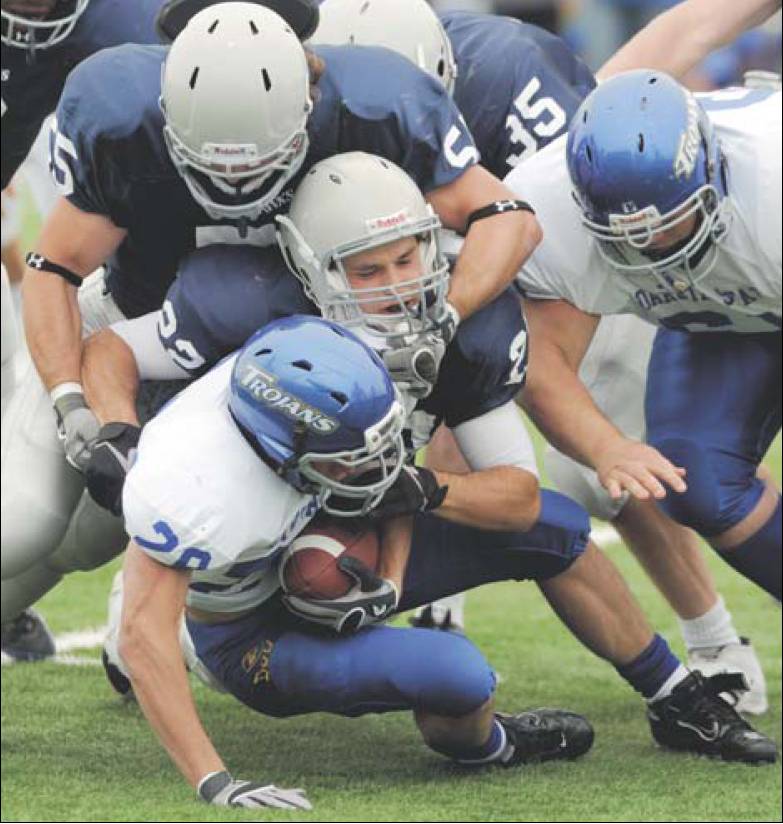
In the second quarter, he and teammate Jason Kraft — a hard-hitting senior linebacker — were converging a Jamestown receiver when that player slid to the ground to avoid the impending hard tackle. Without time to stop, Kraft inadvertently hit Willis helmet-to-helmet.
The hit dazed Willis, but he wasn’t worried about a concussion.
“At the time, I was more worried about my neck,” Willis said.
He went back in the game and kept playing, but said he didn’t feel right when he went back to the sideline. He felt dizzy when he left the field before halftime.
Willis tried practicing the next week, but almost immediately became dizzy when he exerted himself.
A mild concussion was the diagnosis.
Three weeks later, Willis was cleared to play following a CT Scan. He sat out the next game — the Blue Hawks’ home loss against Black Hills State — as a precaution, but came back for DSU’s crucial game at South Dakota Mines on Oct. 23 in Rapid City, S.D.
“I didn’t really feel anything during the whole game,” Willis said. “I was definitely more tentative than I was before. I wasn’t playing the way I was before I had the first concussion.”
Willis had almost made it through the entire game without incident when he took the hit that ended his career.
On DSU’s final punt in the fourth quarter, Willis was pursuing the return man when he took a shot in the helmet.
“The kid who had the ball ran right by me,” Willis said. “I didn’t know where I was and Luke Leno pulled me off the field (after the play).
“After that game, I didn’t feel well at all.”
Tricky diagnosis
Diagnosing a concussion is tricky business, says Kreidt. In his 11th year as DSU’s head athletic trainer, Kreidt said he has seen several injuries that could be described as concussions. Few, however, are immediately recognizable — or reported.
“If you’re watching the game really closely, you’ll see somebody get hit and he’ll be stunned for a second, walk to the huddle and be able to shake it off by the time the next play comes around and just continue playing,” Kreidt said. “That’s the tough situation, too, is the kids have to report them.”
Willis said he knew very little about how concussion symptoms could vary from person to person until he was diagnosed with his first.
“Even then, I thought it was going to be something where I got a headache for a day or two and I was fine,” he said. “I tried to come back to practice and Tim told me, ‘Different people react differently, you never know how long this is going to take.’ I came back that first practice and realized, OK, this is going to take longer that I thought.”
The second concussion had a far different affect on Willis and his brain function.
In the following days, Willis said he felt best when he was alone at home and lying in bed. Going to class was a chore. He had trouble reading, even thinking.
“For the first four days, I just laid there in bed and tried not to think,” Willis said. “When I tried to think, my head felt like my brain was on fire.”
Kreidt said numerous studies on concussions have shown that less activity after a concussion helps a person’s brain heal faster.
“If you really want to truly recover from a concussion, you’re just going to have to just shut down completely,” Kreidt said. “That’s the tough part with these college athletes. They still have to go to classes where they’re mentally working the mind. That’s a tough part, too, is for them to completely shut down and let the brain recover.”
DSU is in the infant stages of preparing to test its student-athletes who could potentially suffer a concussion.
Next school year, Kreidt said instructors and trainers in the athletic and physical education departments hope to conduct baseline tests on Blue Hawk athletes using the King-Devick Test.
Dr. Alan King of Dickinson and Dr. Steve Devick of Chicago developed the King-Devick Test 35 years ago as a way to determine reading disabilities in children for their optometry school thesis. Recent studies by University of Pennsylvania researchers have determined that another version of the test can be used to determine if an athlete has suffered a concussion.
The test takes about two minutes and can be performed on the sidelines during games. It is accurate to the 95th percentile in diagnosing concussions.
Kreidt said the King-Devick Test is another step forward in helping medical professionals treat athletes who have suffered head trauma.
“We’ve got to find better ways to find concussions,” Kreidt said. “They’re happening out there and we don’t even know it.”
Willis hopes to be a part of the tests when he returns to school next year. He wants to get back to the national track and field meet next season.
While Willis won’t be on the football field next fall, Kreidt said his story will serve as an example of how serious athletes should take concussions.
But that hasn’t stopped Willis from wishing he could be out on the field. He’s already beginning to think about what his life will be like without football.
“When I think about it, it’s going to be pretty tough,” Willis said.
The Dickinson State basketball team poses with the Northwest A&F team, as well as numerous coaches and officials, including DSU President Dr. Richard McCallum.
Here’s a quick update on the Dickinson State men’s basketball team’s trip to China according to an e-mail from head coach Ty Orton.
On its second day, the team visited Tiananmen Square and ate “unique foods†in the alley food shops nearby. Needless to say, senior Nathan Lebsock and freshman Zach Edward didn’t enjoy their fish and brains combo meal.
Everywhere the players go, they have been asked to take numerous photos “This adds 15 to 20 minutes of extra time at every place we venture to. The people are impressed with the size of our guys and that they happen to play basketball,†Orton said.
On their third and fourth days, the Blue Hawks spent time at Northwest Agriculture and Forestry University in Yangling and played in two basketball games. “The tour was fun and very informative for the players and coaches,†Orton said.
The teams first game was played in front of 4,000 students who Orton said took off a national holiday to stay and watch the game. Orton said he was told the university turned away more than 8,000 students who wanted to watch the game in the packed facility. “The game was a great success and everyone involved enjoyed the experience,†he said.
Sophomore Matt Lee was named the game’s Most Valuable Player after scoring 15 points and grabbing 10 rebounds as the Blue Hawks won 82-67.
The team played in game with mixed teams on their fourth day.
On the fifth day, yesterday, Orton said the team was having trouble finding an Internet connection or cellphone reception.


 Dustin Monke