Richardton Ethanol Plant Looks to Future After Debt Is Paid

RICHARDTON — The Red Trail Energy ethanol plant is heading into the 2016 farming season free of debt and with its sights on the future.

The nine-year-old investor-led company, which crushed corn into more than 54 million gallons of ethanol last year, informed investors at the company’s annual meeting March 17 that it had paid off its final $5.5 million in debt. “I think it was a surprise for them,” Red Trail Energy CEO Gerald Bachmeier said. “I don’t think it was expected.”

According to the company’s SEC filings, Red Trail Energy was scheduled to be paid off over the next three years.

“With our bank debt and our cash position, the board made the position to pay it off,” Bachmeier said.

On top of that, Board Chairman Sid Mauch said Red Trail Energy investors were also “really pleased to hear” they’d still be receiving yearly dividend payments despite paying off the debt.

“We struggled for years because the industry was at negative margins,” Mauch said. “Through good management and paying attention to detail and trying to squeeze every little bit of margin that we could out of this plant, we could survive this. That’s the main thing, was to be able to survive the economic impact of the industry, so that when the better times do come back, we’re still here. We’re fortunate to say that we got here. We got that done.”

Bachmeier said since January 2011, Red Trail Energy has reduced its debt by around $50 million, added $13 million in capital and distributed more than $20 million to its investors.

Changing from running the plant on coal to natural gas in 2014 was a big step in the right direction, Bachmeier added.

“That has increased our capacity close to over 10 million gallons of production per year,” he said.

Bachmeier said he foresees the plant producing close to a record 65 million gallons of ethanol this year, and noted that while recent corn prices may not make farmers too happy, they’ve been good for the ethanol industry.

“I think there’s a balance that will find its way. It always does,” he said. “We’re looking forward to continuing to serve the corn farmers in southwestern North Dakota.”

North Dakota farmers planted an estimated 2.75 million acres of corn in 2015, with all but around 7 percent of that being harvested.

Though corn acreage is down from the state’s all-time high of 3.85 million acres in 2013, Bachmeier said he’s optimistic about this year. Despite a dry spring, he said producers are telling him they’re still set on planting a good amount of corn.

“Some of them are actually increasing (corn) acres this year,” he said.

Though it’s impossible to forecast what the future will hold for the agriculture industry, let alone Red Trail Energy, Bachmeier said he believes the company is positioned well financially to continue improving the plant.

“With the efficiency and everything that we have in the plant, I think we’re going to be here for a long time to come,” he said.

In lean times for oil industry, salespeople bear down

Joe Zayden, the Bakken region operations manager for Flow Data, had a booth Thursday, April 15, 2016, at the Bakken Oil Product & Service Show at the West River Ice Center in Dickinson. He said his company is weathering the slowdown by “basically just trying to maintain what we have.” Dustin Monke / Forum News Service

Charnel Zetsch came to Dickinson State University on a softball scholarship seven years ago.

She arrived in the early days of the oil boom and eventually found herself working in the energy industry.

Today, she’s a district sales manager for Magid Glove & Safety and is among several industry salespeople who are asking questions like this: “Why are you paying for a $10 glove when you could be buying a $2 glove?”

After all, with oil prices hovering around $40 a barrel at best, these truly are lean times in the North Dakota energy industry.

That point was drilled home at the Bakken Oil Product & Service Show this week in Dickinson. The trade show drew far fewer exhibitors than it did last year and, aside from some peak traffic moments, was considerably slower — just like the western North Dakota oil and gas industry.

Zetsch, who didn’t have an exhibit at the show, spent much of Thursday walking the West River Ice Center interacting with other oilfield industry salespeople to get a sense of how their businesses are doing.

“It’s tough right now,” she said. “We’re all kind of feeling this pressure. I think what most people are doing right now is really just ramping up and going back and looking at standard operational procedures. Whether it be inventory or the service side of things, they’re really trying to figure out where they were shorthanded and where they were super heavy-handed and try to balance the two.”

Tim Liston, who works in business development for Industrial Measurement and Control, said his company is looking at alternative ways to increase business. He said he made some good leads at the show and his booth drew attention because his company showed off its customized lease automatic custody transfer unit — a device that accurately measures oil.

As expected, Liston said business on the oil and gas production side has dropped off considerably. However, he said midstream companies — those who work with pipelines, refining or trucking — “are still spending money.”

“We’re looking for companies who still have project money available and they’re still going ahead with projects,” Liston said. “… That’s where I’m spending my time.”

The same was true for Winters Instruments sales representative Peter Chronis, who stood behind a table stocked with pressure gauges of all sizes and tried to make some connections.

The company, which has nine offices around the world, sells pressure instruments on every end of the oil production process. But, because the production is slower than a year ago, Chronis said he’s taking the opportunity to “lock in” to current customers who are still spending money, just not as much as they did during the boom years.

“It’s a double-edged sword, depending on which side of the market share pendulum you’re covering,” he said.

Joe Zayden spent two days at the trade show and called it “the slowest one I’ve been to in a couple years now.”

Zayden is the Bakken region operations manager for Flow Data, a Colorado-based company that manufactures and engineers products for wellhead automation. Though oil production in North Dakota hasn’t dropped off much in spite of the drilling drawback, Zayden said his company is weathering the slowdown by “basically just trying to maintain what we have.”

Zayden said his company is positioned well enough to pick up business from smaller wellhead service companies that are folding in the wake of the drop in oil prices.

And like most of the oil industry workers at the show, he remained confident that business will eventually pick up.

“We ain’t going anywhere,” Zayden said. “We’re not shutting down. We’re staying here.”

Residents dealing with repercussions of income tax identity theft

Stacey Buckman has her financial ducks in a row.

She’s a small business owner, does her own taxes, regularly checks her credit report and knows how the ins and outs of the Internal Revenue Service’s 1040 form.

So, she knew something wasn’t right when she filed her taxes online March 30 and almost immediately received an email stating they’d already been filed just hours earlier.

It didn’t take long for Buckman to discover an identity thief had used both her and her husband’s Social Security numbers to file fraudulent income tax returns in their names, costing the IRS thousands of dollars and essentially putting the Buckmans on financial alert for the foreseeable future.

“It can happen to anyone,” Buckman said. “You have no idea. It’s so random.”

Buckman and others who have reported income tax identity theft in southwest North Dakota are part of an increasing statistic, North Dakota Tax Commissioner Ryan Rauschenberger said.

Rauschenberger said in 2015 his office caught nearly 1,000 instances of income tax identity theft, which would have totaled to nearly $1.3 million in fraudulent refunds.

“It’s a major issue for our state and for many, many other states,” Rauschenberger said, adding this type of identity theft is on the rise.

He said North Dakota is part of a consortium of states that have organized in an effort to stop this type of fraud.

The U.S. General Accountability Office estimated that in 2013, the IRS paid $5.8 billion in fraudulent refunds because of identity theft, with more fraudulent payments likely going undetected or unreported.

Anthony Willer, of Dickinson, said he received a letter from Rauschenberger’s office last Saturday requesting verification of the W-2 forms used in filing his family’s taxes before he had even filed.

Like Buckman, Willer said he planned to file his taxes later than normal this year because he had been waiting to receive various tax forms.

“Something wasn’t matching up with the system as far as the tax amounts that were paid,” Willer said.

He said the tax commissioner’s office flagging his filings as affected by fraud helped him report the identity theft. Still, Willer said he spent an entire day making sure his family’s identities, as well as their finances and credit history, were secure.

“It’s a huge inconvenience,” he said.

Rauschenberger said it’s also important to report identity theft to the state attorney general’s office consumer protection department.

Buckman and Willer each reported their identity theft to area law enforcement, as a police report is a required part of clearing a person’s name after their identity has been stolen or compromised, Dickinson Police Capt. David Wilkie said. That police report then shows up on a person’s credit history for seven years, with it serving as a note to future creditors and to help keep their credit scores unaffected by the fraud.

Wilkie said it seems that random people are being targeted for income tax identity theft.

“It’s tough to say how they’re picking their victims,” Wilkie said. “If we knew that, it would make it a lot easier to warn people. It kind of seems like age has something to do with it. Although I have heard of young people getting their identities stolen too.”

Most of the incidents occur late in the tax season, Rauschenberger said.

Monday is the deadline for Americans to file their taxes.

“The key is you should file early,” he said. “Don’t wait until the last minute. That’s one of the major reasons we push that you should file early.”

Buckman said she typically files her family’s taxes in February or early March. She also always files with her husband, David, as head of the household. She learned that the identity thief had filed using her as the head of the household instead, which became an automatic red flag for the IRS.

How their Social Security numbers were compromised, however, remains a mystery.

“There’s really no way of knowing,” Buckman said. “In speaking with TurboTax, the IRS and law enforcement, they’re saying that in a majority of these cases, it’s being done by someone overseas.”

Like Buckman, Willer said he’s knowledgeable about taxes and never expected his identity to be stolen through his filings.

“You think it’s something that takes place somewhere else. Not in Dickinson. Not in a small area,” Willer said. “It’s quite common unfortunately. Too common.”

As they move forward, both Buckman and Willer said they’re going to stay vigilant with their finances and check their credit reports and bank accounts often. Buckman said she may even go as far as attempting to request a new Social Security number to prevent future identity theft.

“My biggest takeaway from this is to make sure I file early,” Buckman said. “File as early as absolutely possible to prevent someone else from having the opportunity to compromise you and put you in a bad situation. Because God knows where this really will end?”

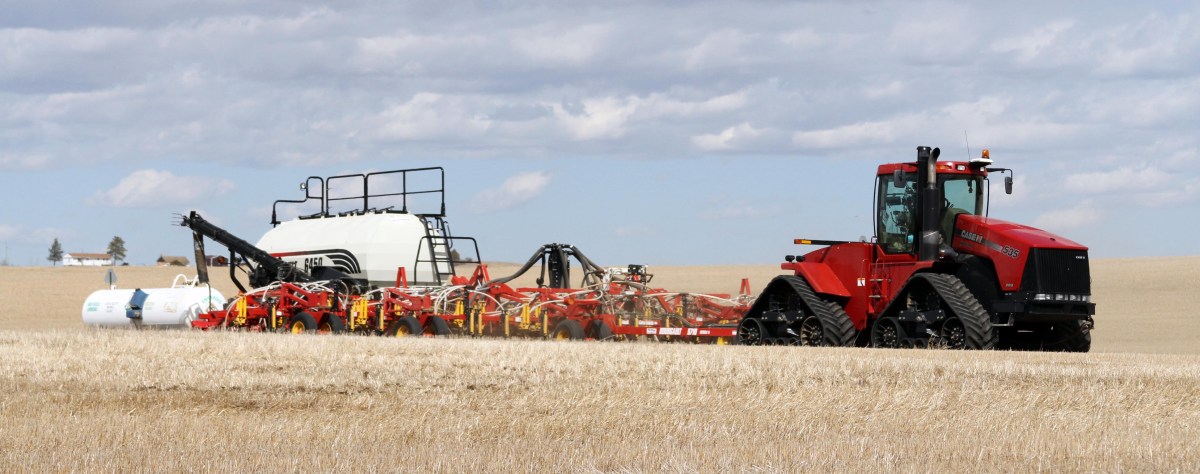
Planting season well underway, though farmers hope precipitation is in future

MOTT — After 23 years of farming, Mark Anderson is happy to stick to his “game plan.”

The Regent-area farmer said neither below-average precipitation nor low commodity prices have shaken him much this year. He’s still seeding the crops he’d planned for and said Monday that he’s more than halfway finished.

Though with much of western North Dakota in a moderately dry drought, according to the U.S. Department of Agriculture’s drought monitor, Anderson and others say they can’t help but hope for a little rain soon.

“It’d be nice to get a good rain to settle the dust,” he said. “I think everybody would have kind of a weight lifted off their shoulders if they’d get an inch of rain.”

Most southwest North Dakota farmers are in the same boat as Anderson — about half done with their spring planting while hoping for some moisture to give those seeded crops an early boost.

Garret Swindler, who farms east of Anderson in the Mott area, said the only benefit to the dry year so far is farmers were fighting wet and muddy fields just to get their crops seeded last spring.

He said the moisture left in the topsoil after winter is fine for seeding, but it’ll only be good if planting season if followed by some rain.

“There’s enough moisture there to get the crops started,” he said. “We’re definitely planting deep. … We just have to make sure that seed has enough moisture to germinate and get out of the ground. But you can’t really wait on rain either.”

Duaine Marxen, the Hettinger County Extension agent in Mott, said most farmers he works and speaks with on a regular basis have been in the field for the past couple of weeks, and like Anderson and Swindler, most are well on their way to wrapping up planting efforts. Contending with dry conditions and high winds, however, have made for some challenging days, he said.

“No one here will complain if it starts raining,” Marxen said with a laugh.

Farmers might get their wish this weekend.

The National Weather Service is forecasting some showers for southwest North Dakota this week, with chances increasing toward the weekend and into next week.

That could be a welcome relief, as Todd Hamilton, a meteorologist with the National Weather Service in Bismarck, said the Dickinson area is already 1 inch below average rainfall for the year.

“We haven’t really had any real significant precipitation in quite some time,” Hamilton said, adding it has been about six months since southwest North Dakota experienced a large precipitation event.

He said conditions are “abnormally dry” throughout the western and central parts of the state.

“We are still early in the growing season now, so there’s certainly potential for us to move out of this,” he said.

Anderson said he has wrapped up seeding his spring wheat and Swindler planned to be finished with it by today. After that, both said they’d move on to other crops such as flax, canola and corn.

Anderson said while some farmers might be trying to “outguess” the weather or the future of commodity prices in deciding what or where they plant certain crops, he’s happy to stay the course and stick to what has worked for more than two decades.

“What looks poor now may be your best moneymaker in the end,” he said. “… I’ve been through these times before. You just seed the crop and cross your fingers.”

Slope, Bowman county leaders express frustration with federal overreach

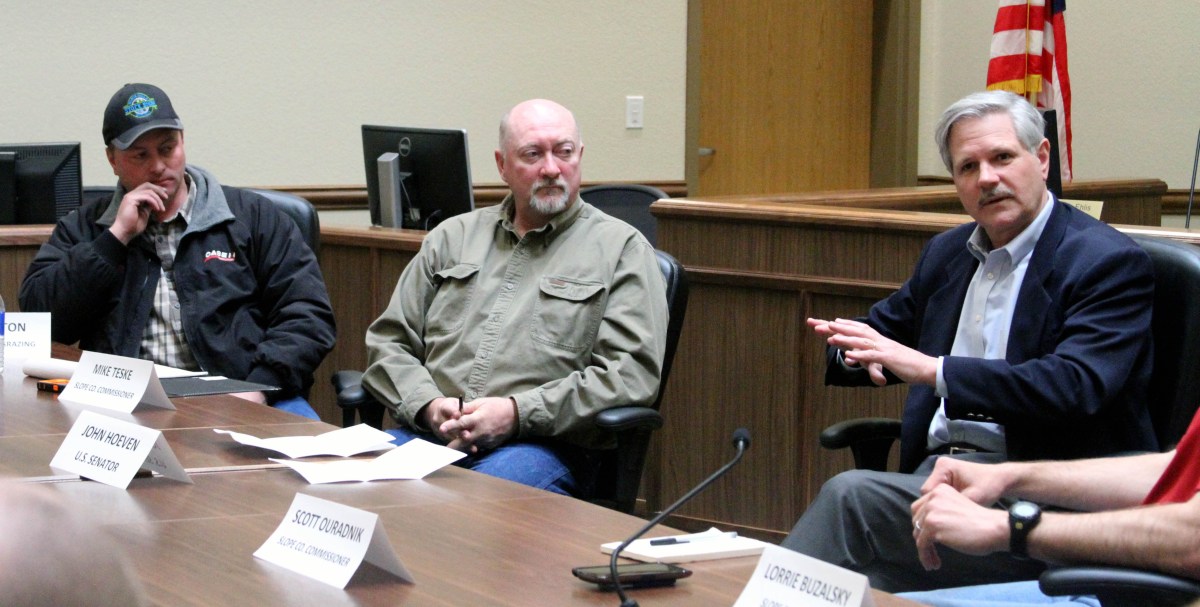
AMIDON — Residents of the two most southwestern counties in North Dakota expressed their concerns and the perceived helplessness they felt about federal government overreach to Sen. John Hoeven on Monday during separate roundtable gatherings.

The Republican senator held hour-long meetings in both Bowman and Amidon to speak with county and city officials, landowners, ranchers and business leaders about a variety of topics that originate at a national level and affect them.

While many Bowman residents expressed gratitude for Hoeven’s work to secure grant funding for its $34 million hospital project and the new Bowman Airport, their leaders, as well as those in Slope County, railed on what they see as the federal government having too much of a say in what happens not only in North Dakota, but in their own backyards.

“It’s people like us who have little meetings that don’t make a difference anymore,” Lauren Klewin, a Slope County rancher and longtime board member for Slope Electric Cooperative, said during the Amidon roundtable.

Klewin spent nearly five minutes talking off the cuff about the variety of ways area residents feel hamstrung by federal bureaucracy and what he felt was increasing and all-but unstoppable overreach through the Obama administration’s Clean Water Rule and Clean Power Plan, as well as the U.S. Forest Service’s grazing plans.

“Regardless of who we ever have as a president, I feel like these federal agencies are running on their own,” Klewin said.

Hoeven responded by telling Klewin and others that some members of Congress and the court system continue to push back against the new carbon emission standards proposed by the Environmental Protection Agency, and noted the importance of who nominated to be the next Supreme Court justice.

“Is it going to be someone who reflects North Dakota’s interest or someone who reflects the Obama agenda?” Hoeven asked. “… We can’t constantly have the federal government coming in and putting all these regulations on us.”

State Rep. Keith Kempenich, a Bowman Republican who represents District 39 in the Legislature, spent time at the Bowman roundtable asking for Hoeven’s help curtailing federal regulations on coal-fired power and the politicizing of climate change research and science.

“They’ve completely walked away from the science of it,” Kempenich said. “They’re pushing an agenda. Are your colleagues understanding this, for the most part? That’s where it gets frustrating. Because that’s where it’s coming from, is 20 square miles on the East Coast.”

Hoeven said after the Bowman roundtable that the concerns he heard echo those of many North Dakotans.

“As I listen to people all over the state of North Dakota, that’s what they’re saying,” he said.


Powder River trade off

Rodney Schaff, chairman of the Bowman Airport Authority, thanked Hoeven for his work to secure $12 million in grants for the airport, which opened last May.

He also spoke about the Powder River Training Complex, a U.S. Air Force training area that encompasses a large area in southwest North Dakota and neighboring South Dakota.

“We don’t have anything against military training,” Schaff said. “I’m an old Air Force vet. … But we said there’s got to be trade off here too.”

Hoeven said the Air Force is waiting to conduct low-altitude flights in southwest North Dakota until the Bowman Airport has installed equipment that allows it to communicate with the national air traffic controllers about flight training being conducted in the area.

“This Powder River range is very important to the Air Force, but at the same time it’s got to work for general aviation,” he said in an interview after the Bowman roundtable.