Hoeven Backs Trump, Though They Don’t Agree on Everything

North Dakota’s Republican senator said Wednesday that he is maintaining his support of Donald Trump’s presidential campaign.

Sen. John Hoeven, following a roundtable with Dickinson business and city leaders, lived up to his promise to support his party’s presidential nominee despite being relatively quiet about Trump’s candidacy.

“I support Trump as our nominee for the party,” Hoeven said. “I don’t agree with everything he says, but I agree that he would be better for our state and our country than Secretary Clinton, who would continue the kind of big regulation, big government, big tax approach the current administration has.”

Hoeven has long been an opponent of the Obama administration’s regulatory policies and said he believes a Hillary Clinton presidency would mean more of the same.

Nonetheless, Hoeven has been tight-lipped about Trump since the New York businessman accepted the Republican nomination for president and was the state’s highest-ranking GOP official who didn’t attend Trump’s speech at the Williston Basin Petroleum Conference last May in Bismarck.

Hoeven, who is seeking re-election in November, also responded to criticisms by his opponent, current state Rep. Eliot Glassheim. On Tuesday, the Grand Forks Democrat called for Hoeven to withdraw his support of Trump following what he called the presidential candidate’s “demeaning insults” about Kazir Khan, a Muslim-American father of a fallen soldier.

Glassheim said Hoeven should condemn Trump’s statements.

“What’s more, Sen. Hoeven should explain to North Dakotans precisely why he continues to support Donald Trump while refusing to condemn, distance himself from, or even comment on, Trump’s outrageous behavior,” Glassheim stated in a release. “If Sen. Hoeven cannot honestly offer such an explanation to voters, he should have the courage to withdraw his support for Trump’s candidacy for president.”

Hoeven said he’s more focused on his own re-election campaign and issues pertaining to North Dakotans than the presidential election.

“I tell the people what I’m about, what I believe in, what I believe can help our state — a positive vision for the future of North Dakota, the vision of our country — and then it’s up to them,” Hoeven said. “It’s an honor to serve North Dakota, but people decide. That’s how I’ve always approached it. That’s how I’m approaching it now and as long as I’m in office, that’s how I will approach it. That’s what’s important.”

Hoeven did, however, say that “everyone should support Gold Star families,” the designation for families who have lost a member during military service in wartime.

The senator added that while he knows Libertarian Party presidential candidate Gary Johnson well and considers him a friend, he won’t be backing his campaign.

Johnson was born in Hoeven’s hometown of Minot, and served as New Mexico’s governor at the same time as Hoeven was governor of North Dakota.

“He’s an interesting guy, a good guy,” Hoeven said. “I agree with him on some things but obviously not others. We’re good friends and it’s always interesting to see what he’s going to offer.”
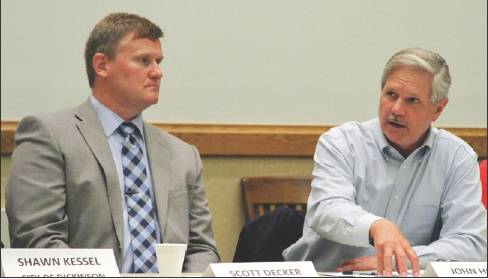
Dickinson City Leaders, Sen. Hoeven Talk Drug Crime

Dickinson leaders told U.S. Sen. John Hoeven on Wednesday that a federal law enforcement presence in the city may be necessary to help address the state’s growing opioid epidemic.

Drug crime has become increasingly more complex and organized in western North Dakota in the past three years, Dickinson Mayor Scott Decker said, relaying information Southwest Narcotics Task Force leaders told the Dickinson City Commission on Monday at their regular meeting.

“For us, what would be nice is to have that federal presence,” Decker said. “A lot of this stuff is going to end up in federal jurisdiction.”

Task Force members said Monday that the city has become “the stop” for drug runners coming out of Denver, Chicago and as far away as Mexico.

Methamphetamine and heroin laced with fentanyl, a synthetic opioid shipped to the U.S. from countries like China, are the top concerns of drug task force leaders in western North Dakota.

Hoeven, a North Dakota Republican, said this week he introduced new legislation that would close a loophole that currently allows synthetic drugs to enter the U.S.

The Illegal Synthetic Drug Safety Act of 2016, which Hoeven co-sponsored with Sen. Chris Coons, D-Del., would change a law that allows overseas companies to sell the drugs in the U.S. by labeling the products as “not safe for human consumption.”

Hoeven said the legislation has been endorsed by the National Law Enforcement Association and drug companies.

“Our laws have to catch up with the new types of drugs that are out there on the market,” he said.

Decker also pressed for more law enforcement funding, and spoke about the Southwest Narcotics Task Force’s worries that their agents will become overworked by the continuing rise in in-depth narcotics investigations during the roundtable.

“One of their biggest issues is the funding and getting the level of law enforcement they need — the experienced law enforcement they need to combat this type of sale,” Decker said. “They need a certain type of person — a certain type of agent with the right experience.”

Dickinson City Administrator Shawn Kessel pointed to the perceived decrease in narcotics seizures and arrests by the Southwest Narcotics Task Force agents this year, saying instead of arresting low-level drug offenders, the agents are effectively triaging their caseload and focusing on high-profile cases.

“If you look at a simple statistical way of measuring success, it’s going to look like we have less of a problem,” Kessel said. “That couldn’t be further from the truth.”

Airport officials ask for Hoeven’s support

Officials from the Dickinson Theodore Roosevelt Regional Airport reiterated their need for Hoeven’s support at the federal level as they try to continue providing commercial air service after United Airlines announced in June its intention to ends its flights into Dickinson.

Hoeven said he has requested that the U.S. Department of Transportation expedite approval of the airport’s Essential Air Service designation to ensure commercial service to the airport.

When United announced it wanted to pull out, the airport was under the impression the airline would apply for federal EAS designation, which would federally fund its flights into Dickinson. It has yet to do that.

“We’ve done this before,” Hoeven said. “We don’t want to go work to approve someone for air service that doesn’t fit what you want.”

Airport manager Kelly Braun said he has been “working diligently” to try and get both United and other airlines to submit proposals for EAS to the DOT.

“Any help we can get from your office to persuade airlines to give proposals to the DOT would be helpful,” Braun told Hoeven.

Braun said United was issued a stay order to continue providing service to the airport past the Sept. 30 date for an EAS provider to be in place.

“They have a stay order that’ll prevent them from pulling out of the market until an EAS provider is selected,” he said.

The airport is also seeking to rebuild its runway by 2020 due to its inability to accommodate the 50-passenger planes that currently fly into the airport.

Along with that, Dickinson Airport Authority Chairman Jon Frantsvog said more airlines — including any that would serve Dickinson through the EAS program — are discontinuing their use of 50-seaters in favor of 70-passenger jets. That’ll only further deteriorate the runway, he said.

“The key is to get the FAA dialed in,” Hoeven said, adding the Federal Aviation Administration has been traditionally open to providing financial support for runway upgrade projects. “… We’ll make the case based on aircraft, saying we’ve got to get this runway transitioned as the airlines transition to 70-passenger aircraft.”

Law Enforcement Center Remodel Bids Get OK

The cost to remodel the Dickinson Law Enforcement Center will be much less than the Stark County Commission anticipated at just less than $1 million, commissioners learned at their monthly meeting Tuesday.

Rob Remark of JLG Architects told commissioners that bids for the project came in lower than expected, even with a high contingency percentage on the project — due to possible unforeseen “surprises” that contractors could find hiding behind walls and in the ceilings of the building, which was built in the 1980s.

Remark said the project will only cost around $663,000 in contracting, electrical and mechanical fees. However, he said there will be a 15 percent contingency on the costs.

With contingencies and soft costs added in, the total cost of the project is about $992,000.

“It’s a small project, a small scale,” Remark said. “It’s a remodel to an existing building. We know there’s going to be some surprises when the ceilings and the walls come out. There’s surprises that the design team made the decision … to plan for rather than make assumptions for.”

Nonetheless, commissioners accepted the bids and were pleased with the price tag.

“This project came in under what we assumed it was going to cost by about $500,000,” Commissioner Jay Elkin said.

Commissioner Pete Kuntz added that early in the process, the commission expected the remodel to cost around $1.4 million.

The Law Enforcement Center is home to the Stark County Sheriff’s Office and formerly also housed the Dickinson Police Department, which moved into the Public Safety Center last year.

Stark County Sheriff Terry Oestreich said some of the soft costs will be to update technology and safety aspects of the building, including adding new interrogation room hardware and software to match what the police department uses.

“What’s happening is the city, in their building, they have interview rooms that run with this system,” Oestreich said. “But actually our interview rooms there are going to be utilized more because they’re in the same building as our jail. So we wanted to try and have the same system for ease of operation so that there will be less chance of error in those recordings.”

Oestreich jokingly referred to the current recording system as being “off the shelf, from Walmart,” but noted more seriously that it’s “not very reliable.”

Remark said it’s unlikely the contingency costs would be that high, nor would the soft costs, meaning the project will likely come in at a lower budget.

  • Scull Construction informed the commission that the Stark County Courthouse building project began Tuesday and that the west end of the courthouse parking lot will be closed beginning today.
  • Representatives of the Waters Edge Subdivision southwest of Dickinson along Patterson Lake and the Heart River Golf Course approached the commission about the potential of paving a gravel road into the subdivision. County road superintendent Al Heiser will work with the homeowners assocation on creating a proposal.

Column: We Need More Visits Like Giancarlo’s

[fcc_jw_player key=”ovzeCHJk”]

It’s easy to complain about the federal government — especially here in the upper Midwest.

We’re the forgotten country. The Flyover States. The reddest part of the nation increasingly regulated by a very blue 69 square miles on the East Coast.

So it was something of a pleasure to see federal commodities regulator

J. Christopher Giancarlo visit Dickinson on Monday for a conversation about North Dakota’s oil and energy industry.

Giancarlo, who sits on the Commodity Futures Trading Commission, got a crash crash course in North Dakota energy and the Bakken from Sen. Heidi Heitkamp, North Dakota Petroleum Council President Ron Ness and Justin Bethancourt, ConocoPhillips’s operations superintendent for the Bakken. For more than an hour, the four discussed just what the energy business means to the state.

Giancarlo’s take on the oil business is simple and, frankly, a pretty popular opinion. He believes it’ll stay steady and keep jobs plentiful in the Bakken, but he knows prices probably won’t be climbing back to $100 a barrel anytime soon.

He cited the sluggish world economy and the oil industry’s own technology improvements — such as the ability to drill more than dozen wells on one pad — as reasons why oil will likely never employ as many people in the state as it did a few years ago. He may have said it best when he said oil companies are a victim of their own successes created during the Bakken and Eagle Ford shale booms.

Still, Giancarlo is confident the oil business isn’t busting in North Dakota and beyond, saying that oil companies here can wait for prices to get back to more comfortable levels.

“Some of our overseas competitors are hoping we can’t wait it out — that we can’t wait out the low prices,” he said. “I think they’re going to be surprised when they see this type of ingenuity, preparing ourselves for the lower prices. We can wait it out.”

Most of what Giancarlo said, many already knew. He just helped reinforce it.

What we should really take from Giancarlo’s visit is that he came to North Dakota and other Great Plains states recently — he also met with wheat and cattle producers in both South Dakota and North Dakota — because he wanted to see what his commission is dealing with at the ground level.

He drove through the emptiness of western South Dakota, where cattle outnumber people. He spoke with farmers and ranchers, and oil rig workers — the people producing the commodities his commission is charged with helping regulate.

It’s promising to see a regulator like Giancarlo actually leave the Beltway and visit us simple folk here in the Plains states to learn more about what makes things tick around here and find out just how important this area is in powering the nation, be it by food or fuel.

The Obama administration’s push for more federal regulation hits us right at home, whether it’s the coal, oil or agriculture industries. Wouldn’t it be nice to see those charged with implementing that regulation be forced to walk a day in the shoes of an oil rig worker or a farmer before making decisions that affect their livelihoods?

We need more people like Giancarlo willing to get out of D.C. and see what people in this part of the country are doing to move America forward.

Convicted Murderer of Dickinson Woman Dies in New England Prison

NEW ENGLAND — A woman serving life in prison for a 1990 murder of a Dickinson woman died this week at the New England women’s prison, just days after she was denied parole.

Jayta (Christopher) Schmidt, 52, was found unresponsive on Tuesday at the minimum-security Dakota Women’s Correctional and Rehabilitation Center, where she was an inmate.

Schmidt was convicted in 1991 of murdering Dickinson resident Cindy Owen on Feb. 7, 1990. She was serving life in prison and had twice been denied parole, according to court records. The state Parole Board denied her most recent request on Sunday and deferred her next hearing parole until 2031, according to board records.

The North Dakota Highway Patrol stated in a news release that after Schmidt was found, she was airlifted to Bismarck and was pronounced dead at CHI St. Alexius Health. The case remains under investigation by the Highway Patrol, the Bureau of Criminal Investigation and the State Medical Examiner’s Office. The Hettinger County Sheriff’s Office assisted in the case.

Sgt. Chris Messer of the Highway Patrol, an investigator on the case, said he could not confirm how Schmidt died.

Schmidt was 26 years old when she killed Owen, 30, by shooting her three times in the abdominal area with a .44-caliber Ruger magnum, according to court documents.

The murder happened in Owen’s 1979 Plymouth sedan near what then known as Johnston’s Inc., a beverage distributor on 23rd Avenue East. Schmidt then took the car and headed west on Interstate 94 before she was arrested in Golden Valley County.

Owen was once the girlfriend of Schmidt’s brother, William Sandoval.

Her trial and hearings — highlighted by Schmidt’s attitude and the threat of a media blackout — lasted much of 1990 and drew large media attention in western North Dakota leading up to her conviction.