
Quality-of-life factors determine if people choose to live in Dickinson

James Kramer told a group of Dickinson city leaders Tuesday that “individual factors” such as recreation, tourism, arts and culture are becoming the main influences in where people choose to live their lives.

The city’s Parks and Recreation director said he sees it almost daily when business leaders and Dickinson State University recruiters bring potential employees and students, respectively, to the West River Community Center in an effort to convince them to work, learn and live in Dickinson.

“In olden days, people moved to a place where there are job opportunities,” he said. “Nowadays, people may have two or three different employment opportunities, and they’re going to go look at those and base their decision on different individual factors. Does that community have what I’m looking for to live?”

Kramer’s comments kicked off the Quality of Life luncheon hosted by the Dickinson Area Chamber of Commerce at Lady J’s.

The luncheon featured short presentations on areas the influence Dickinson’s well-being by Terri Thiel, executive director of the Dickinson Convention and Visitor’s Bureau; Jim Kelly, interim CEO of the Theodore Roosevelt Presidential Library Foundation, and Ty Orton, executive director of the DSU Heritage Foundation.

Kramer said the parks department is turning its focus to improving long-neglected areas of its portfolio, such as the city’s trail system as well as possible improvements around the Patterson Lake Recreation Area.

He said trails are “an area where we’re lacking.”

“We definitely need to take a look at our trail system and expand it,” Kramer said. “We have begun working with the city to create a master plan and create some new opportunities in that area. We look forward to doing that in the future.”

He said opportunities exist for expansion of recreational opportunities near Patterson Lake, and pointed to the two-mile Crooked Crane Trail project that will be completed this summer as an example of that.

Like Kramer, Kelly also gave a taste of quality-of-life improvements that could be in Dickinson’s future.

Kelly spoke about the Theodore Roosevelt Presidential Library project on DSU’s campus and showed renderings of what the library would look like when completed. The project is likely to begin construction on the DSU rodeo grounds near the corner of State Avenue and Fairway Street this summer.

The first project, a replica of Roosevelt’s Elkhorn Ranch cabin made out of cottonwood trees found in the Badlands, could begin construction this summer after the final Roughrider Days Rodeo held in June.

The library — which renderings showed would be a large, sweeping structure complete with an all-glass great hall — would be years in the making and Kelly said would require “significant site preparation” as plans require vast landscaping improvements to the 26-acre site.

“As you go by the site now, it’s sort of flat as a pancake and as flat as the top or your table,” he said. “That’ll change significantly as we get into the building of the facility.”

If the library comes to fruition as planned, Thiel said Dickinson has more than enough hotels to give visitors a place to stay. She said the city has 1,773 rooms available at 21 lodging properties — a 135 percent increase from 2004.

However, the city’s hotel occupancy rate dropped 32.5 percent from 2014 to 2015 because of the decrease in the area’s oil activity. With that in mind, Thiel said the CVB’s advertising push in print, online and social media has been to promote Dickinson’s hotel availability.

“We really try to educate people in the state about that,” she said.

Orton, who closed the speeches by talking about the progress the new Heritage Foundation is making, said part of maintaining Dickinson’s quality of life is for the university to find and retain students who want to stay in the city after they graduate.

“We have students there right now that have stayed through some very hard times,” Orton said. “They stayed because of their true love of DSU and this city. They chose to stay in Dickinson because of their love for the community, because of the quality of life. Those are the people we need to make sure they can stay around, they can continue to build this community 20, 30, 40 years from now.”

Southwest North Dakota Meets Doug Burgum

Doug Burgum spent the past two days introducing himself to southwest North Dakotans, and left with an endorsement from a longtime area leader.

The Fargo-based tech millionaire and Republican candidate for governor wrapped up his trip Wednesday by receiving an endorsement from Dennis Johnson, Dickinson’s former mayor and president of TMI Systems Design Corp. — one of the city’s largest businesses.

“He’s one of the smartest guys I’ve ever met and I think he has what North Dakota needs right now,” said Johnson, who introduced Burgum to a crowd of a few dozen gathered at the B2 Lounge in downtown Dickinson. “We need to continue diversifying the economy and he knows all about that.”

Burgum and his lieutenant governor candidate, Watford City Mayor Brent Sanford, spent Tuesday visiting Bowman, Scranton and Hettinger. They then went to Beach and Medora on Wednesday before returning to Dickinson. Burgum is facing state Attorney General Wayne Stenehjem and architect Paul Sorum in the June 14 primary.

Though he owns a ranch in southwest North Dakota, Burgum has made few appearances in the area since announcing his candidacy in January. He and Sanford, who joined the campaign during the North Dakota Republican convention in March, tried to make up for that this week.

The duo said they mostly heard from voters concerned about property taxes, infrastructure needs and declining sales in the wake of the oil industry’s downturn.

They claimed very few southwest North Dakotans pushed them on Burgum’s social leanings — both he and Stenehjem are on record supporting gay marriage and have been quiet on most other social issues — and said he saw this as a sign of what voters are truly concerned about.

“We’re not running on social issues,” Burgum said. “We’re running because we believe we can get conservative business leaders into the office — people who can help set the state on the right track, relative to our fiscal things. It (social issues) doesn’t come up. We don’t talk about it and they don’t bring it up, because I don’t think it’s the thing that’s leading on voter’s minds right now.”

Burgum was behind both Stenehjem and state Rep. Rick Becker in the state convention delegate voting, receiving just 15 percent of the vote on the first ballot and 10 percent on the second ballot.

However, earlier this month, his campaign released internal polling showing him trailing Stenehjem by just 4 percent

— 44 to 40 percent with 15 percent undecided and 1 percent backing Sorum, who joined the race after the convention. He reiterated that he doesn’t plan to release details of how his campaign came to those numbers.

“We’re very confident in the accuracy of the polling data and we’re very confident in how it was done,” Burgum said. “It is the same numbers we’re making decisions off of. I’m a guy who is data-driven. I’m not going to make decisions off of some pumped-up set of data.”

Several Dickinson business leaders listened to Burgum give his pitch for office during the meet and greet.

He said in a separate interview that, if elected, he’d push for more local “empowerment.” He used Sanford — who, in addition to being Watford City’s mayor, owns an automotive dealership — as an example of someone spent a good chunk of time during oil boom years lobbying for legislative funding as his city’s population and needs boomed.

“I want to make sure we’re the most empowered state we can possible be,” he said. “… If a mayor of a city has to spend half of their year, every other year, coming to Bismarck to try and get some dollars to come back to their community versus actually being in their community and driving ideas and making things happen, we’re taking them away from a productive role and making them come to the center to actually get an allocation.”

Scott Decker, who is running for mayor of Dickinson, attended the Wednesday evening meet and greet but didn’t say whether or not he was supporting Burgum for governor.

Decker, instead, said he used the opportunity to get “on my soapbox,” and tell the candidate about issues bothering him

— including the amount of energy-related funding that was allocated to non-Oil Patch areas in previous legislative sessions.

“I think he’s hearing different things from a lot of people,” Decker said.

Burgum spoke about his ownership in a cattle operation with the Hanson family of Slope County, though he laughed and said he’s “not pretending to be a real rancher.”

In his speech to the group, Burgum’s voice broke when speaking about Robert Hanson, a longtime Slope County rancher who Burgum said “really filled an important hole in my life” in the years following his own father’s death.

John Hanson, Robert’s son who became friends with Burgum while they were attending North Dakota State University, called him a “man who has particular skills — rare skills.”

“He has a huge amount of energy, he has a huge amount of passion, he is completely sincere about his desire to serve the people of the state and, in every way thus far, he has proven himself,” Hanson said. “He’s a leader. He’s exceptional. He’s an uncommon man.”

Burgum said he was pleased with what he learned on his trip to the southwest corner of the state, and, after visiting with many people affected by the energy industry’s downturn, leaves convinced he has a chance at winning the June primary.

“You can’t go to one of those places and go, ‘It’s never been a better time to be a North Dakotan,’” he said.

Residents dealing with repercussions of income tax identity theft

Stacey Buckman has her financial ducks in a row.

She’s a small business owner, does her own taxes, regularly checks her credit report and knows how the ins and outs of the Internal Revenue Service’s 1040 form.

So, she knew something wasn’t right when she filed her taxes online March 30 and almost immediately received an email stating they’d already been filed just hours earlier.

It didn’t take long for Buckman to discover an identity thief had used both her and her husband’s Social Security numbers to file fraudulent income tax returns in their names, costing the IRS thousands of dollars and essentially putting the Buckmans on financial alert for the foreseeable future.

“It can happen to anyone,” Buckman said. “You have no idea. It’s so random.”

Buckman and others who have reported income tax identity theft in southwest North Dakota are part of an increasing statistic, North Dakota Tax Commissioner Ryan Rauschenberger said.

Rauschenberger said in 2015 his office caught nearly 1,000 instances of income tax identity theft, which would have totaled to nearly $1.3 million in fraudulent refunds.

“It’s a major issue for our state and for many, many other states,” Rauschenberger said, adding this type of identity theft is on the rise.

He said North Dakota is part of a consortium of states that have organized in an effort to stop this type of fraud.

The U.S. General Accountability Office estimated that in 2013, the IRS paid $5.8 billion in fraudulent refunds because of identity theft, with more fraudulent payments likely going undetected or unreported.

Anthony Willer, of Dickinson, said he received a letter from Rauschenberger’s office last Saturday requesting verification of the W-2 forms used in filing his family’s taxes before he had even filed.

Like Buckman, Willer said he planned to file his taxes later than normal this year because he had been waiting to receive various tax forms.

“Something wasn’t matching up with the system as far as the tax amounts that were paid,” Willer said.

He said the tax commissioner’s office flagging his filings as affected by fraud helped him report the identity theft. Still, Willer said he spent an entire day making sure his family’s identities, as well as their finances and credit history, were secure.

“It’s a huge inconvenience,” he said.

Rauschenberger said it’s also important to report identity theft to the state attorney general’s office consumer protection department.

Buckman and Willer each reported their identity theft to area law enforcement, as a police report is a required part of clearing a person’s name after their identity has been stolen or compromised, Dickinson Police Capt. David Wilkie said. That police report then shows up on a person’s credit history for seven years, with it serving as a note to future creditors and to help keep their credit scores unaffected by the fraud.

Wilkie said it seems that random people are being targeted for income tax identity theft.

“It’s tough to say how they’re picking their victims,” Wilkie said. “If we knew that, it would make it a lot easier to warn people. It kind of seems like age has something to do with it. Although I have heard of young people getting their identities stolen too.”

Most of the incidents occur late in the tax season, Rauschenberger said.

Monday is the deadline for Americans to file their taxes.

“The key is you should file early,” he said. “Don’t wait until the last minute. That’s one of the major reasons we push that you should file early.”

Buckman said she typically files her family’s taxes in February or early March. She also always files with her husband, David, as head of the household. She learned that the identity thief had filed using her as the head of the household instead, which became an automatic red flag for the IRS.

How their Social Security numbers were compromised, however, remains a mystery.

“There’s really no way of knowing,” Buckman said. “In speaking with TurboTax, the IRS and law enforcement, they’re saying that in a majority of these cases, it’s being done by someone overseas.”

Like Buckman, Willer said he’s knowledgeable about taxes and never expected his identity to be stolen through his filings.

“You think it’s something that takes place somewhere else. Not in Dickinson. Not in a small area,” Willer said. “It’s quite common unfortunately. Too common.”

As they move forward, both Buckman and Willer said they’re going to stay vigilant with their finances and check their credit reports and bank accounts often. Buckman said she may even go as far as attempting to request a new Social Security number to prevent future identity theft.

“My biggest takeaway from this is to make sure I file early,” Buckman said. “File as early as absolutely possible to prevent someone else from having the opportunity to compromise you and put you in a bad situation. Because God knows where this really will end?”

Stark County Courthouse Renovation Moves Forward

The Stark County Commission moved closer Tuesday to finalizing design plans for the Stark County Courthouse renovation and addition that’ll begin this summer, and discussed taking additional public input on the project before construction begins.
Rob Remark, the project leader for JLG Architects in Dickinson, asked for the commission’s approval during its regular monthly meeting at the courthouse to move forward on the design

The committee will do a virtual “walk through” of the project Thursday as a member of the public, as a county worker and as a sheriff’s offi ce employee escorting a detainee to the courtroom. They’ll also discuss specifi c materials that could be used in the project both on the exterior and interior.

Continue reading “Stark County Courthouse Renovation Moves Forward”

Slope, Bowman county leaders express frustration with federal overreach

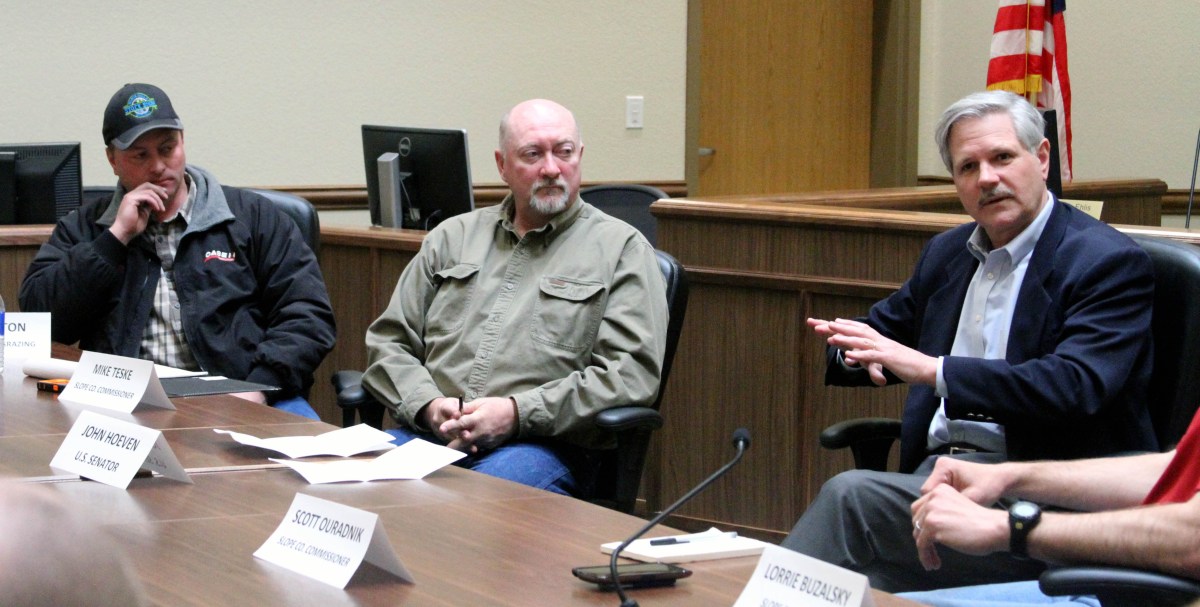
AMIDON — Residents of the two most southwestern counties in North Dakota expressed their concerns and the perceived helplessness they felt about federal government overreach to Sen. John Hoeven on Monday during separate roundtable gatherings.

The Republican senator held hour-long meetings in both Bowman and Amidon to speak with county and city officials, landowners, ranchers and business leaders about a variety of topics that originate at a national level and affect them.

While many Bowman residents expressed gratitude for Hoeven’s work to secure grant funding for its $34 million hospital project and the new Bowman Airport, their leaders, as well as those in Slope County, railed on what they see as the federal government having too much of a say in what happens not only in North Dakota, but in their own backyards.

“It’s people like us who have little meetings that don’t make a difference anymore,” Lauren Klewin, a Slope County rancher and longtime board member for Slope Electric Cooperative, said during the Amidon roundtable.

Klewin spent nearly five minutes talking off the cuff about the variety of ways area residents feel hamstrung by federal bureaucracy and what he felt was increasing and all-but unstoppable overreach through the Obama administration’s Clean Water Rule and Clean Power Plan, as well as the U.S. Forest Service’s grazing plans.

“Regardless of who we ever have as a president, I feel like these federal agencies are running on their own,” Klewin said.

Hoeven responded by telling Klewin and others that some members of Congress and the court system continue to push back against the new carbon emission standards proposed by the Environmental Protection Agency, and noted the importance of who nominated to be the next Supreme Court justice.

“Is it going to be someone who reflects North Dakota’s interest or someone who reflects the Obama agenda?” Hoeven asked. “… We can’t constantly have the federal government coming in and putting all these regulations on us.”

State Rep. Keith Kempenich, a Bowman Republican who represents District 39 in the Legislature, spent time at the Bowman roundtable asking for Hoeven’s help curtailing federal regulations on coal-fired power and the politicizing of climate change research and science.

“They’ve completely walked away from the science of it,” Kempenich said. “They’re pushing an agenda. Are your colleagues understanding this, for the most part? That’s where it gets frustrating. Because that’s where it’s coming from, is 20 square miles on the East Coast.”

Hoeven said after the Bowman roundtable that the concerns he heard echo those of many North Dakotans.

“As I listen to people all over the state of North Dakota, that’s what they’re saying,” he said.


Powder River trade off

Rodney Schaff, chairman of the Bowman Airport Authority, thanked Hoeven for his work to secure $12 million in grants for the airport, which opened last May.

He also spoke about the Powder River Training Complex, a U.S. Air Force training area that encompasses a large area in southwest North Dakota and neighboring South Dakota.

“We don’t have anything against military training,” Schaff said. “I’m an old Air Force vet. … But we said there’s got to be trade off here too.”

Hoeven said the Air Force is waiting to conduct low-altitude flights in southwest North Dakota until the Bowman Airport has installed equipment that allows it to communicate with the national air traffic controllers about flight training being conducted in the area.

“This Powder River range is very important to the Air Force, but at the same time it’s got to work for general aviation,” he said in an interview after the Bowman roundtable.