Gift to sportsmen: Longtime teacher donates 1,120 acres of family land to Game and Fish to establish Wildlife Management Area


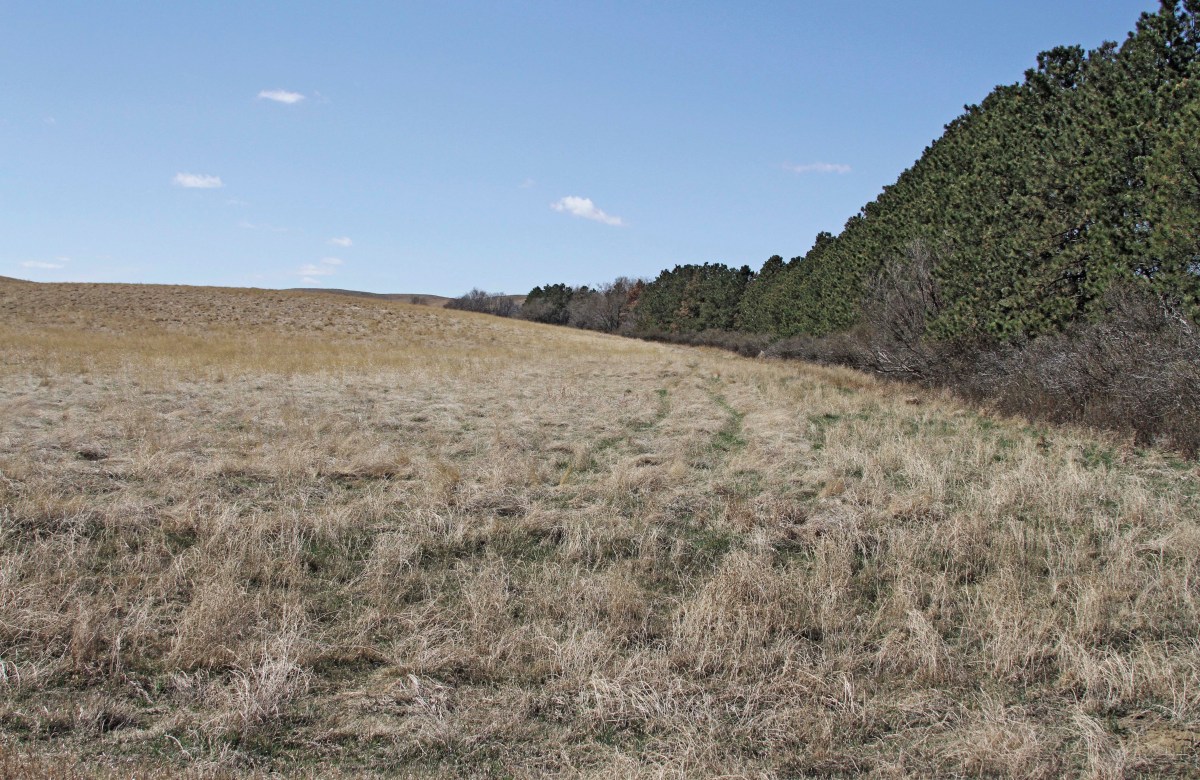
LEFOR — Tucked away a few miles west of the Enchanted Highway south of Gladstone is a large and secluded tract of land where pheasants pop out of thick grassland and deer hide in tree rows that stretch for nearly a half-mile.

It’s an area soon to become Stark County’s first North Dakota Game & Fish Department Wildlife Management Area.

The 1,120 acres of land–which consists of an adjoining section, half-section and quarter-section–was gifted to the Game and Fish Department by Regina Roth, a longtime teacher and lover of wildlife who died in January.

“I wish I would have known her because I don’t know why she did it,” said Casey Anderson, the Game & Fish Department’s assistant wildlife division chief.

Anderson said one of Roth’s wishes is certain, however. It’s that she wanted to ensure the WMA was named after her parents, Adam and Theresa Raab, who homesteaded the area. Anderson said Game & Fish will be honoring that wish.

Game & Fish has yet to complete the land acquisition process and Anderson said it may take a couple years before the WMA is complete.

The department must fence the entire area, place proper signage and rework agreements with a local farmer who leases the roughly 450 acres of cropland within the future WMA.

“We’ll get boundary fences and stuff up as soon as we can. That’s kind of the first order of business,” Anderson said. “When we were talking about doing habitat work and stuff like that, the fact that there’s an ag lease that we’re going to uphold is OK. Because there’s some things that have to be done on it before we start worrying about habitat work.”

Anderson said the boundary fencing will be up by this fall’s pheasant hunting season.

“There’s going to be all kinds of opportunities down there, as far as hunting opportunities,” he said.

The original Raab farmstead–an idyllic western North Dakota farm setting–is also part of the land donation. It’s surrounded on the north, south and east sides by hundreds of Ponderosa pine trees and Evergreens, and there are some other outbuildings.

“She had some wishes that we try to maintain that farmstead,” Anderson said, adding that Game & Fish is still checking into what it’s legally allowed to do with the farm and house on it. “We’re not necessarily in the business of having living quarters, but we’d sure like to maintain her wishes.”

Norma Hirning, whose husband Roger farms the land inside what will become the WMA, said the entire Raab family–including Regina and her brother Irving–were animal lovers who cared deeply for their land.

“The entire time I’ve known those people, they’ve had a real love for animals. Whether it’s wildlife or cattle, whatever,” Hirning said.

Though Hirning said Roth was a very private person, she touched countless lives as a teacher.

After graduating from Lefor High School, Roth began teaching at a country school nearby before even obtaining her degree from what was then Dickinson State Teacher’s College. She ended up teaching first and second grades in Mott, where she also became the elementary principal, until her retirement.

There are 215 Wildlife Management Areas throughout North Dakota either managed or partially managed by Game & Fish. The WMAs are open to hunting, fishing and trapping, and are also used for hiking, primitive camping and nature study, according to the department’s website.

Of those WMAs, only around 30 are larger than the Raab Wildlife Management Area, and many of those in western North Dakota are near Lake Sakakawea and Lake Oahe.

“This is a huge gift to the sportsmen and women of North Dakota,” Anderson said. “It’s going to open a lot of opportunities for locals that need a place to hunt.”

When Anderson presented information about the WMA to the Stark County Commission last Tuesday, Commissioner Ken Zander figured the land could have brought more than $1 million on the open market.

“When you look around, there’s not too many of us–myself included–who would have thought of doing something like this before we or I would have cashed in, and taken the money and run,” he said. “It’s a beautiful gesture.”
Twins Stop in Rothsay Home to Comfort 8-Year-Old Fan

ROTHSAY, Minn. — The look in Cole Fielder’s eyes said more than words.

When two Minnesota Twins baseball players and two of the team’s all-time greats walked into his bedroom Wednesday afternoon, the eight-year-old didn’t move.

But his eyes did.

“When his eyes go up, that means yes,” said his mother, Dori Fielder.

Twins Michael Cuddyer and Mike Redmond, along with Hall of Famer Harmon Killebrew and twotime World Series champion Dan Gladden, visited Cole as part of the Twins Winter Caravan.

Cole has Type I spinal muscular atrophy (SMA), a motor neuron disease which causes the muscles to atrophy, and can’t leave the house during cold months.

Doctors diagnosed Cole with SMA when he was just five weeks old.

Today, Cole is in a wheelchair, on a ventilator, has no motor functions and can’t speak. His eyes are his only form of communication.

“I’m sure it’s a little overwhelming for him,” said Redmond, a catcher entering his second season with the Twins. “On the other hand, I’m sure it’s something he’ll remember for the rest of his life.”

The caravan spent more than 30 minutes at the Fielder’s house in Rothsay, speaking with Cole and his family, taking pictures and signing memorabilia.

“I don’t think they realize what they really did for him and did for us,” Dori said.

The players said they do very few house calls during the regional goodwill tour, which also stopped in Duluth, Wadena and Fergus Falls on Wednesday.

“It’s very unique,” said Cuddyer, a third baseman entering his sixth season. “We don’t necessarily get to single homes.”

While the family rubbed shoulders with the players, the youngest members of the Fielder family, 5-year-old Tori and 4-year-old Noah, enjoyed playing with “T.C.”, the Twins mascot, who brought memorabilia items for the kids.

However, the most surprising moment for the Fielder family was the appearance of Killebrew, who wasn’t scheduled to be with the team.

“To come to a home like this, I think, is a pretty special thing to do,” said the 69-year-old Killebrew. “They’re real Twins fans here.”

That may be an understatement.

Everything in Cole’s room is associated with the major league team.

The pennants on the wall, the blanket on his bed and countless other Twins items show the family’s dedication to the baseball team.

The allegiance began when a Twins baseball game caught Cole’s attention four years ago.

“My brother just started watching it a little bit and he started liking it,” said 13-yearold Nick Fielder. “So we started watching it.”

Today, it’s his best outlet and a bonding tool for the Fielder family.

“I didn’t even start watching baseball until Cole started watching baseball,” said his father, Rick Fielder.

Kay Siebert, one of Cole’s former nurses, spent the past two years urging the public relations staff that handles the caravan to make a stop in Rothsay to visit Cole.

Siebert could hardly hold back tears of joy when she saw Cole with the players.

“I was just tickled,” Siebert said. “This is the kind of thing Cole really lives for.”

Momentous victory: Hawks rally to beat Lights, help Biesiot tie NAIA wins record

Hank Biesiot wanted to go left. Dave Velasquez insisted he go right.

Velasquez got his way and threw a touchdown pass that helped write another page in his head coach’s chapter in college football’s history books.

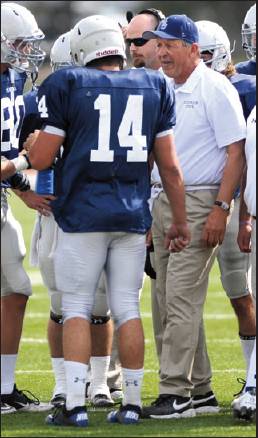
Dickinson State’s senior quarterback threw two of his three touchdown passes in the fourth quarter, including a 3-yard strike to Presley Straub on fourth down with 22 seconds remaining that helped lift the Blue Hawks to a 21-20 come-from-behind victory over Montana State-Northern on Saturday afternoon at the Badlands Activities Center.

The win helped Biesiot tie the NAIA career coaching wins record with 256 and gave the Blue Hawks (1-2, 1-2 Frontier), who rallied from a 13-point fourth-quarter deficit, their first-ever Frontier Conference victory. Biesiot, in his 37th season at DSU, was just happy to see the team get its first win of the 2012 season.

“We’ve been in a lot of close games,” Biesiot said. “I’m happy to have one go our way.”

The coach and quarterback debated what they should do during a time out before the game-tying touchdown, all the while knowing they were looking to either pass or have Velasquez run.

Velasquez told Biesiot he felt better rolling out to his right and found Straub open on a screen pass in the front right corner of the end zone.

“He wanted to roll me out to the left,” Velasquez said. “I told him we should probably roll out to the right. It won’t be an accurate pass if we go to the left. We saw each other. He (Straub) was wide open. I gave him a little toss just like playing catch in the backyard.”

Freshman kicker Chad Bryant nailed the extra point to put the Blue Hawks ahead and MSU-Northern junior quarterback Derek Lear misfired on two Hail Mary attempts in the final seconds — including one with no time on the clock after DSU senior cornerback Mike Fisher was called for pass interference on what should have been the game’s final play.

Velasquez was 15 of 31 for 230 yards and hit seven different receivers.

He threw a 21-yard TD pass to Tanner Leak in the second quarter and a 56-yarder to freshman Wyatt Mirich in the fourth quarter — just four plays after MSU-Northern had taken a 20-7 lead with 8:22 remaining in the fourth.

“We made too many mistakes,” MSU-Northern head coach Mark Samson said. “Then we had to suck it up at the end of the game and we didn’t get it done. That’s, in a nutshell, how we played today. We should have never been in that situation to begin with. We just didn’t do things when we had to really do them.”

DSU outgained MSU-Northern 340 to 297 in total yards despite being held to just 125 yards rushing on 41 carries.

After playing to a 7-7 halftime tie, the Lights (0-3, 0-3 Frontier) took the two-score lead when Lear found Brandon O’Brien for touchdown passes on back-to-back series. O’Brien caught a 17-yard TD pass with 1:37 left in the third quarter and hauled in a 14-yard strike to cap an 11-play, 80-yard drive in the fourth.

Perhaps the biggest difference in the game came when DSU blocked an extra point after O’Brien’s first touchdown pass.

DSU, which had struggled running the football much of the game, used offensive balance to fight back.

The Blue Hawks caught the Lights napping when Velasquez connected with a wide-open Mirich for his first career touchdown over the middle. They then ground out the clock on a 13-play, game-winning drive that took 4:42.

Junior receiver Jimmy Smith came up with two big catches on the final series. He dragged his feet in bounds along the DSU sideline for a 16-yard reception up to the DSU 4 on a fourthand-9 and set up Straub’s TD with a 7-yard catch after junior tailback Myren Moore was pushed back to the 10 on a pitch.

“I felt my feet drag. I didn’t know if I’d got them in bounds,” Smith said with a smile. “I was at full extension. Dave put the ball the only place he could. I did my best to get to it and ended up there, ended up coming up with it somehow.”

Lear threw for 108 yards and rushed for 70 to lead Northern. Stephen Silva rushed for 77 yards on 19 carries, including a 14-yard touchdown on the Lights’ opening drive of the first quarter.

Moore led DSU on the ground with 64 yards on 16 carries but came up short on a pair of runs from the 1-yard line late in the second quarter that would have given the Blue Hawks a halftime lead.

DSU turned the ball over on downs at the 2-yard line on that series, got the ball back on a MSU-Northern fumble on the kickoff and marched to the 14 — only to have Bryant miss a 28-yard field goal attempt into the wind with 8 seconds left before halftime.

Yet, for the first time in three tries, DSU didn’t dwell on its misfortunes from early in the game.

“We yelled the whole week, ‘finish, finish, finish,’” Velasquez said. “We got shut down on the 1-yard line and we had things go the other way. You’ve got to come back and you’ve got to finish and we did.”

Biesiot is now in a three-way tie for the coaching wins record with Frosty Westering, the former coach at Pacific Lutheran University, and Kevin Donley of St. Francis (Ind.). Donley’s Cougars were idle this week.

Biesiot, who already owns the NAIA record for most wins at one school, and Westering have all 256 of their wins at NAIA institutions. Donley had 11 of his wins come at the NCAA Division II level.

That means if Biesiot wins one more game before Donley wins 11, then he will pass Westering as the winningest coach at only NAIA schools. DSU visits Southern Oregon for the first time at 2 p.m. MDT next Saturday in Ashland, Ore.

“I know he’s not all about that, but I’m just happy we’re one of the teams that can get him there,” Straub said.

MSUN 7 0 6 7 — 20 DSU 0 7 0 14 — 21

First quarter

MSUN–Stephen Silva 14 run (Trevor Baum kick), 6:59.

Second quarter

DSU–Tanner Leak 21 pass from Dave Velasquez (Chad Bryant kick) 8:10.

Third quarter

MSUN–Brandon O’Brien 17 pass from Derek Lear (kick blocked), 1:37.

Fourth quarter

MSUN–O’Brien 14 pass from Lear (Baum kick), 8:22. DSU–Wyatt Mirich 56 pass from Velasquez (Bryant kick), 6:58. DSU–Presley Straub 3 pass from Velasquez (Bryant kick), :22

TEAM STATISTICS MSUN DSU

First downs 19 19 Rushes-yards 38-189 41-125 Passing yards 108 215 Comp.-Att.-Int. 11-20-0 15-31-0 Total yards 108 215 Fumbles-lost 2-21-1 Penalties-yards 6-40 3-31 Punts-Avg. 5-45.4 6-37.8

INDIVIDUAL STATISTICS

RUSHING: MSUN, Stephen Silva 19-77, Lear 12-70, Justin Montelius 4-49, Orin Johnson 3-3. DSU, Myren Moore 16-64, Presley Straub 11-31, Dave Velasquez 7-16, Kyle Stanton 4-13, Jordan Moore 2-2. PASSING: MSUN, Lear 11-20-0 108. DSU, Velasquez 15-31-0 230. RECEIVING: MSUN, Brandt Montelius 4-46, O’Brien 2-32, Silva 2-22, Mick Miller 1-5, Johnson 1-4, J. Montelius 1-(minus-3). DSU, Jimmy Smith 5-66, Cody Clausen 3-34, Tanner Leak 2-38, Presley Straub 2-21, Wyatt Mirich 1-56, J.T. Keith 1-9, Kyle Stanton 1-6.

DEFENSIVE LEADERS

TACKLES (FOR A LOSS): MSUN, James Chandless 12, David Arteaga 11, Butch Hyder 9, Josh Baum 7 (1), Ryan Craig 6 (1.5), Mike Carbon 4, Jordan Van-Voast 4 (1.5). DSU, Kyle Watson 11 (.5), Jaylen Sokoloski 10, Jay Grosz 9 (.5), Nolan Schwartz 5, Cord Berg 5 (2), Colton Hill 5 (1), Mike Fisher 4. SACKS: MSUN, Craig, Van Voast. DSU, None. INTERCEPTIONS: None.

Having no coach hasn’t been a problem for Ramon Miller — he’s a 2-event Olympian

Editor’s Note: This is the last in a three-part series previewing Dickinson State alumni who are competing for the Bahamas at the Summer Olympics in London.

Ramon Miller has no one to blame but himself for how he performs at the Summer Olympics.

Miller is taking an approach that isn’t unprecedented. But it’s not one most world-class runners are known to take in their training.

For more than a year, the Bahamas sprinter and Dickinson State graduate has been without a proper coach.

It hasn’t seemed to hinder him either.

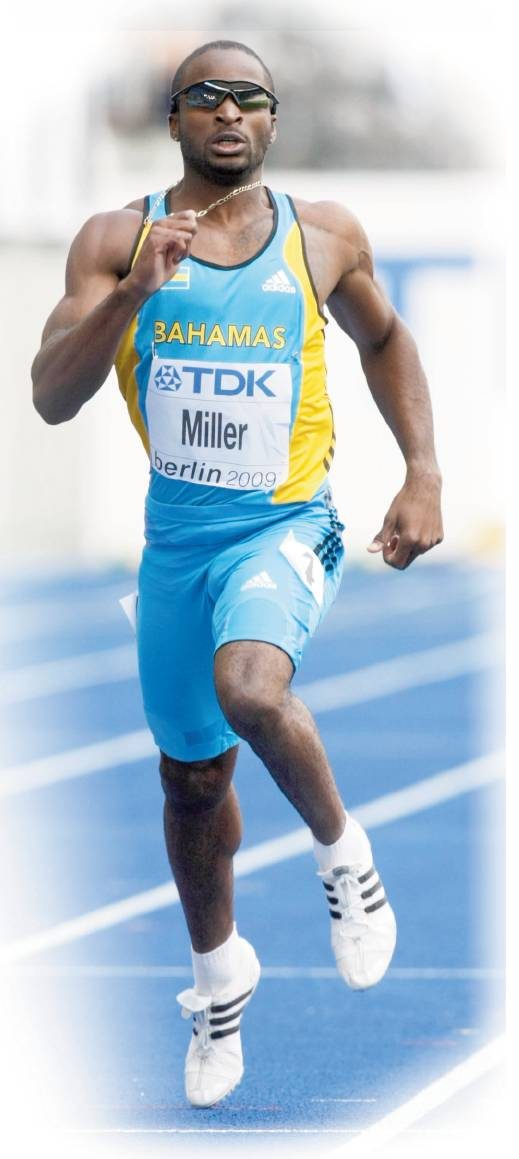
Miller has qualified for the London games in three different events — the 200 and 400 meters and as a member of the Bahamas’ outstanding 1,600 relay team. However, he only plans to compete in the 400 and 1,600 relay.

“This year, I’m doing everything on my own,” Miller said. “I’m sailing my own ship, so if anything goes wrong, I’m to blame. I’m the captain of everything right now.”

After leaving Dickinson in 2010 — two years after helping the Bahamas 1,600 relay team win a silver medal at the Beijing Olympics — Miller went to Orlando, Fla., where he began working with former U.S. Olympic team coach Brooks Johnson.

But, something just didn’t click between Miller and the veteran mentor.

“He’s a pretty good coach, but he just wasn’t my suit,” Miller said.

The difficulty of not being able to mesh with Johnson was compounded by back and hamstring injuries, turning 2010 into a nightmare for Miller.

“It was a real rough year for me,” Miller said.

It wasn’t without a couple of silver linings though.

In October of that year, Miller won a bronze medal in the 400 meters with a time of 45.55 seconds at the Commonwealth Games in New Dehli. One month later, he celebrated the birth of his daughter, now 20-month-old Rammonica.

In 2011, he left Johnson’s camp and has been mostly on his own ever since.

“I just wasn’t progressing like I wanted to,” Miller said. “I made a decision and I just started working on my own, doing what I did in Dickinson, which I know helped me. After I left him, I started to see an improvement.”

In August 2011, Miller won his heat in the 400 meters at the World Championships in Daegu, South Korea, with a time of 45.31 seconds. He finished just 13th overall. In October, he won another bronze, this time at the Pan American Games in Guadalajara, Mexico, with a time of 45.01 seconds.

That set him up for this year’s big push toward London.

He ran a personal-best time of 44.87 seconds in the 400 while finishing second to Demetrius Pinder in the Bahamas Olympic Trials and had an Olympic qualifying time of 20.5 seconds in the 200 at a meet in Tampa, Fla., in May.

Miller’s breakout season comes as no surprise to DSU head track and field coach Pete Stanton.

“Ramon has just taken off,” said Stanton, who coached Miller to 12 NAIA individual or relay championships. “He’s so talented and has such great work ethic. He knows where he wants to go.”

While Miller wants to challenge for the podium in the 400, he knows his best shot of earning another Olympic medal comes as a member of his countries’ 1,600 relay team. The Bahamas owns the fifth-fastest time in the world (3:00.56) coming into the Olympics. But, that time was set at the end of April, far from when any of the runners — Miller included — were at their peak.

“Me and the guys, we talk every day,” Miller said of his relay teammates. “We talk about how practice is going. We don’t even talk about the relay. Once we come together, everybody is healthy and we’re going to go after it and hope for the best.”

Miller opted not to run the 200 at the Olympics, saying he hit the qualifying mark while trying to test his speed and see if his training was progressing well. Plus, his time doesn’t rank high enough for him to be considered a medal contender.

Nonetheless, Stanton said to qualify for the Olympics in three events says much about the level at which Miller is competing.

“He’s just an extreme talent,” Stanton said. “When you take three events, how many people in the world can qualify in three events for the Olympics?”

Steadily Soaring: After barely missing Beijing Olympics, Trevor Barry enters London as high jump favorite

Editor’s Note: This is the second in a three-part series previewing Dickinson State alumni who are competing for the Bahamas at the Summer Olympics in London.

One centimeter. It’s practically nothing.

But, one centimeter is all that kept Trevor Barry from qualifying for the Olympics four years ago.

One centimeter is also what has made Barry’s trip to the 2012 Summer Olympics in London so sweet.

“It’s kind of a redemption,” he said with a smile.

High jump is an athletic discipline that puts great importance on small increments and adjustments.

Little improvements, over a span of years, have helped the Dickinson State alumnus become one of the world’s best high jumpers.

He has reached 7 feet, 7 inches (2.31 meters) this season and hit 7-7¼ (2.32 meters) last September to win a bronze medal at the World Championships in Daegu, South Korea. Last year’s performance has Barry thinking big.

“I feel like I’m in good position to be a contender for a medal,” Barry said.

He has the right to feel good about his chances when the high jump qualifying begins Aug. 5. After all, he has come a long way in four years — even if all he has done is increase his personal-best jump by a seemingly meager 3 inches.

Still, it’s an amount DSU head track and field coach Pete Stanton said matters a great deal in the high jump.

“It’s a cliché: sports come down to inches,” Stanton said. “But it’s even more so in high jump. It comes down to centimeters.”

Barry, who helped DSU win NAIA national championships in 2004, 2005 and 2006, has been on the rise since barely missing the 2008 Olympics in Beijing.

He took a silver medal behind countryman Donald Thomas with a height of 7-6 (2.29 meters) at the 2010 Commonwealth Games in New Dehli. In 2011, less than two months before his bronze at the World Championships, Barry won gold at the Central American and Caribbean Championships by leaping 7-5¾ (2.28 meters). This year, the Mizuno-sponsored athlete ranks fourth in the Diamond League, a global competition for many of the top athletes in select disciplines.

“My story is not a Cinderella one,” Barry said. “It’s persistence and dedication.”

Getting to this point has been a steady climb, a journey Barry has done mostly on his own.

Living in Fargo, Barry generally works out alone.

He takes film of his practices and sends them to two coaches, world-renowned Bahamas track and field coach Keith Parker and Troy Kemp, an assistant coach at Northern Arizona who won the gold medal at the 1995 World Championships. Kemp helps Barry with his strength and training regimen while Parker keeps an eye on the technical aspects.

Training without any competition can be viewed as a drawback, but Barry said it works well for him.

“It’s kind of a mental thing,” he said. “Each athlete has their own preference. For me, I don’t have anyone to compete with. I don’t have anyone to set me back either. My limit is my limit.”

Since Barry arrived at DSU in 2003, Stanton said the eight-time NAIA champion — only two of which came in the high jump — has never lacked confidence.

That attitude, the coach believes, may play a major factor in London.

“The big thing Trevor has going for him is his consistency over the last year, and his confidence,” Stanton said. “He’s always been pretty confident, but now I think he knows the level that he’s at and where he’s going.”

If Barry has his way, he’s going to the medal stand after the high jump finals on Aug. 7.

“I have the confidence,” Barry said. “I know what it takes to compete at this level. Right now, anything is possible.”