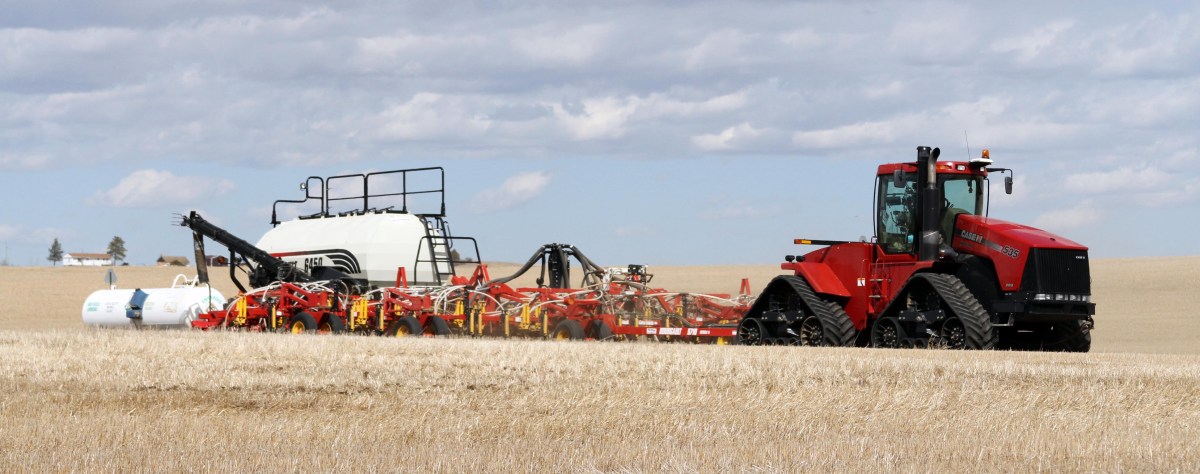
Planting season well underway, though farmers hope precipitation is in future

MOTT — After 23 years of farming, Mark Anderson is happy to stick to his “game plan.”

The Regent-area farmer said neither below-average precipitation nor low commodity prices have shaken him much this year. He’s still seeding the crops he’d planned for and said Monday that he’s more than halfway finished.

Though with much of western North Dakota in a moderately dry drought, according to the U.S. Department of Agriculture’s drought monitor, Anderson and others say they can’t help but hope for a little rain soon.

“It’d be nice to get a good rain to settle the dust,” he said. “I think everybody would have kind of a weight lifted off their shoulders if they’d get an inch of rain.”

Most southwest North Dakota farmers are in the same boat as Anderson — about half done with their spring planting while hoping for some moisture to give those seeded crops an early boost.

Garret Swindler, who farms east of Anderson in the Mott area, said the only benefit to the dry year so far is farmers were fighting wet and muddy fields just to get their crops seeded last spring.

He said the moisture left in the topsoil after winter is fine for seeding, but it’ll only be good if planting season if followed by some rain.

“There’s enough moisture there to get the crops started,” he said. “We’re definitely planting deep. … We just have to make sure that seed has enough moisture to germinate and get out of the ground. But you can’t really wait on rain either.”

Duaine Marxen, the Hettinger County Extension agent in Mott, said most farmers he works and speaks with on a regular basis have been in the field for the past couple of weeks, and like Anderson and Swindler, most are well on their way to wrapping up planting efforts. Contending with dry conditions and high winds, however, have made for some challenging days, he said.

“No one here will complain if it starts raining,” Marxen said with a laugh.

Farmers might get their wish this weekend.

The National Weather Service is forecasting some showers for southwest North Dakota this week, with chances increasing toward the weekend and into next week.

That could be a welcome relief, as Todd Hamilton, a meteorologist with the National Weather Service in Bismarck, said the Dickinson area is already 1 inch below average rainfall for the year.

“We haven’t really had any real significant precipitation in quite some time,” Hamilton said, adding it has been about six months since southwest North Dakota experienced a large precipitation event.

He said conditions are “abnormally dry” throughout the western and central parts of the state.

“We are still early in the growing season now, so there’s certainly potential for us to move out of this,” he said.

Anderson said he has wrapped up seeding his spring wheat and Swindler planned to be finished with it by today. After that, both said they’d move on to other crops such as flax, canola and corn.

Anderson said while some farmers might be trying to “outguess” the weather or the future of commodity prices in deciding what or where they plant certain crops, he’s happy to stay the course and stick to what has worked for more than two decades.

“What looks poor now may be your best moneymaker in the end,” he said. “… I’ve been through these times before. You just seed the crop and cross your fingers.”

Column: Farmers Prepare for an Ugly Year

There’s volatility in the lifeblood of southwest North Dakota.

And I’m not talking about oil. People often forget how challenging life can be for family farms.

This year is poised to be no different.

In mid-March, myself and Brock White — my co-host on “Insight,” a weekly news talk show that airs on Consolidated Channel 18 and streams on The Press website — interviewed North Dakota Agriculture Commissioner Doug Goehring for 25 minutes about the upcoming planting season and the challenges North Dakota farmers are expecting this year. Goehring, early in the interview, put it bluntly.

“It is a bit depressing,” he said, laughing quietly before quickly turning serious.

I, like so many others in our area, grew up a farm kid and understand the importance farmers, ranchers and the agriculture industry have on our economy and our culture. This year, Goehring said, all signs point to struggles for many North Dakota farmers.

“We have a lot of farmers who, first of all, are very concerned — and have been for the past year and a half — about falling prices,” he said. “We’re to the point where it doesn’t even look like there’s a flashlight or any daylight at the end of the tunnel.”

Many balance sheets just aren’t penciling out for farmers this year, Goehring said. With current prices, most aren’t even looking at profi ts. Their projections show big losses.

Goehring and I even shared similar stories that we’ve heard about longtime North Dakota farmers who didn’t get approved for their operating loans by banks they’ve been going to for years.

In short, they’ve reached the point where it’s fi nancially uncertain if they can even continue farming. And for most, it’s the only livelihood they’ve ever known. All this is happening because of sagging commodity markets.

The price for 14 protein spring wheat — which is medium-quality — closed at $4.34 a bushel on Thursday. Hard amber durum was at $4.60. Those are extraordinarily low prices in today’s markets. Corn, sunfl ower, canola and soybean prices also are all low as farmers head into the planting season.

“You’re trying to fi nd that crop that’s not going to do as much harm to you,” Goehring said.

Most commodity prices are the same — or lower — than they were 20 years ago.

At the same time, operating costs for farmers keep going up. Machinery is more expensive, insurance prices keep climbing, fuel — while at fairly moderate price levels today compared to a couple years ago — still isn’t cheap.

Goehring, in our interview, mentioned an equipment dealer who had sold one tractor between last fall and this spring. That points out the obvious ways in how other livelihoods in our state are affected by farming.

On top of all this, we live in a world where farmers are expected to produce more and more food, which means more production from all farmers — not just those in North Dakota. While it may seem like a cliche point to make, if farmers can’t afford to farm, how are we going to feed 7 billion people (and growing)?

Goehring said his hope is that prices will begin climbing into the summer — possibly changed by weather, production in other ag commodity markets across the world or unforeseen issues altogether.

“We live off from hope,” he said, “and let’s face it, farmers are a unique breed. You live by faith and hope, because you don’t control the weather and you don’t control the markets. And those two things look like they could be rather volatile this year.”

Bowman’s Steve Brooks balances ranching with role as ND Stockmen’s Association president

BOWMAN — Skeeter Brooks is getting an education not only in ranching, but also the often unseen business that happens outside of the corrals.

The 25-year-old is part of the sixth generation at Brooks Chalky Butte Angus Ranch, and said her ranching education is growing every day — particularly through her father Steve Brooks’ role as North Dakota Stockmen’s Association president.

“We learn a lot from it,” she said. “Every day, somebody might call and they’ll have a question about brands or something, so that furthers us in our education. You meet so many people too. There’s always people stopping by. When you go somewhere, you always run into somebody.”

Steve Brooks — who runs Brooks Chalky Butte Angus Ranch north of Bowman with his brother, Ryan, and their families — has spent a lifetime ranching. But for the past year and a half, he has also taken on the leadership role among cattlemen in the state. Though the position forces him to balance his time between working on the ranch and on behalf of his peers throughout the state, Brooks said he’s pleased with what he’s been able to accomplish — even if it keeps him very busy.

“Being president of Stockmen’s has involved a lot more than I realized,” he said with a laugh, noting he was also president of American Angus Association in 2003. “That was a big job, and I thought this was a step down and a lot less time consuming, but it’s not.”

During last year’s legislative session, Brooks said he drove from Bowman to Bismarck a dozen times. He’s taken trips to Washington, D.C., to meet with the state’s Congressional delegation and others in the agriculture industry.

And he does all of it while operating the 109-year-old ranch that’s gearing up for its annual production sale April 2 in Bowman. They’ll be selling about 180 bulls that day, as well as 1,000 of their customers’ bred heifers.

“It’s a lot harder to get away,” he said.

As Stockmen’s Association president, Brooks has lobbied against government overreach in the country-of-origin labeling (COOL) program for marketing U.S. beef, helped ensure a beef checkoff rate increase from $1 to $2 a head to help with the program’s long-term sustainability, represented southwest North Dakota landowner interests in a debate against the Bureau of Land Management over the classification of the sage grouse as an endangered species, and lobbied against the controversial Waters of the U.S. rule that would allow the federal government, namely the Environmental Protection Agency and the U.S. Army Corps of Engineers, jurisdiction over most of the nation’s bodies of water — including waters on private land.

The most recent issue he’s working through is how a change in state tax law has affected the way counties can charge property tax on those leasing state school land, which is done mostly for use as pasture.

“We’ve been working on some of that to get that straightened out,” Brooks said, adding the Stockmen’s Association is seeking the state attorney general’s opinion on the matter.

He also said the Stockmen’s Association is aiming to increase brand fees 50 cents soon because of increases in its health insurance and salaries that help keep the association competitive in the job market.

Brooks said it’s a good time to be an established cattleman in North Dakota.

“Last year was the best market we’d ever seen in the history of cattle in the U.S.,” he said. “We turn around and it’s dropped 60-70 cents a pound and we’re still in the second-best market we’ve been in.”

And at the end of the day, that’s who Brooks is — a cattleman who is doing what he can to ensure more family ranches and farms stay afloat.


Ag commissioner: 2016 outlook ‘pretty dismal’ for farmers

Doug Goehring may be North Dakota’s agriculture commissioner, but at the end of the day, he’s still a farmer.

Like any farmer, he has to deal with the low commodity prices that have producers from southwest North Dakota to the Red River Valley concerned and apprehensive about what the 2016 growing season will bring.

“It’s pretty dismal,” Goehring said of the state’s ag outlook. “… At this point, my understanding visiting with farmers — and even on our own farm — is there’s some hard decisions to make.”

Goehring admitted he’s even thinking about giving up a piece of rented land that may not pencil out as profitable this year.

He said he’s heard the same story throughout the state as farmers weigh their input costs with commodity prices that are lower than they’ve been in several years and are causing them to see red on the bottom lines of their projected yearly balance sheets.

“Farmers don’t see any black anywhere they look,” he said. “Then it’s a matter of trying to assess, ‘Where can you lose the least amount of money at?’”

Ron Haugen, a farm management specialist with the North Dakota State University Extension Service in Fargo, is part of a group that releases an annual report meant to aid producers in planning for the upcoming growing season.

“This has been some of the lowest prices we’ve had in several years,” he said.

North Dakota farmers are planning for their worst spring wheat prices in at least six years — nearly $2.50 a bushel lower than recent averages — with durum wheat at its lowest since 2011, according to the Extension Service’s data.

Corn prices, for the past two years, have been about $1.50 a bushel lower than recent averages and are nearly half the price of what they were in the 2012-13 marketing season.

Oil sunflowers are $8.35 per hundred weight lower than average and down nearly $5 since last year. Soybeans and canola are both at their lowest point in the past five years and well below recent averages.

“To have tight margins is actually more the norm,” Haugen said. “The last five years have seen extraordinarily high prices. This is getting back to more normal, where things are tighter.”

Despite the benefit of farmers and ranchers having the lowest fuel prices than they’ve had in several years, the gains there don’t stack up with low commodity prices.

Greg Fitterer, with Helena Chemical in New England, has been in the fertilizer and bulk fuel sale business much of his life.

He said farmers know little to nothing is going to pencil out positive at current commodity prices. Fertilizer prices aren’t much more expensive than they were five years ago, either, and he said the producers his company works with aren’t likely to back off on how much fertilizer they put on, unless spring becomes unusually dry, because they feel it’ll help keep their yields higher.

“Everything goes in cycles,” he said. “You have your ups and your downs. I’d say most guys’ goals this year is to break even. To not lose equity. It’s sad, but you’re basically not trying to strike out and hit a single.”

Goehring said he’d still like to see the chemical and fertilizer business — especially when it comes to nitrogen fertilizer and anhydrous ammonia — settle into more reasonable price in line with ag and energy commodities.

“There’s things way out of whack,” he said. “It’s gotten to a point where the industry is charging what it’ll bear and they need to come down a little bit. They’ve been squeezing too much out of the farmer, and taking advantage of the opportunity — when commodity prices are high, we’re going to get more from the farmer.”

Goehring said most farmers are looking at “bare bones minimum” spending plans to try and get through 2016 with the hope that better years and higher commodity prices — along with a better world economy, which greatly dictates those commodity prices — are around the corner.

“They’re trying to figure out everything that they can do to make that balance sheet work so they can buy another day, buy another year, another season to farm,” Goehring said. “Because chances are, a year and a half from now, things are going to be a little bit better.”

Erratic weather brings ups, downs during harvest for area farmers

The only delay Lenci Sickler saw this week in his family’s spring wheat harvest was a combine that broke down Wednesday.

North of Dickinson, farmers like Sickler haven’t been affected much by the colder temperatures and rain showers that have hindered their counterparts south of town since Sunday.

“We’ve kind of been in a weird pocket here where we’re at,” Sickler said during a phone interview while driving a combine.

In rural Hettinger County between New England and Regent, Jon Stang hasn’t been so lucky.

“We’re shut down for the day,” Stang said.

Continue reading “Erratic weather brings ups, downs during harvest for area farmers”