BELFIELD — The company trying to build an oil refinery just three miles from Theodore Roosevelt National Park in Billings County isn’t slowing down its efforts, even after the Dakota Prairie Refinery sold at a loss earlier this week.
Thomas Johnson, chief operating officer of California-based Meridian Energy Group, said Tuesday’s sale of the Dickinson diesel refinery doesn’t affect his company’s goal of building the Davis Refinery, which would process 55,000 barrels of Bakken crude a day.
“We did economic modeling, what our costs are going to be and concluded that we’re going to make some profits there in the Bakken and the Belfield area,” Johnson said.
Tesoro bought the Dakota Prairie Refinery from MDU Resources Group and Calumet Specialty Products, which broke ground on the refinery in 2013 and opened it in May 2015.
Johnson pointed to the Davis Refinery’s efforts to build a refinery that’ll produce gasoline, jet fuel and ultra-low sulfur diesel fuel as the difference between its plans and the Dakota Prairie Refinery, which processed 20,000 barrels of oil into around 8,000 barrels of diesel fuel a day, along with a set of byproducts.
MDU Resources spent $430 million on the refinery and reported that it lost $7.2 million in its first quarter of operations. The refinery’s construction was plagued by cost overruns and construction delays.
Johnson said he was involved in the building of PetroMax Refining, a 25,000-barrel-a-day refinery in Houston that opened last year, and said Meridian is using a similar business model with the Davis Refinery.
“We were successful last year, so we fully anticipate being successful this time,” Johnson said. “The key is not to get into a situation like Dakota Prairie. It’s unfortunate what happened, but it is a good lesson to learn.”
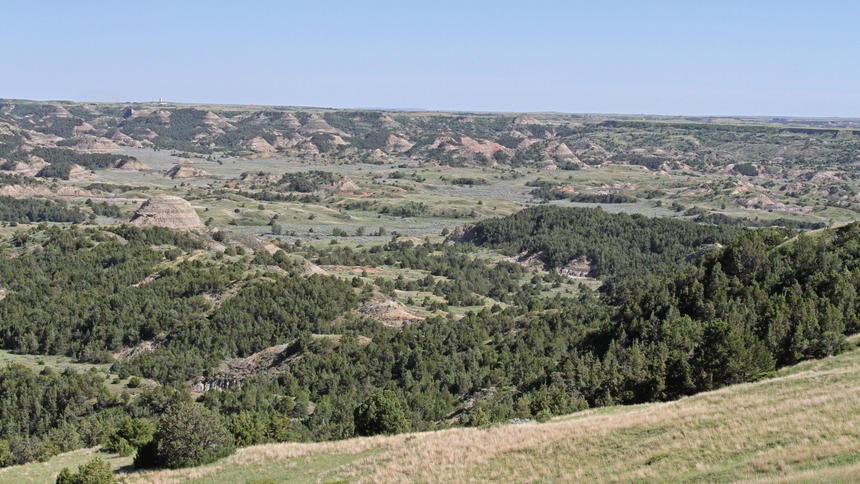
In an effort to rally community support for the Davis Refinery, Meridian is hosting a public gathering at 5 p.m. Tuesday atop Buck Hill, the highest point in Theodore Roosevelt National Park’s South Unit.
Opponents of the refinery have said it will be clearly visible from Buck Hill, and have used that as ammunition to stop it from being built.
“Basically, we want to give everybody kind of an opportunity to see that the view from Buck Hill towards the refinery,” said Adam Williams, Meridian’s director of corporate communications. “We’re going to have some surveyors out and we’ll be floating several large weather balloons at the exact height as the top of the crude tower from grade. We want to do all we can to give people an opportunity to see what the effects will be, or if there’s any visual line of sight from Buck Hill. My guess is it won’t be too visible from the naked eye.”
The Billings County Commission is scheduled to discuss the Davis Refinery for its third straight monthly meeting at 9 a.m. Wednesday. Williams said Meridian CEO Bill Prentice plans to attend the meeting, along with several other of the company’s key players.

 Dustin Monke