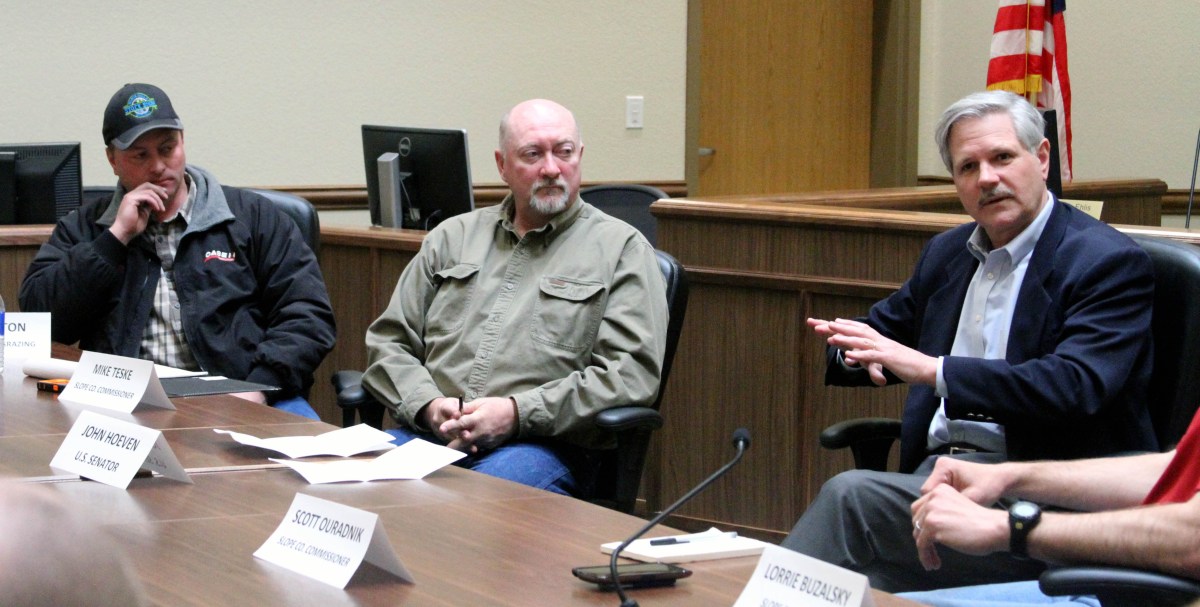
AMIDON — Residents of the two most southwestern counties in North Dakota expressed their concerns and the perceived helplessness they felt about federal government overreach to Sen. John Hoeven on Monday during separate roundtable gatherings.
The Republican senator held hour-long meetings in both Bowman and Amidon to speak with county and city officials, landowners, ranchers and business leaders about a variety of topics that originate at a national level and affect them.
While many Bowman residents expressed gratitude for Hoeven’s work to secure grant funding for its $34 million hospital project and the new Bowman Airport, their leaders, as well as those in Slope County, railed on what they see as the federal government having too much of a say in what happens not only in North Dakota, but in their own backyards.
“It’s people like us who have little meetings that don’t make a difference anymore,” Lauren Klewin, a Slope County rancher and longtime board member for Slope Electric Cooperative, said during the Amidon roundtable.
Klewin spent nearly five minutes talking off the cuff about the variety of ways area residents feel hamstrung by federal bureaucracy and what he felt was increasing and all-but unstoppable overreach through the Obama administration’s Clean Water Rule and Clean Power Plan, as well as the U.S. Forest Service’s grazing plans.
“Regardless of who we ever have as a president, I feel like these federal agencies are running on their own,” Klewin said.
Hoeven responded by telling Klewin and others that some members of Congress and the court system continue to push back against the new carbon emission standards proposed by the Environmental Protection Agency, and noted the importance of who nominated to be the next Supreme Court justice.
“Is it going to be someone who reflects North Dakota’s interest or someone who reflects the Obama agenda?” Hoeven asked. “… We can’t constantly have the federal government coming in and putting all these regulations on us.”
State Rep. Keith Kempenich, a Bowman Republican who represents District 39 in the Legislature, spent time at the Bowman roundtable asking for Hoeven’s help curtailing federal regulations on coal-fired power and the politicizing of climate change research and science.
“They’ve completely walked away from the science of it,” Kempenich said. “They’re pushing an agenda. Are your colleagues understanding this, for the most part? That’s where it gets frustrating. Because that’s where it’s coming from, is 20 square miles on the East Coast.”
Hoeven said after the Bowman roundtable that the concerns he heard echo those of many North Dakotans.
“As I listen to people all over the state of North Dakota, that’s what they’re saying,” he said.
Powder River trade off
Rodney Schaff, chairman of the Bowman Airport Authority, thanked Hoeven for his work to secure $12 million in grants for the airport, which opened last May.
He also spoke about the Powder River Training Complex, a U.S. Air Force training area that encompasses a large area in southwest North Dakota and neighboring South Dakota.
“We don’t have anything against military training,” Schaff said. “I’m an old Air Force vet. … But we said there’s got to be trade off here too.”
Hoeven said the Air Force is waiting to conduct low-altitude flights in southwest North Dakota until the Bowman Airport has installed equipment that allows it to communicate with the national air traffic controllers about flight training being conducted in the area.
“This Powder River range is very important to the Air Force, but at the same time it’s got to work for general aviation,” he said in an interview after the Bowman roundtable.

 Dustin Monke