Grain Storage Bags Saving Farmers Time, Money This Harvest

Though they may look like snowdrifts that somehow survived into the summer, the humongous white plastic bags that are appear on the southwest North Dakota landscape during harvest are full of very valuable commodities.

The 300- to 500-foot grain storage devices, which can hold anywhere from 12,000 to 34,000 bushels of wheat, are being used more than ever by area farmers who want cheaper and easier methods of storing their product once it’s off the field.

“There’s no way in the world I could farm that many acres without doing the bagging,” said Craig Fisher, who farms around 17,000 acres near Richardton and sells grain bagging machines through his business, Antelope Farm Supply.

Fisher started using grain bags in 2010 and jokes that a couple years later he was roped into selling them for Loftness, a Hector, Minn.-based company that builds the grain bagging machines.

Fisher said his sales doubled from 2014 to 2015 and have gone up another 25 percent this year.

He said many farmers are now using the bags in fields they’re harvesting, which cut down on truck transport.

“There’s always that lull when farmers quit hauling and they’ve got to keep grinding,” Fisher said. “Those bags really give you that flexibility, if you can manage the labor to do it.”

Keith Witte, who farms throughout central Hettinger County, has been using grain bags instead of adding extra bin space for the past three years. The Regent farmer said he has been impressed with the bags’ durability and the amount of money he has saved.

He has filled eight 12,000-bushel bags so far this summer and plans to fill three to four more.

“It does save me more, short-term,” Witte said. “Bins are long term and would be wonderful to have. But at the price, it’s not as feasible as this.”

Fisher said he sells three different bags, a 12-by-500-foot bag that holds 34,000 bushels of grain, a 10-by-500-footer that holds 22,000 bushels, and a 10-by-300-footer that hold 13,000 bushels. The smallest bag is the most common, he said.

Ben Hetzel, manager of Southwest Grain in Lemmon, S.D., said his elevator has been using the bags the past four years to help manage the volume of grain it takes in during harvest.

Because Lemmon is not on a major rail line and only has around 1 million bushels of storage capacity in bins, it was often faced with turning producers away during harvest after its bins filled up.

Since the elevator started using grain bags, however, Hetzel said it has been able to add about another 1 million bushels in storage capacity through their use of the 500-foot bags.

“Not having a lot of big space to hold grain for a few months, we’ve relied heavily on that to get us through harvest,” he said.

This year, the elevator has put around 700,000 bushels of grain in bags, and has used them as transitional storage beginning with winter wheat in early harvest. Hetzel said once bin storage space is cleared, they transfer the grain out of the bags. Once that happens, more grain will come in. That product is then put in bags and the process starts over.

“In order to do what we’ve done, we’d have really needed about a million bushels of space (in bins),” he said. “Even if you go cheap, that’s a $3 million-plus project. We might have total right now of 10 percent of that invested in this, and over 50 percent of that is something you can recoup your investment out of it.”

Hetzel said while using the bags has been profitable for his cooperative, the tool has been divisive among producers.

“The guys who hate them had a bad experience and won’t go there again,” he said.

Fisher and Hetzel said some farmers were scared off the bags because they aren’t impervious to large hail. Thunderstorms that ripped through the Mott and Regent area this summer brought large jagged hail and poked hundreds of holes in grain bags owned by farmer Alan Honeyman.

Hetzel said that also happened in Lemmon and “created a little nightmare,” though the bags still served their purpose.

Witte said the only issues he has had is the bags can attract wildlife if holes are poked in them.

“You have to do a great job of cleaning up any spills or anything around the bag. Don’t let the wildlife find it as a food source, or you’re out of luck. They’ll eat it,” he said with a laugh. “If a pheasant starts to poke on it, they’ll come back.”

Fisher said the bags are not supposed to be a long-term storage solution like grain bins. He suggests keeping grain in the bags for, at most, two years.

“We’ve had luck with them, but we empty them out in a timely fashion,” he said.

Federal Commodities Regulator Believes US Oil Industry Can Wait for Prices to Improve

[fcc_jw_player key=”ovzeCHJk”]

One of the nation’s leading commodities market regulators said Monday he’s confident the American energy industry can remain stable through the current period of lower oil prices, despite what overseas competition believes.

Christopher Giancarlo, a commissioner on the U.S. Commodity Futures Trading Commission, discussed North Dakota’s role in world oil markets with Sen. Heidi Heitkamp and two of the state’s energy industry leaders at the Dickinson Public Safety Center before getting an oil rig tour in Dunn County.

“Some of our overseas competitors are hoping we can’t wait it out — that we can’t wait out the low prices,” Giancarlo said. “I think they’re going to be surprised when they see this type of ingenuity, preparing ourselves for the lower prices. We can wait it out.”

Giancarlo received a crash course in the state’s oil and gas industry Monday as part of a visit to the upper Midwest that also included agricultural stops in western South Dakota and northwest North Dakota.

“You can’t really understand how to assist a business with the regulatory concerns if you don’t actually understand how they make their money, how they get up in the morning and put food on the table at night,” Giancarlo said.

‘All about survival’

North Dakota Petroleum Council President Ron Ness and Justin Bethancourt, the Bakken operations and maintenance superintendent for ConocoPhillps in Dickinson, gave Giancarlo a nuts-and-bolts walkthrough of how the North Dakota oil industry came to be and how its economy has been shaped by the most recent boom of the past decade.

Giancarlo said a sluggish world economy is keeping oil prices from climbing back to levels seen when the Bakken oil play boomed. He said volatile currency prices around the globe have spilled over into commodity prices of all kinds and has forced producers to hedge their risks.

“You guys have done enormous, fantastic work in supply — both in terms of discovery and production, and then also in terms of productivity and efficiency,” Giancarlo said. “So the supply side of the equation is in really good shape. The problem is the demand side. The demand side is caught in this sort of sluggish global growth that we’re seeing across the western world, across the developing world. Part of the times we live in right now is that anxiety over that missing global growth.”

Ness and Bethancourt said an oil producer’s ability to drill more than a dozen oil wells on a single well pad, an unheard of practice of at the start of the Bakken oil boom, has helped drive profits while lowering production costs.

“I do come away proud of American ingenuity,” Giancarlo said. “The ability to first ramp up and then build this amazing infrastructure. Then, almost as a reward for their success, to see the fall in prices and then once again readjust to that is tremendous. I don’t know if any other country in the world could have done what we’ve done. But we’re a victim of our own success in some ways.”

Ness said oil companies involved in the Bakken shale play are in a better place now than they were at the beginning of 2016.

“The independents, their stock value has been decimated, their balance sheets have been decimated,” he said. “If you would have been here in January or February, we were at risk of losing two or three of our top-five producers to bankruptcy.”

Ness added later that one of the latest trends in the state’s energy market is that operators are selling interests in their drilled-but-uncompleted wells to hedge funds as a way to finance wells that haven’t been brought into production.

“At this point, it’s all about survival,” he said.

Saudi Arabia’s role 

Heitkamp and Giancarlo also delved into Saudi Arabia’s role in guiding the world oil markets. The senator said she frequently hears from North Dakotans who are quick tell her the Saudis are forcing oil prices down in an effort to push the American shale producers out of the market.

“I think the Saudis have been driving the market down. I’m not convinced the Saudis can drive the market back up,” she said. “At some point, they’re going to have more competition than what they want.”

Giancarlo and Heitkamp both said the Saudis, much like North Dakota, are creating value-added industries to help them move past this period of lower oil prices instead of relying solely on crude oil production.

Heitkamp said she also believes the Saudis have recalibrated their long-term price expectations.

“They’re looking at this as transitional,” she said. “They’re trying to figure out what the new Saudi economy is going to look like. They look at the long-term trends in supply and demand.”

Giancarlo added that the Saudis are fine with prices where they are right now “because it’s causing all this pain in the most innovative oil production area in the world, which is right here. It’s causing a lot of pain. It’s an ideal situation for them to be in. They want to maintain their distribution relationships.”

Exec: Davis Refinery Not Affected by Dakota Prairie Refinery Sale

BELFIELD — The company trying to build an oil refinery just three miles from Theodore Roosevelt National Park in Billings County isn’t slowing down its efforts, even after the Dakota Prairie Refinery sold at a loss earlier this week.

Thomas Johnson, chief operating officer of California-based Meridian Energy Group, said Tuesday’s sale of the Dickinson diesel refinery doesn’t affect his company’s goal of building the Davis Refinery, which would process 55,000 barrels of Bakken crude a day.

“We did economic modeling, what our costs are going to be and concluded that we’re going to make some profits there in the Bakken and the Belfield area,” Johnson said.

Tesoro bought the Dakota Prairie Refinery from MDU Resources Group and Calumet Specialty Products, which broke ground on the refinery in 2013 and opened it in May 2015.

Johnson pointed to the Davis Refinery’s efforts to build a refinery that’ll produce gasoline, jet fuel and ultra-low sulfur diesel fuel as the difference between its plans and the Dakota Prairie Refinery, which processed 20,000 barrels of oil into around 8,000 barrels of diesel fuel a day, along with a set of byproducts.

MDU Resources spent $430 million on the refinery and reported that it lost $7.2 million in its first quarter of operations. The refinery’s construction was plagued by cost overruns and construction delays.

Johnson said he was involved in the building of PetroMax Refining, a 25,000-barrel-a-day refinery in Houston that opened last year, and said Meridian is using a similar business model with the Davis Refinery.

“We were successful last year, so we fully anticipate being successful this time,” Johnson said. “The key is not to get into a situation like Dakota Prairie. It’s unfortunate what happened, but it is a good lesson to learn.”

In an effort to rally community support for the Davis Refinery, Meridian is hosting a public gathering at 5 p.m. Tuesday atop Buck Hill, the highest point in Theodore Roosevelt National Park’s South Unit.

Opponents of the refinery have said it will be clearly visible from Buck Hill, and have used that as ammunition to stop it from being built.

“Basically, we want to give everybody kind of an opportunity to see that the view from Buck Hill towards the refinery,” said Adam Williams, Meridian’s director of corporate communications. “We’re going to have some surveyors out and we’ll be floating several large weather balloons at the exact height as the top of the crude tower from grade. We want to do all we can to give people an opportunity to see what the effects will be, or if there’s any visual line of sight from Buck Hill. My guess is it won’t be too visible from the naked eye.”

The Billings County Commission is scheduled to discuss the Davis Refinery for its third straight monthly meeting at 9 a.m. Wednesday. Williams said Meridian CEO Bill Prentice plans to attend the meeting, along with several other of the company’s key players.

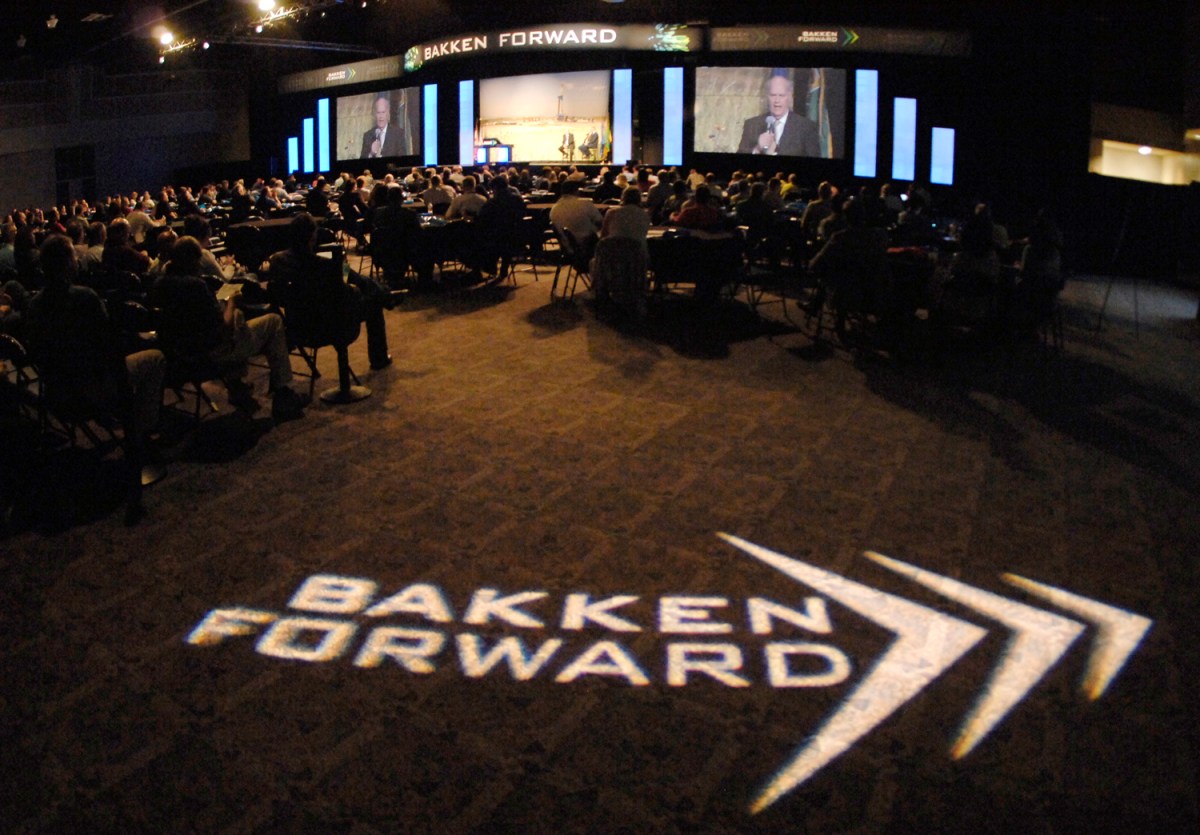
Western North Dakota energy service leaders, legislators optimistic after oil conference

BISMARCK — As the price of oil hovered around $50 a barrel last week, many western North Dakota oilfield and energy service companies turned to the Williston Basin Petroleum Conference to try to get a feel for where their industry is headed.

Most said they now feel better about the future of their businesses, as do state legislative leaders.

“What stood out to me was really the positivity,” said Matthew R. Kostelecky, president of B. J. Kadrmas, a Dickinson oilfield service company. “I really thought we’d be coming here with a lot of doom and gloom, obviously. But after listening to a lot of these CEOs and important people in business, it really just seems like this is the time to be efficient, smart, creative, kind of weather the storm, and it’s all going to come back.”

The past two years have been the 37-year-old Kostelecky’s first oil price downturn. He took over the business midway through the boom, only to watch work slow after a couple years. He paid close attention to what Whiting CEO Jim Volker and ConocoPhillips Lower 48 President Don Hrap said when they spoke at the conference.

“The attitude is that ultimately there’s a positive outlook for the future, but I think this is a new normal,” Kostelecky said. “For my generation, this is the first time that we’ve seen this. So it’s new to us, but the industry veterans, they’ve been there, they’ve done that. It’s just like anything else. You have to get past these difficult times.”

State Sen. Kelly Armstrong, R-Dickinson, said he felt conference attendees left invigorated by Thursday speeches from Republican presidential candidate Donald Trump and former college football coach Lou Holtz.

He said Trump’s energy platform resonated with the industry folks in the building, and tied into themes he heard throughout the week.

“We need consistent, reasonable regulation that protects the environment while allowing people to do business,” said Armstrong, the NDGOP chairman and son of Dickinson oilman Mike Armstrong. “All they want is tax certainty and regulatory certainty. That’s what they want. Especially for some of these tertiary things for the oil industry.”

Along with an industry push for better regulations, innovation at the wellhead and the future of value-added petroleum byproducts and industries were focused on throughout the week.

North Dakota Senate Majority Leader Rich Wardner, a Dickinson Republican, sat through multiple sessions, listening to everything from the future of natural gas liquids to industry price predictions. He said he feels that while recovery may time some time, “things are looking up for the industry.”

“I heard this: $65 oil is the new $100 oil because they’ve now got so many efficiencies,” Wardner said. “Technology is moving forward in allowing the industry to get more oil out of the rock.”

Paul Steffes, CEO of Dickinson-based Steffes Corp., said many industry leaders anticipate gradual uptick in work. Hearing that, he’s a more enthusiastic about business prospects.

Steffes Corp. manufactures equipment used at the wellhead during the extraction process, most notably its engineered flare systems that have decreased the amount of natural gas flared throughout the Bakken.

Steffes said he spoke with several people who said their companies will need more equipment to support their drilled but uncompleted wells (DUCs) once they’re put into production.

“It certainly has a possibility that we could be spiked and be much busier than we have ever planned we were going to be, as soon as they finish these DUCs,” he said. “It is possible that we’ll be busier than we’ve ever been. That is kind of a scary thing.”

KC Homiston, the co-owner and president of Highlands Engineering in Dickinson, said he’s accepted the oil industry’s “new normal.”

The oilfield aspects of Highlands’ business have declined during the slowdown because, as a civil engineering and land surveying firm, they service companies who put up rigs. There are less than 30 rigs in North Dakota today. Throughout much of 2014, there were more than 190 rigs.

“That’s the bread and butter of what we do for them,” Homiston said. “A lot of our work is dependent on the number of rigs that were in play.”

Homiston said he thought the conference had “less buzz” and fewer people compared to the one he attended in May 2014, when the price of a barrel of oil was around $109 and there were 191 drilling rigs in the state. Still, he’s more optimistic about the industry than he has been.

“You talk to people, I think they still have a smile on their face and they think the long-term optimistic conversation is still there,” he said.

Homiston said he anticipates a slow uptick in business once DUCs starting going into production.

Referencing speeches given by from MBI Energy Services CEO Jim Arthaud and other industry leaders, Homiston said the overarching message from the conference was simple.

“Hang in there. It’s coming back.”

Hoeven, fertilizer dealers oppose anhydrous restrictions

North Dakota politicians and agriculture leaders say a “reinterpretation” of U.S. Department of Labor rules may lead to one-third of North Dakota’s fertilizer retailers eliminating anhydrous ammonia sales.

U.S. Sen. John Hoeven said he is working with the state’s Department of Agriculture, producer organizations and fertilizer sales dealers to kill the proposed change that would hold 275 small fertilizer retailers in the state and around 3,800 nationwide to the same standards as much larger warehouse wholesalers, thereby raising costs for the retailers and, in turn, farmers.

Hoeven said around 90 North Dakota fertilizer retailers have stated they’d be likely to eliminate anhydrous ammonia sales if the new standards are put in place. Anhydrous ammonia is the primary nitrogen fertilizer used by North Dakota farmers.

Ron Kessel, a sales representative at Helena Chemical in New England, said while his company wouldn’t have to eliminate anhydrous sales, “it would change how we do business.”

Last July, the Occupational Safety & Health Administration released a memorandum titled “Process Safety Management of Highly Hazardous Chemicals and Application of the Retail Exemption,” detailing its revised interpretation of rules for exempting retail fertilizer facilities from the same standards larger fertilizer warehouses are held to. According to the memorandum, the change is tied to President Barack Obama’s executive order to improve chemical facility safety and security following the West, Texas, explosion in April 2013.

“You’ve got people out here trying to farm — it’s a tough time for farmers because of low commodity prices — and they come out with these rules and regulations and say it’ll cost a couple thousands, and that’s not true at all,” Hoeven said.

Gary Knutson, executive director of the North Dakota Agricultural Association, said he’s still waiting for answers for why the changes are necessary, as well as a breakdown of costs associated with the proposed changes.

“Bottom line is, we’re looking for answers yet,” Knutson said.

Hoeven said OSHA and the Department of Labor haven’t been transparent with the costs that would be associated with storage improvements southwest North Dakota retailers would need to make to be in compliance with the reinterpreted rules.

OSHA documents state the cost, on average, would only be around $2,100 per facility. But Hoeven and others vehemently dispute that.

The senator said OSHA denied a freedom of information request sent by state Agriculture Commissioner Doug Goehring’s office asking about details for how it came to the $2,100 figure.

“That’s not right,” Hoeven said. “It’s going to cost them more than 10 times that.”

Delane Thom, the general manager for CHS Southwest Grain near Taylor, said he figures his company would have to spend more than $100,000 to upgrade its nine anhydrous ammonia distribution sites, and that’s “just the tip of the iceberg.” He added he’ll have a more concrete idea of how much his company would be spending after a third-party assesses its locations for compliance changes.

Should the regulations go through, Thom said Southwest Grain would have no choice but to pass the costs on to farmers, and said discussions would be had about closing some of its satellite anhydrous locations.

“That’s not our intent, but we’ve just got to make a business decision at that point and see if it feasibly makes any sense,” Thom said.

Kessel and other North Dakota’s fertilizer retailers say they already have strict regulations on how they must store and distribute hazardous materials, and the new regulations would force them to pass additional costs along to farmers and producers.

“We want all of employees and our farmers in our local communities to be safe,” he said. “We’re very concerned and cognitive of that. We don’t know that these additional regulations are going to make it any safer without adding a bunch of additional costs to it.”

Kessel said another area of safety concern being raised by retailers is that if some satellite anhydrous retail sites around the state were to close because of the new regulations, it’d create a more direct hazard because many farmers would be putting anhydrous tanks on the road for longer periods of time.

Under North Dakota law, the heavy anhydrous tanks cannot be hauled at more than 25 mph.

“If you actually have nurse tanks being pulled that much further and through that much traffic, I think it’s going to add some safety concerns,” he said.

Thom said he could foresee farmers — some of whom have invested hundreds of thousands of dollars into purchasing their own anhydrous tanks — moving away from anhydrous ammonia and toward urea as their primary nitrogen fertilizer. However, he said, farmers need to use twice as much urea for it to have the same effect as anhydrous ammonia, which could add more costs to his and other businesses.

Hoeven wrote a letter to U.S. Secretary of Labor Thomas Perez on April 28 addressing his concerns. North Dakota Rep. Kevin Cramer in March was part of a bipartisan group of 41 members of Congress who requested the 2017 Labor, Health and Human Services, Education appropriations bill prevent using federal funds to implement new regulations on anhydrous ammonia facilities throughout the nation.

Hoeven said he’s likely to put a provision preventing the anhydrous ammonia regulations from being implemented in the Department of Labor’s 2017 funding bill.

“I’ll put legislation in to stop it if I have to,” he said.