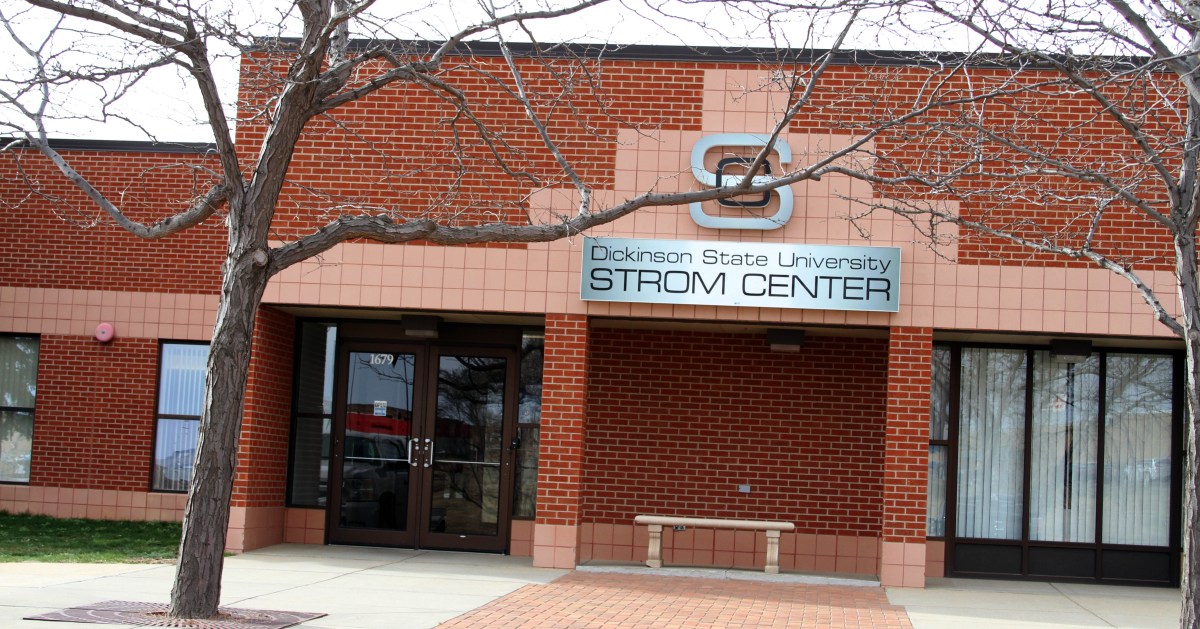
DSU shuttering Strom Center: Grant funding struggles, foundation dissolution led to entrepreneurship center’s closure

Ray Ann Kilen said she cried as Dickinson State University President Tom Mitzel told her the university would be closing the school’s Strom Center for Entrepreneurship and Innovation.

Still, the Strom Center director said she understood the “business decision” the university was forced to make.

“At the end of the day, you have to take care of the core business, which is the university,” Kilen said. “I commend him (Mitzel) and I don’t have any criticism of his decision based on the business decision that says we have to take care of the university first.”

The Strom Center, which opened in 2007 in DSU’s off-campus building in north Dickinson, will close April 11. It has four full-time employees, including Kilen, a part-time administrative worker and two student interns.

The Strom Center is financed through a mixture of state, federal and private grants, and is not accounted for in DSU’s operating budget — which was recently slashed $1 million because of state-mandated 4.05 percent across-the-board cuts.

“It’s a difficult economic time,” Mitzel said. “Grants aren’t easy to pursue. They haven’t been able to uphold that end of the business.”

Kilen said the Strom Center was also no longer receiving endowment funds that had been channeled to it through the old DSU Foundation, which is in financial receivership.

“Had we not lost our support through the foundation, we wouldn’t be having this conversation,” Kilen said in an interview.

Kilen and Mitzel said while grant money was slowly trickling in, it wasn’t coming fast enough to sustain the Strom Center’s operation.

“We knew that we were upside down financially,” Kilen said. “There’s no doubt about that.”

The Strom Center was started through donations by DSU alumni Jerome and Rosie Strom and local businesses. Its goal was to help revitalize the southwest North Dakota economy by encouraging entrepreneurs.

Kilen said she estimates that since it opened, the Strom Center has impacted about 1,500 businesses and helped 200 small businesses get started. She also estimates the center has helped small businesses access a combined $100 million in lending capital.

The Strom Center also houses the regional office of the Small Business Development Center, TechWest, as well as other state-based business programs.

Mitzel said DSU will work to transition services the Strom Center provides to departments on DSU’s campus.

“We’ll be reaching out to all the main entities and the services it has been providing to keep them going,” Mitzel said.

Kilen said she’s still committed to DSU and the Strom Center’s initial mission, and hopes to help assure its work isn’t undone because of its closure.

“My commitment has always been to the people we serve,” she said. “I love what I do and I feel very passionate about the industry I work in and the clients we’ve supported. My next step would be to talk to partners to understand where those new relationships can be built so the people we serve can continue having services.”


Sax Remodels Downtown Building Into Custom and Detailing Center

When Sax Motor Co. left downtown Dickinson three years ago for a shiny new dealership in the north business district, owner Pam Kostelecky was adamant about keeping the unique and recognizable brick building in the company.

“We were approached by many entrepreneurial and semi-entrepreneurial ideas of how people saw this space,” she said.

Some envisioned the building — on the corner of Third Avenue West and Villard Street, the two most heavily traffi cked streets in Dickinson

— as a brewery or a restaurant. Others saw a prominent commercial space with two fl oors, offi ces and lots of storage space.

Kostelecky, however, said she couldn’t let the building and its history transfer to someone else.

So, when Sax Motor began running out of space it needed for detailing and customization work at its new dealership and shop off 21st Street West, the company saw an opportunity at the place they had called home since 1952.

And with that, Sax Customs was born.

“It was just good timing,” said Christian Kostelecky, Sax Motor’s general manager and Pam’s son.

The amount of business brought in by the oil boom left Sax with less shop space than it initially planned in its new building, and that demand necessitated by oilfi eld companies and those related to the industry for add-ons such as toolboxes, grill guards and even more durable fl oor mats led to the opening of Sax Customs, Christian Kostelecky said.

While that business has obviously tempered with the oil industry’s slowdown, it’s still a big part of what Sax Customs has been doing since it opened in November 2014.

“I love it. It’s really nice,” Sax Customs Manager James Rixen. “To have the space we have now, compared to the space we had in the old building — we’ve got a lot more space.”

In the shop area, dozens of boxes sat ready to be unpacked on a recent weekday afternoon while WeatherTech fl oor mats were stacked in the basement storage. New shipments of those, which Rixen said is one of the most popular items, come in more than once a week.

There’s a detailing center on the southwest side of the shop, where used cars the dealership acquires via tradeins are sent to be cleaned before being put on the lot. The only major change inside is that a wall was constructed for a car wash.

Dale Johnson, who laughs and says he can’t count the number of years he has worked for Sax, spends most of his day installing bedliners.

The Sax Customs shop remodel gave him two sprayon bedliner booths to work in, and he’s constantly doing just that. Johnson said someone can do two pickup bedliners in one day, “if you’re fast, if you’re at it.”

Pam Kostelecky calls Johnson “the best in the business,” before smiling and admitting her obvious bias. She may not be far off though. Johnson is serious about his craft.

“You don’t want to rush anything because then you start getting sloppy and the workmanship isn’t there,” he said. “The end result, if you have to redo something, it’s not worth it.”

Pam Kostelecky said she’s proud that the building has found a new use, since she believed the dealership and the town had mutually outgrown the space.

“We needed to have customer convenience for getting in and out of the building,” she said. “The community had grown so much that we were having challenges meeting customer needs at this location.”

Sax sold its sales building across Villard Street to American West Real Estate, but kept the storage warehouse and parking area it leases from BNSF Railway.

Outside, the building has undergone a slight redesign, with a new brick exterior meant to better blend in with downtown.

“It gives it some dimension and, I think, a little more prominence on that corner,” Pam Kostelecky said.

KO Construction did the bulk of the work, she said, and even helped remodel the upstairs offi ces, which come complete with a separate entrance, into a new space that the Kosteleckys plan on leasing.

“We tried to keep as much original as we could,” Pam Kostelecky said.

Bowman’s Steve Brooks balances ranching with role as ND Stockmen’s Association president

BOWMAN — Skeeter Brooks is getting an education not only in ranching, but also the often unseen business that happens outside of the corrals.

The 25-year-old is part of the sixth generation at Brooks Chalky Butte Angus Ranch, and said her ranching education is growing every day — particularly through her father Steve Brooks’ role as North Dakota Stockmen’s Association president.

“We learn a lot from it,” she said. “Every day, somebody might call and they’ll have a question about brands or something, so that furthers us in our education. You meet so many people too. There’s always people stopping by. When you go somewhere, you always run into somebody.”

Steve Brooks — who runs Brooks Chalky Butte Angus Ranch north of Bowman with his brother, Ryan, and their families — has spent a lifetime ranching. But for the past year and a half, he has also taken on the leadership role among cattlemen in the state. Though the position forces him to balance his time between working on the ranch and on behalf of his peers throughout the state, Brooks said he’s pleased with what he’s been able to accomplish — even if it keeps him very busy.

“Being president of Stockmen’s has involved a lot more than I realized,” he said with a laugh, noting he was also president of American Angus Association in 2003. “That was a big job, and I thought this was a step down and a lot less time consuming, but it’s not.”

During last year’s legislative session, Brooks said he drove from Bowman to Bismarck a dozen times. He’s taken trips to Washington, D.C., to meet with the state’s Congressional delegation and others in the agriculture industry.

And he does all of it while operating the 109-year-old ranch that’s gearing up for its annual production sale April 2 in Bowman. They’ll be selling about 180 bulls that day, as well as 1,000 of their customers’ bred heifers.

“It’s a lot harder to get away,” he said.

As Stockmen’s Association president, Brooks has lobbied against government overreach in the country-of-origin labeling (COOL) program for marketing U.S. beef, helped ensure a beef checkoff rate increase from $1 to $2 a head to help with the program’s long-term sustainability, represented southwest North Dakota landowner interests in a debate against the Bureau of Land Management over the classification of the sage grouse as an endangered species, and lobbied against the controversial Waters of the U.S. rule that would allow the federal government, namely the Environmental Protection Agency and the U.S. Army Corps of Engineers, jurisdiction over most of the nation’s bodies of water — including waters on private land.

The most recent issue he’s working through is how a change in state tax law has affected the way counties can charge property tax on those leasing state school land, which is done mostly for use as pasture.

“We’ve been working on some of that to get that straightened out,” Brooks said, adding the Stockmen’s Association is seeking the state attorney general’s opinion on the matter.

He also said the Stockmen’s Association is aiming to increase brand fees 50 cents soon because of increases in its health insurance and salaries that help keep the association competitive in the job market.

Brooks said it’s a good time to be an established cattleman in North Dakota.

“Last year was the best market we’d ever seen in the history of cattle in the U.S.,” he said. “We turn around and it’s dropped 60-70 cents a pound and we’re still in the second-best market we’ve been in.”

And at the end of the day, that’s who Brooks is — a cattleman who is doing what he can to ensure more family ranches and farms stay afloat.


JE Dunn building the state

With the oil boom in full swing, Marc Mellmer saw the possibilities for growth and looming building projects in western North Dakota, and he wanted JE Dunn Construction to be a part of it.

Nearly three years and more than 20 building projects later, the 31-year-old construction operations coordinator sits in his sensible, windowless office in one of the city’s newest buildings — one his firm had no hand in building, he notes with a laugh — and said despite the economic downturn in North Dakota set off by plunging oil prices, business is still looking good.

“I’ve been asked a million times, ‘Why would JE Dunn put an office in Dickinson, N.D.? That just seems crazy. Why would you do that?’” he said with a smile. “But our goal was to touch the entire state, and we’ll continue to touch the entire state and create relationships.”

This year, JE Dunn will begin or continue work on — among its many projects — the North Dakota governor’s residence and the new Bank of North Dakota Financial Center in Bismarck, Harold Newman Arena in Jamestown, and the Trinity High School reconstruction and expansion, a project near to Mellmer’s heart as he’s a graduate of the Dickinson Catholic school.

Mellmer graduated from Trinity 13 years ago and went on to earn his degree in construction management at the University of Minnesota. He was working for JE Dunn on the Sanford Health Clinic in Detroit Lakes, Minn., when he began pushing for the company to bid on projects in booming Dickinson.

“I requested that we begin to chase projects in western North Dakota, and it was made my primary responsibility to not only pursue the projects I wanted to back home, but also take them from the pre-construction all the way through the completion and warranty phase of projects,” Mellmer said.

So far, Mellmer and his team are doing just what he set out to do.

JE Dunn came to the area in 2011 to build the Mercy Medical Center Birthing Center in Williston, where they’ve had an office since 2012. Not long after that, the company was awarded building contracts for the $70 million Williston Area Recreation Center and the $100 million CHI St. Joseph’s Health campus in Dickinson.

“When we were about halfways through St. Joe’s hospital project, we decided we needed to open an office in Dickinson,” Mellmer said. “What anchored those projects like that were not only the fact that we were building those two big jobs, but also servicing those buildings and staying close to the owners and being committed to the area — to both Williston and Dickinson — after we completed the projects. And then the smaller projects started to spawn off of the two big anchor projects.”

Mellmer said what makes the JE Dunn Dickinson and Williston offices unique within the company is that they chase projects across in the entire state.

“The logistics of the North Dakota offices are different than the logistics of any of our other offices in the country,” he said. “They’re all in metropolitan areas, where you have a certain radius of work that keeps the business afloat. We think of North Dakota as a client. That’s been our motto from day one.”

JE Dunn, which is headquartered in Kansas City, Mo., has 22 offices in cities across the nation. It’s two smallest are Dickinson and Williston. Between the two Oil Patch hubs, the firm has about 20 full-time employees, and Mellmer said at any given time, it can employ 10 to 15 more specialists working in the state for up to two years at a time. Most of its work is done by local subcontractors.

“We thought it was in the best interest of us and our clients to open a physical office and hire local people to work for JE Dunn,” said Mellmer, a Dickinson native. “And also import our people to become local residents of western North Dakota and commit to the area.”

The newest employee is Michael Murphy, a project engineer and recent graduate of North Dakota State University who’s doing pre-construction work on the planned Newman Arena

Murphy, from Fargo, works in the Dickinson office but said he’ll be traveling around the state regularly once the arena project begins. He said he was convinced to join JE Dunn after speaking to the firm’s representatives at a job fair.

“The Dickinson area, at the time, was a very expanding market,” he said. “With the recent oil declines, the construction is still going strong. Being a new hire here, it’s a good opportunity.”

Other employees, like project coordinator Melissa Gjermundson, have been around the area their entire lives. She said working for JE Dunn has been a good fit.

Gjermundson came on board after spending time working for Dickinson’s planning and zoning office, Marathon Oil Co., and as a Dickinson Police Department dispatcher. She met Mellmer while working for the city shortly after its leaders decided to build the Public Safety Center — the new police and fire station that’s now the workplace of her former dispatch co-workers. At JE Dunn, she primarily works with subcontractors.

“I make sure they get their contracts,” she said. “I make sure they’re compliant and I make sure that they get paid.”

Having a strong stable of subcontractors is vital to JE Dunn’s success in western North Dakota, Mellmer said.

When the firm moved first started working in North Dakota, he said the oil boom made it difficult to hire top-quality subcontractors.

“The biggest successes were building the hospitals and the Williston recreation center at the peak of the boom, when contracting was at it’s highest level of difficulty,” Mellmer said. “From then, being able to transition to do smaller projects and more of what I’d call normal-size projects for western North Dakota, we’ve made a really smooth transition to become economic in building those projects and really creating relationships with our owners of these smaller projects, which seem to be difficult for a large corporation.”

Because the firm planted roots during the oil boom, Mellmer said he knows projects will become fewer and farther between with the state in an economic slowdown. He said that just means JE Dunn will have to venture out of western North Dakota more often and seek contracts in cities like Fargo and Grand Forks.

“That’s where we hold our ground and stretch our wings even further, and chase projects down every rabbit hole,” Mellmer said.

He said JE Dunn doesn’t view itself as a construction firm that only chases huge projects, and notes that the slowdown has afforded it the opportunity to do work that means a big deal to some small towns.

He pointed to the projects such as a new classroom and library at the Home on the Range near Sentinel Butte, the Killdeer Aquatics and Wellness Center that’s nearing completion, and the Flasher High School and Gymnasium.

All are small projects compared to JE Dunn’s usual scale, but Mellmer described them as fun and a positive experiences because of the response the firm receives from the small communities.

“We’re not too big or too proud to chase and work in any town, on any project, of any size,” he said.
‘Crossing’ into new territory: Oilfield entrepreneur enters restaurant business with new steakhouse

Seth Murphy knows next to nothing about running a restaurant.

But he knows what he likes: great food, a place he can both bring his family and conduct business, and a venue that can be used to give back to the community.

He wants The Crossing to provide all of that and more when it opens next summer.

The Dickinson oilfield entrepreneur said he isn’t letting the western North Dakota energy industry downturn keep him from diversifying his business ventures.

“Everyone says it’s a hard industry, and I’m sure it is,” Murphy said of the restaurant business. “But hard is a relative term. Not everybody deals with what we deal with by 5 a.m. every morning either.”

Murphy, the president of oilfield service company SM Fencing, said he wanted to start a business separate from the energy industry that would be able to provide an amenity to southwest North Dakota community.

He and his company believe they’ve found that opportunity with The Crossing, an 11,000 square foot steakhouse and bar under construction on north State Avenue near the Sierra Ridge apartment complex.

Kodee Gartner, the management director of Endeavor West — Murphy’s latest business entity that will function as the operations arm for The Crossing — said being a part of the team starting the restaurant has been rewarding in that they’ve been able to start with a blank canvas and move forward independently.

“What is our vision and how are we going to get there?” she said. “There is no blueprint. This is us sketching it out on a kitchen table, and trying to figure out what this is going to look like and how this is going to go. One of our biggest advantages is our team is deep in common sense.”

When complete, The Crossing will have two levels and ability to seat around 270 people.

Beyond that, Gartner said, The Crossing will have two private conference rooms able to provide space for everything from parties to board meetings, and another area she said can be called a “multi-use space.”

“We want The Crossing to be where people celebrate their life’s biggest moments,” Gartner said.

While the group’s main focus is to bring another dining opportunity to the area, it also hopes to use The Crossing as a philanthropic entity.

Gartner, who like Murphy is from the Killdeer area, was brought on board a little over a year ago and she was sold on The Crossing, in part, because of Murphy’s wish to conduct more philanthropic efforts.

“When I started on, what was appealing was he’s looking for a legacy impact,” she said. “… That’s part of the Crossing’s DNA is there will be social good woven into it.”

Gartner said The Crossing wants to be known as a gathering hotspot and the restaurant of choice for locals, both old and new, and be able to cater to changing social demographics.

“It isn’t a goal to build this to service the oilfield if and when it comes back,” Murphy said. “We’re building this to serve the locals that have been here that input good into the community. The agricultural segment is going to be a big part of what we play to.”

Ashley Lamphier, a business development specialist with Endeavor West, came to Dickinson from the Atlanta area through her friendship with Gartner. The two had worked together in the past, and after moving here, Lamphier said she fell in love with the area and her new company’s long-term plans, starting with The Crossing.

“I really see it as becoming almost a cornerstone of the community,” she said. “I think it’s going to be a big place where people can gather.”

As for the food, Murphy said he wants The Crossing to be as meat and potatoes as it gets, catering first to southwest North Dakotans and staying away from “fancier” entrees. A “simple menu” is planned.

They hope to have a general manager hired this week. That person will be charged with hiring around 30 employees, and running the day-to-day operations of The Crossing.

Murphy said he hopes to hire a manager he can trust to implement a strong work ethic while also being unafraid to try new things.

“None of us have restaurant experience,” Murphy said. “We know what we like. We purposefully didn’t bring anyone into the team that had restaurant experience because the way you’ve always done it is not always the right way. Just because it’s been done one way for 30 years doesn’t mean it can’t be done better.”