
Decker's attorney moves to suppress sexual abuse interrogation confession

The attorney for a Dickinson man facing life in prison for allegedly sexually abusing a 6-year-old female relative asked a judge to suppress state’s evidence of a police interrogation video that shows his client confessing to the crime.

Gregory Paul Decker, 53, who is facing charges of continuous sexual abuse of a child, a Class AA felony, took the stand Tuesday before Southwest District Judge Dann Greenwood after watching his 30-minute interogation video from Jan. 1.

The video shows Decker admitting to the allegations without prompting and within minutes of being interviewed by Dickinson Police Cpl. Brandon Stockie. According to court documents, Decker allegedly touched the girl on her private areas “five or six” times during 2015.

Tuesday’s hearing represented one of two cases against Decker for continuous sexual abuse of a child. The other alleges that in 1997 and 1998, he engaged in approximately 10 sexual acts within another female relative who, at the time, was between 6 and 7 years old.

Decker was arrested the morning of Jan. 1, his birthday, just hours after Dickinson police were called to his home after reports of a fight.

Following an evening with family and friends to celebrate he and his wife’s birthdays, Decker was confronted about the alleged abuse and then punched in the face by a man, who has not been identified by the court other than being a family acquaintance. Decker was taken to CHI St. Joseph’s Health sometime after 12:30 a.m., received stitches around his eye and was then released to police, who took him to the Public Safety Center for questioning about the incident.

Decker’s attorney, Michael Hoffman, alleges in the motion to suppress that Decker did not understand that Stockie, the lead detective on the case, had read him his Miranda rights because he was in pain after being assaulted, was confused and had high anxiety, and knew he was being being called a child molester by family and friends. Hoffman also alleges Decker didn’t know why the detective was questioning him, and said the detective “stated he was there to get (Decker) help for (his) problem or addiction.”

Within about three minutes of being questioned by Stockie, and before the detective brought up the alleged sexual abuse, Decker asked him, “What do you want me to say, that I was molesting her?”

“Well is that what happened?” Stockie asked.

“Well, yeah,” Decker replied.

Decker and the girl’s mother were both questioned by Stockie, which led to Decker’s eventual arrest. After Decker admitted to sexually abusing the girl, he told Stockie he wanted to get help and said he had been sexually abused as a young child.

Decker told Stockie he feared that he would lose his wife and family, and that his home would be terrorized.

Hoffman argued that Stockie purposefully led Decker to believe he’d help him get counseling and didn’t lead him to believe he may be placed under arrest. Stockie said during questioning that he employed a ruse detectives frequently use to try and extract evidence from suspects, and that what he did was a legal interrogation tactic.

Hoffman later brought Decker’s intelligence into question, calling him a “vulnerable person.”

Assistant state’s attorney James Hope argued that because Decker was released by the hospital, he was fully capable of answering Stockie’s questions despite his injuries, and said Decker’s history shows no reason to believe he has any mental vulnerabilities.

Decker is being held at the Southwest Multi County Correction Center. He will have a pretrial conference June 14, and a jury trial is scheduled to begin July 6. He faces the maximum sentence of life in prison without the possibility of parole. A pretrial conference for his other sexual abuse charge is scheduled for July 19.

Burglar who shot himself in head after standoff gets probation

The Reeder man who shot himself in the head after a standoff with Dickinson police last December was sentenced to three years of supervised probation Monday during an arraignment at the Stark County Courthouse.

Jeremy Mellmer, 32, had a five-year prison sentenced suspended by Southwest District Court Judge William Herauf after the judge agreed to the Stark County state attorney’s deal to keep the severely injured Mellmer out of the corrections system.

“He shot himself in the head and left himself in considerable poor health, which will greatly impact his life going forward as well as the reality of any extended incarceration,” said James Hope, Stark County assistant state’s attorney.

Mellmer pled guilty Monday to theft of property and burglary charges, both Class C felonies, after breaking into the home of Dickinson resident Bernard Deichert and stealing approximately $3,000 worth of firearms and other items on Nov. 24.

Mellmer, who wore a large neck brace and an eyepatch over his right eye, spoke in a gravely voice and mustered only one-word answers when responding to the judge’s questions.

Herauf said he was concerned about the proposed sentence, but agreed to keep Mellmer’s health burden out of the state’s hands.

“I’m going to go along with what’s been worked out, otherwise the state is faced with the problems that your health creates,” he said, before speaking directly to Mellmer about his future. “We’re not having this conduct again. None of it whatsoever.”

Joseph Mrstik, Mellmer’s court-appointed attorney, spoke on Mellmer’s behalf before Herauf agreed to the sentence.

“Through his own actions, Mr. Mellmer has significantly limited the ability to live his life and, frankly, if it weren’t for his father, he’d probably be out on the street and not doing very well,” Mrstik said. “My point is, he’s basically just taking it one day at a time, trying to make up for lost time and appreciating the fact that he’s still here.”

Mellmer escaped police during a traffic stop on Nov. 30. Police searched for him until Dec. 2, when they surrounded a house on the 900 block of Ninth Street East. The standoff ended when Mellmer shot himself. He has not been charged for that incident.

However, Mellmer is not done with court appearances.

He will have pretrial conference July 5 on charges of possession of marijuana with intent to deliver, a Class B felony, and possession of methamphetamine paraphernalia and carrying concealed firearm or weapon, both Class A misdemeanors. A July 20 trial is scheduled.

Hope said the state has few concerns about Mellmer committing further crimes following his final sentencing, solely because of his health.

“We’ll monitor his health condition and see how his recovery goes, and whether the health condition he has now is permanent,” Hope said in an interview.

Western North Dakota energy service leaders, legislators optimistic after oil conference

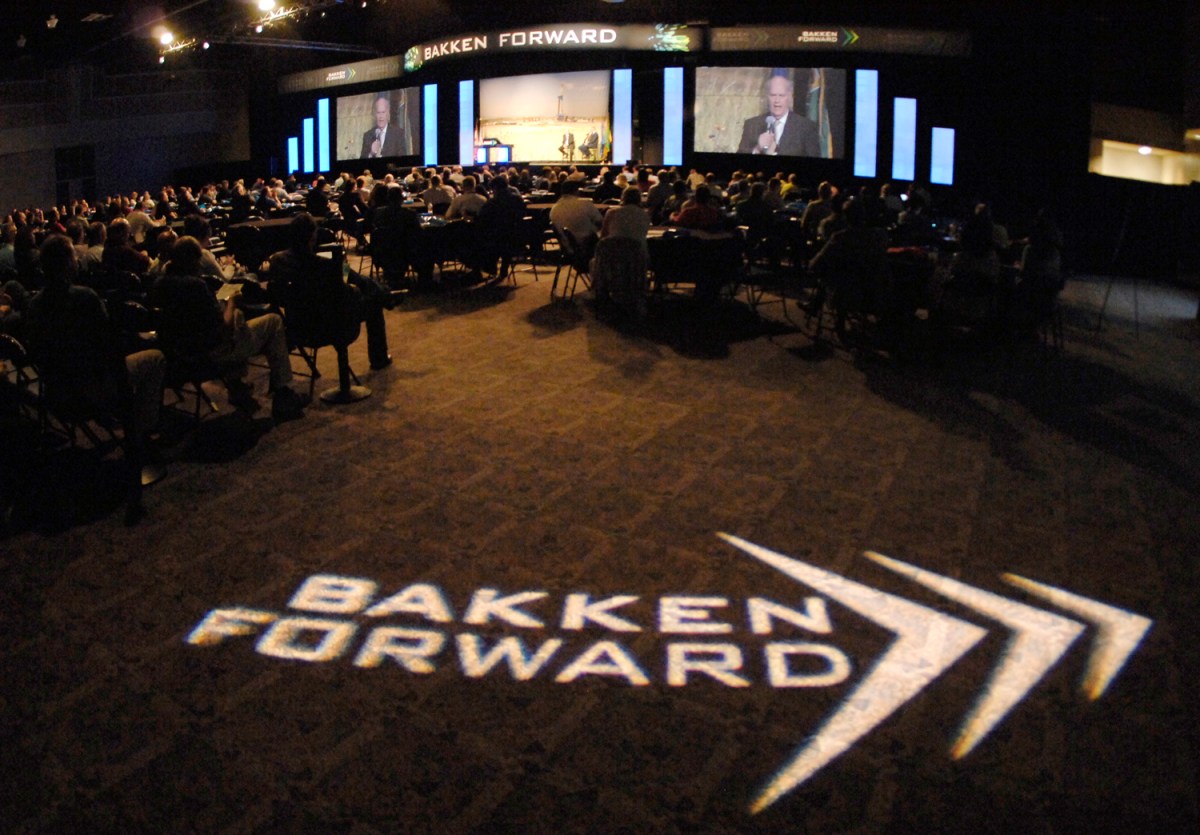
BISMARCK — As the price of oil hovered around $50 a barrel last week, many western North Dakota oilfield and energy service companies turned to the Williston Basin Petroleum Conference to try to get a feel for where their industry is headed.

Most said they now feel better about the future of their businesses, as do state legislative leaders.

“What stood out to me was really the positivity,” said Matthew R. Kostelecky, president of B. J. Kadrmas, a Dickinson oilfield service company. “I really thought we’d be coming here with a lot of doom and gloom, obviously. But after listening to a lot of these CEOs and important people in business, it really just seems like this is the time to be efficient, smart, creative, kind of weather the storm, and it’s all going to come back.”

The past two years have been the 37-year-old Kostelecky’s first oil price downturn. He took over the business midway through the boom, only to watch work slow after a couple years. He paid close attention to what Whiting CEO Jim Volker and ConocoPhillips Lower 48 President Don Hrap said when they spoke at the conference.

“The attitude is that ultimately there’s a positive outlook for the future, but I think this is a new normal,” Kostelecky said. “For my generation, this is the first time that we’ve seen this. So it’s new to us, but the industry veterans, they’ve been there, they’ve done that. It’s just like anything else. You have to get past these difficult times.”

State Sen. Kelly Armstrong, R-Dickinson, said he felt conference attendees left invigorated by Thursday speeches from Republican presidential candidate Donald Trump and former college football coach Lou Holtz.

He said Trump’s energy platform resonated with the industry folks in the building, and tied into themes he heard throughout the week.

“We need consistent, reasonable regulation that protects the environment while allowing people to do business,” said Armstrong, the NDGOP chairman and son of Dickinson oilman Mike Armstrong. “All they want is tax certainty and regulatory certainty. That’s what they want. Especially for some of these tertiary things for the oil industry.”

Along with an industry push for better regulations, innovation at the wellhead and the future of value-added petroleum byproducts and industries were focused on throughout the week.

North Dakota Senate Majority Leader Rich Wardner, a Dickinson Republican, sat through multiple sessions, listening to everything from the future of natural gas liquids to industry price predictions. He said he feels that while recovery may time some time, “things are looking up for the industry.”

“I heard this: $65 oil is the new $100 oil because they’ve now got so many efficiencies,” Wardner said. “Technology is moving forward in allowing the industry to get more oil out of the rock.”

Paul Steffes, CEO of Dickinson-based Steffes Corp., said many industry leaders anticipate gradual uptick in work. Hearing that, he’s a more enthusiastic about business prospects.

Steffes Corp. manufactures equipment used at the wellhead during the extraction process, most notably its engineered flare systems that have decreased the amount of natural gas flared throughout the Bakken.

Steffes said he spoke with several people who said their companies will need more equipment to support their drilled but uncompleted wells (DUCs) once they’re put into production.

“It certainly has a possibility that we could be spiked and be much busier than we have ever planned we were going to be, as soon as they finish these DUCs,” he said. “It is possible that we’ll be busier than we’ve ever been. That is kind of a scary thing.”

KC Homiston, the co-owner and president of Highlands Engineering in Dickinson, said he’s accepted the oil industry’s “new normal.”

The oilfield aspects of Highlands’ business have declined during the slowdown because, as a civil engineering and land surveying firm, they service companies who put up rigs. There are less than 30 rigs in North Dakota today. Throughout much of 2014, there were more than 190 rigs.

“That’s the bread and butter of what we do for them,” Homiston said. “A lot of our work is dependent on the number of rigs that were in play.”

Homiston said he thought the conference had “less buzz” and fewer people compared to the one he attended in May 2014, when the price of a barrel of oil was around $109 and there were 191 drilling rigs in the state. Still, he’s more optimistic about the industry than he has been.

“You talk to people, I think they still have a smile on their face and they think the long-term optimistic conversation is still there,” he said.

Homiston said he anticipates a slow uptick in business once DUCs starting going into production.

Referencing speeches given by from MBI Energy Services CEO Jim Arthaud and other industry leaders, Homiston said the overarching message from the conference was simple.

“Hang in there. It’s coming back.”

Hoeven, fertilizer dealers oppose anhydrous restrictions

North Dakota politicians and agriculture leaders say a “reinterpretation” of U.S. Department of Labor rules may lead to one-third of North Dakota’s fertilizer retailers eliminating anhydrous ammonia sales.

U.S. Sen. John Hoeven said he is working with the state’s Department of Agriculture, producer organizations and fertilizer sales dealers to kill the proposed change that would hold 275 small fertilizer retailers in the state and around 3,800 nationwide to the same standards as much larger warehouse wholesalers, thereby raising costs for the retailers and, in turn, farmers.

Hoeven said around 90 North Dakota fertilizer retailers have stated they’d be likely to eliminate anhydrous ammonia sales if the new standards are put in place. Anhydrous ammonia is the primary nitrogen fertilizer used by North Dakota farmers.

Ron Kessel, a sales representative at Helena Chemical in New England, said while his company wouldn’t have to eliminate anhydrous sales, “it would change how we do business.”

Last July, the Occupational Safety & Health Administration released a memorandum titled “Process Safety Management of Highly Hazardous Chemicals and Application of the Retail Exemption,” detailing its revised interpretation of rules for exempting retail fertilizer facilities from the same standards larger fertilizer warehouses are held to. According to the memorandum, the change is tied to President Barack Obama’s executive order to improve chemical facility safety and security following the West, Texas, explosion in April 2013.

“You’ve got people out here trying to farm — it’s a tough time for farmers because of low commodity prices — and they come out with these rules and regulations and say it’ll cost a couple thousands, and that’s not true at all,” Hoeven said.

Gary Knutson, executive director of the North Dakota Agricultural Association, said he’s still waiting for answers for why the changes are necessary, as well as a breakdown of costs associated with the proposed changes.

“Bottom line is, we’re looking for answers yet,” Knutson said.

Hoeven said OSHA and the Department of Labor haven’t been transparent with the costs that would be associated with storage improvements southwest North Dakota retailers would need to make to be in compliance with the reinterpreted rules.

OSHA documents state the cost, on average, would only be around $2,100 per facility. But Hoeven and others vehemently dispute that.

The senator said OSHA denied a freedom of information request sent by state Agriculture Commissioner Doug Goehring’s office asking about details for how it came to the $2,100 figure.

“That’s not right,” Hoeven said. “It’s going to cost them more than 10 times that.”

Delane Thom, the general manager for CHS Southwest Grain near Taylor, said he figures his company would have to spend more than $100,000 to upgrade its nine anhydrous ammonia distribution sites, and that’s “just the tip of the iceberg.” He added he’ll have a more concrete idea of how much his company would be spending after a third-party assesses its locations for compliance changes.

Should the regulations go through, Thom said Southwest Grain would have no choice but to pass the costs on to farmers, and said discussions would be had about closing some of its satellite anhydrous locations.

“That’s not our intent, but we’ve just got to make a business decision at that point and see if it feasibly makes any sense,” Thom said.

Kessel and other North Dakota’s fertilizer retailers say they already have strict regulations on how they must store and distribute hazardous materials, and the new regulations would force them to pass additional costs along to farmers and producers.

“We want all of employees and our farmers in our local communities to be safe,” he said. “We’re very concerned and cognitive of that. We don’t know that these additional regulations are going to make it any safer without adding a bunch of additional costs to it.”

Kessel said another area of safety concern being raised by retailers is that if some satellite anhydrous retail sites around the state were to close because of the new regulations, it’d create a more direct hazard because many farmers would be putting anhydrous tanks on the road for longer periods of time.

Under North Dakota law, the heavy anhydrous tanks cannot be hauled at more than 25 mph.

“If you actually have nurse tanks being pulled that much further and through that much traffic, I think it’s going to add some safety concerns,” he said.

Thom said he could foresee farmers — some of whom have invested hundreds of thousands of dollars into purchasing their own anhydrous tanks — moving away from anhydrous ammonia and toward urea as their primary nitrogen fertilizer. However, he said, farmers need to use twice as much urea for it to have the same effect as anhydrous ammonia, which could add more costs to his and other businesses.

Hoeven wrote a letter to U.S. Secretary of Labor Thomas Perez on April 28 addressing his concerns. North Dakota Rep. Kevin Cramer in March was part of a bipartisan group of 41 members of Congress who requested the 2017 Labor, Health and Human Services, Education appropriations bill prevent using federal funds to implement new regulations on anhydrous ammonia facilities throughout the nation.

Hoeven said he’s likely to put a provision preventing the anhydrous ammonia regulations from being implemented in the Department of Labor’s 2017 funding bill.

“I’ll put legislation in to stop it if I have to,” he said.

City Sales Tax Income Weighs Heavy in Stark Development’s Request for Funding

A body the city of Dickinson helps fund through sales tax dollars got a cool response to its scheduled funding request during Monday’s City Commission meeting at City Hall.

Stark Development Corp. Executive Vice President Gaylon Baker gave a 35-minute presentation on the benefits his organization has had on the area before, during and after the oil boom.

However, Dickinson city commissioners had a tempered response when Baker asked for two more years of continued funding of $750,000 in city sales tax dollars — which is how the city currently helps fund Stark Development — with increases of $50,000 in 2019, 2020 and 2021. Baker’s figures, which culminated in a request of $900,000 for 2021, came with the caveat that sales tax income allows the city to do that.

Continue reading “City Sales Tax Income Weighs Heavy in Stark Development’s Request for Funding”