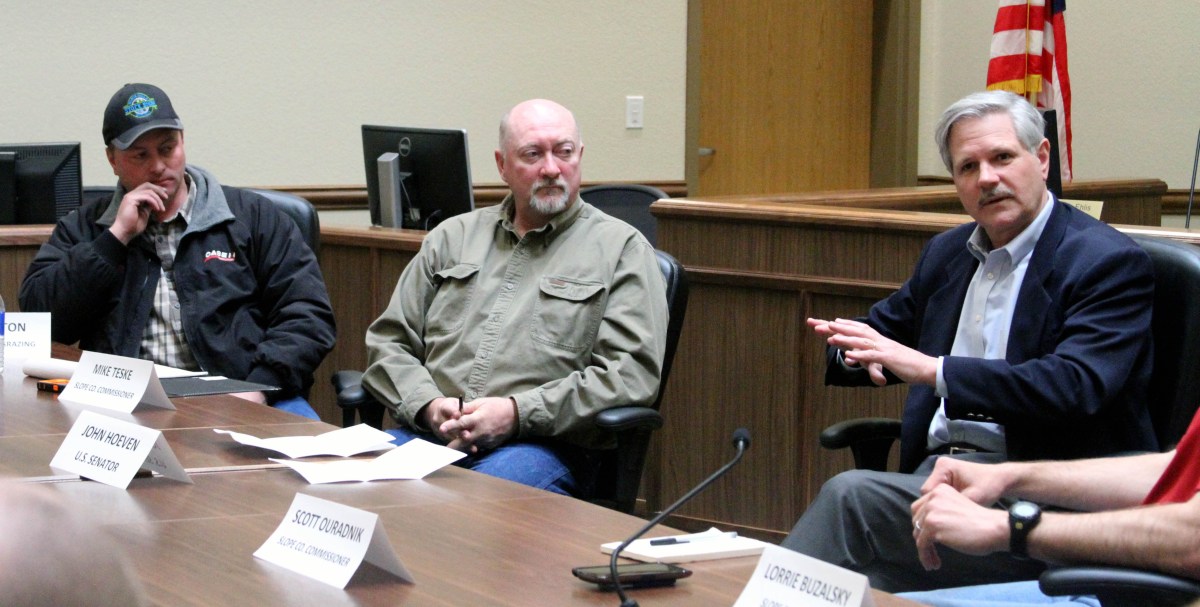
Slope, Bowman county leaders express frustration with federal overreach

AMIDON — Residents of the two most southwestern counties in North Dakota expressed their concerns and the perceived helplessness they felt about federal government overreach to Sen. John Hoeven on Monday during separate roundtable gatherings.

The Republican senator held hour-long meetings in both Bowman and Amidon to speak with county and city officials, landowners, ranchers and business leaders about a variety of topics that originate at a national level and affect them.

While many Bowman residents expressed gratitude for Hoeven’s work to secure grant funding for its $34 million hospital project and the new Bowman Airport, their leaders, as well as those in Slope County, railed on what they see as the federal government having too much of a say in what happens not only in North Dakota, but in their own backyards.

“It’s people like us who have little meetings that don’t make a difference anymore,” Lauren Klewin, a Slope County rancher and longtime board member for Slope Electric Cooperative, said during the Amidon roundtable.

Klewin spent nearly five minutes talking off the cuff about the variety of ways area residents feel hamstrung by federal bureaucracy and what he felt was increasing and all-but unstoppable overreach through the Obama administration’s Clean Water Rule and Clean Power Plan, as well as the U.S. Forest Service’s grazing plans.

“Regardless of who we ever have as a president, I feel like these federal agencies are running on their own,” Klewin said.

Hoeven responded by telling Klewin and others that some members of Congress and the court system continue to push back against the new carbon emission standards proposed by the Environmental Protection Agency, and noted the importance of who nominated to be the next Supreme Court justice.

“Is it going to be someone who reflects North Dakota’s interest or someone who reflects the Obama agenda?” Hoeven asked. “… We can’t constantly have the federal government coming in and putting all these regulations on us.”

State Rep. Keith Kempenich, a Bowman Republican who represents District 39 in the Legislature, spent time at the Bowman roundtable asking for Hoeven’s help curtailing federal regulations on coal-fired power and the politicizing of climate change research and science.

“They’ve completely walked away from the science of it,” Kempenich said. “They’re pushing an agenda. Are your colleagues understanding this, for the most part? That’s where it gets frustrating. Because that’s where it’s coming from, is 20 square miles on the East Coast.”

Hoeven said after the Bowman roundtable that the concerns he heard echo those of many North Dakotans.

“As I listen to people all over the state of North Dakota, that’s what they’re saying,” he said.


Powder River trade off

Rodney Schaff, chairman of the Bowman Airport Authority, thanked Hoeven for his work to secure $12 million in grants for the airport, which opened last May.

He also spoke about the Powder River Training Complex, a U.S. Air Force training area that encompasses a large area in southwest North Dakota and neighboring South Dakota.

“We don’t have anything against military training,” Schaff said. “I’m an old Air Force vet. … But we said there’s got to be trade off here too.”

Hoeven said the Air Force is waiting to conduct low-altitude flights in southwest North Dakota until the Bowman Airport has installed equipment that allows it to communicate with the national air traffic controllers about flight training being conducted in the area.

“This Powder River range is very important to the Air Force, but at the same time it’s got to work for general aviation,” he said in an interview after the Bowman roundtable.
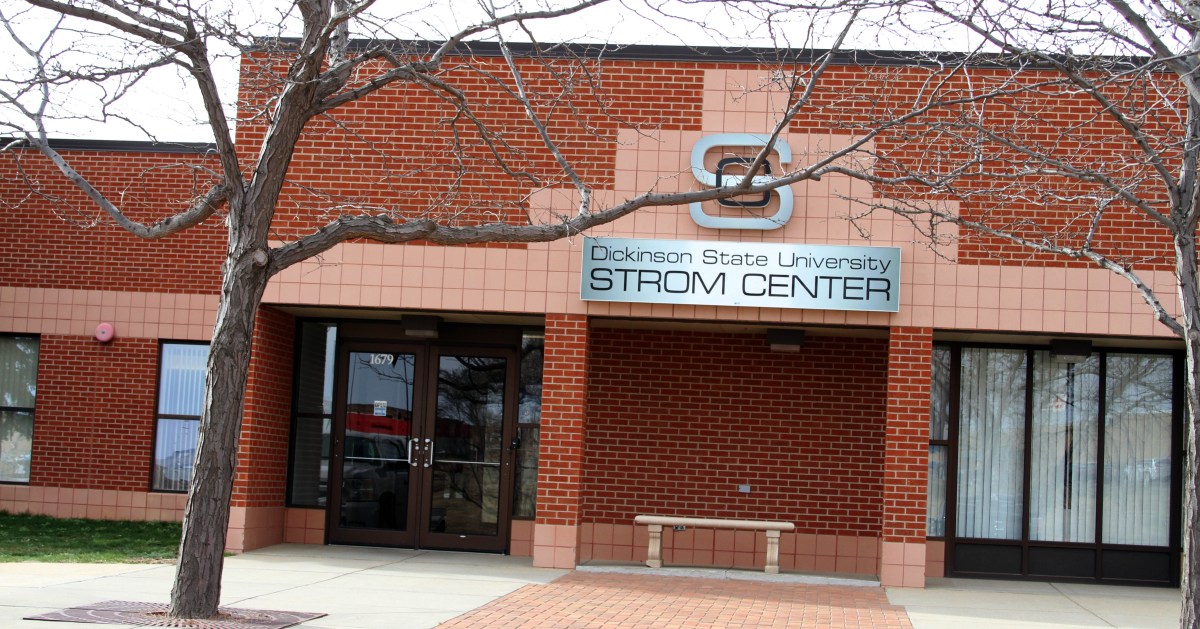
 

DSU shuttering Strom Center: Grant funding struggles, foundation dissolution led to entrepreneurship center’s closure

Ray Ann Kilen said she cried as Dickinson State University President Tom Mitzel told her the university would be closing the school’s Strom Center for Entrepreneurship and Innovation.

Still, the Strom Center director said she understood the “business decision” the university was forced to make.

“At the end of the day, you have to take care of the core business, which is the university,” Kilen said. “I commend him (Mitzel) and I don’t have any criticism of his decision based on the business decision that says we have to take care of the university first.”

The Strom Center, which opened in 2007 in DSU’s off-campus building in north Dickinson, will close April 11. It has four full-time employees, including Kilen, a part-time administrative worker and two student interns.

The Strom Center is financed through a mixture of state, federal and private grants, and is not accounted for in DSU’s operating budget — which was recently slashed $1 million because of state-mandated 4.05 percent across-the-board cuts.

“It’s a difficult economic time,” Mitzel said. “Grants aren’t easy to pursue. They haven’t been able to uphold that end of the business.”

Kilen said the Strom Center was also no longer receiving endowment funds that had been channeled to it through the old DSU Foundation, which is in financial receivership.

“Had we not lost our support through the foundation, we wouldn’t be having this conversation,” Kilen said in an interview.

Kilen and Mitzel said while grant money was slowly trickling in, it wasn’t coming fast enough to sustain the Strom Center’s operation.

“We knew that we were upside down financially,” Kilen said. “There’s no doubt about that.”

The Strom Center was started through donations by DSU alumni Jerome and Rosie Strom and local businesses. Its goal was to help revitalize the southwest North Dakota economy by encouraging entrepreneurs.

Kilen said she estimates that since it opened, the Strom Center has impacted about 1,500 businesses and helped 200 small businesses get started. She also estimates the center has helped small businesses access a combined $100 million in lending capital.

The Strom Center also houses the regional office of the Small Business Development Center, TechWest, as well as other state-based business programs.

Mitzel said DSU will work to transition services the Strom Center provides to departments on DSU’s campus.

“We’ll be reaching out to all the main entities and the services it has been providing to keep them going,” Mitzel said.

Kilen said she’s still committed to DSU and the Strom Center’s initial mission, and hopes to help assure its work isn’t undone because of its closure.

“My commitment has always been to the people we serve,” she said. “I love what I do and I feel very passionate about the industry I work in and the clients we’ve supported. My next step would be to talk to partners to understand where those new relationships can be built so the people we serve can continue having services.”


Column: Farmers Prepare for an Ugly Year

There’s volatility in the lifeblood of southwest North Dakota.

And I’m not talking about oil. People often forget how challenging life can be for family farms.

This year is poised to be no different.

In mid-March, myself and Brock White — my co-host on “Insight,” a weekly news talk show that airs on Consolidated Channel 18 and streams on The Press website — interviewed North Dakota Agriculture Commissioner Doug Goehring for 25 minutes about the upcoming planting season and the challenges North Dakota farmers are expecting this year. Goehring, early in the interview, put it bluntly.

“It is a bit depressing,” he said, laughing quietly before quickly turning serious.

I, like so many others in our area, grew up a farm kid and understand the importance farmers, ranchers and the agriculture industry have on our economy and our culture. This year, Goehring said, all signs point to struggles for many North Dakota farmers.

“We have a lot of farmers who, first of all, are very concerned — and have been for the past year and a half — about falling prices,” he said. “We’re to the point where it doesn’t even look like there’s a flashlight or any daylight at the end of the tunnel.”

Many balance sheets just aren’t penciling out for farmers this year, Goehring said. With current prices, most aren’t even looking at profi ts. Their projections show big losses.

Goehring and I even shared similar stories that we’ve heard about longtime North Dakota farmers who didn’t get approved for their operating loans by banks they’ve been going to for years.

In short, they’ve reached the point where it’s fi nancially uncertain if they can even continue farming. And for most, it’s the only livelihood they’ve ever known. All this is happening because of sagging commodity markets.

The price for 14 protein spring wheat — which is medium-quality — closed at $4.34 a bushel on Thursday. Hard amber durum was at $4.60. Those are extraordinarily low prices in today’s markets. Corn, sunfl ower, canola and soybean prices also are all low as farmers head into the planting season.

“You’re trying to fi nd that crop that’s not going to do as much harm to you,” Goehring said.

Most commodity prices are the same — or lower — than they were 20 years ago.

At the same time, operating costs for farmers keep going up. Machinery is more expensive, insurance prices keep climbing, fuel — while at fairly moderate price levels today compared to a couple years ago — still isn’t cheap.

Goehring, in our interview, mentioned an equipment dealer who had sold one tractor between last fall and this spring. That points out the obvious ways in how other livelihoods in our state are affected by farming.

On top of all this, we live in a world where farmers are expected to produce more and more food, which means more production from all farmers — not just those in North Dakota. While it may seem like a cliche point to make, if farmers can’t afford to farm, how are we going to feed 7 billion people (and growing)?

Goehring said his hope is that prices will begin climbing into the summer — possibly changed by weather, production in other ag commodity markets across the world or unforeseen issues altogether.

“We live off from hope,” he said, “and let’s face it, farmers are a unique breed. You live by faith and hope, because you don’t control the weather and you don’t control the markets. And those two things look like they could be rather volatile this year.”

Bighorn sheep count up 8 percent in western N.D. Badlands

The bighorn sheep population in the western North Dakota Badlands grew by 8 percent, according to a survey recently completed by the North Dakota Game and Fish Department.

Big game biologist Brett Wiedmann, who works out of the department’s Dickinson office, said the results are positive after the bighorn’s all-age die-off from bacterial pneumonia in 2014.

“To see an increase the year after the die-off began is a step in the right direction,” he said.

Wiedmann wrapped up the department’s count earlier this month. Game and Fish biologists count and classify all bighorn sheep in late summer and then recount lambs the following March, as they approach one year of age, to determine recruitment, according to a news release.

The survey revealed 292 bighorn sheep, a count that included 88 rams, 160 ewes and 44 lambs. Wiedmann said 76 percent of lambs survived the winter, an encouraging number.

The count is also a 3 percent increase from the state’s five-year average.

Thirty bighorns believed to be in the North Unit of Theodore Roosevelt National Park weren’t included in the count, and is a number that Wiedmann called an estimate.

A bighorn sheep hunting season is tentatively scheduled to open later this year, but only if there isn’t a recurrence of bacterial pneumonia. The season’s status will be determined Sept. 1, after summer population surveys are completed.

“As it stands right now, we’re pretty confident we’re not losing many adults at this point, so we expect to have a season,” Wiedmann said.

Wiedmann said the pneumonia virus can persist in a bighorn sheep herd for decades.

“We’re by no means out of the woods,” he said.

The northern Badlands population, which was hit the hardest by the die-off, increased 13 percent from last year, according to survey figures. However, the southern Badlands population was down 19 percent.

Adult mortality rates among the bighorns “slowed significantly” last year, and the lamb survival rate compensated for the adult losses of 2014.

“The bad news is that many bighorns are still showing signs of pneumonia, so next year’s survey will be important in determining if the state’s population is continuing to recover from the disease outbreak, or if the pathogens are likely to persist and cause a long-term population decline,” Wiedmann said in a statement.

Dr. Dan Grove, a Game and Fish veterinarian, said disease testing last winter revealed that pneumonia pathogens were present in 16 of 22 bighorns tested.

Killdeer Couple Faces Multiple Charges

KILLDEER — A rural Killdeer couple is at the center of multiple charges that allegedly involved drugs, explosives and a pet rattlesnake — all of which contributed to child neglect — after multiple law enforcement agencies executed a search warrant of their property Friday.

John J. Reiss III and his wife, Sara Brooke Reiss, have been charged with four felonies — including three Class C felony charges each of neglect of a child under the age of 5.

Dunn County Sheriff Clay Coker said both John and Sarah Reiss, as well as Shaun Paul, also of Killdeer, were arrested for possession of methamphetamine, a Class C felony, and meth paraphernalia, a Class A misdemeanor.

According to their respective criminal complaints, John and Sarah Reiss exposed their three children — ages 5, 3 and 2 — to meth, drug paraphernalia, explosives, assault weapons, unsafe and unsanitary living conditions, and people who were under the infl uence of illegal controlled substances. The child neglect charges were added Monday by the Dunn County State Attorney’s Offi ce while the Reisses both were being held at the Southwest Multi County Correctional Center.

The couple also each face a Class B misdemeanor charge of possessing a venomous reptile without the required state permit.

The reptile was a rattlesnake named “Richard,” according to the complaint. Coker said the Reisses have admitted to having kept the animal for several years.

John Reiss was arrested Thursday on an outstanding warrant for failure to appear in court on a suspended license charge. Paul, Sara Reiss and Philip McCoy, of Killdeer, were arrested Friday in the search. McCoy had an outstanding Dickinson city warrant.

At a farmstead owned by the Reiss family, Coker said, an improvised explosive device was also found and had to be disposed of by the Bismarck Bomb Squad.

Also located in the searches were livestock bearing illegally altered brands and weapons that had been modifi ed.

The Southwest Tactical Team, the Badlands Narcotics Task Force and the North Dakota Bureau of Criminal Investigations were part of the search, along with the Dunn County Sheriff’s Offi ce. The North Dakota Department of Game and Fish and the North Dakota Stockmen’s Association responded to the incident because of the animal crimes discovered during the search.

“A lot of fl uid things had to come together to do it safely,” Coker said.

Coker added that he anticipates there being more charges fi led and possibly more arrests stemming from information obtained from the search warrants.

“We’re still in the middle of developing some other cases,” he said.