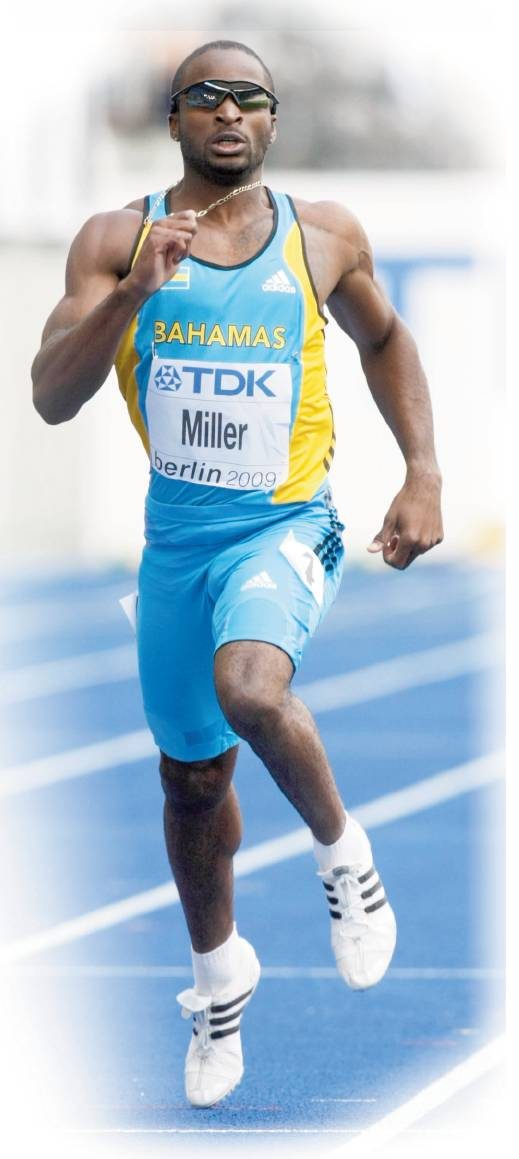
Having no coach hasn’t been a problem for Ramon Miller — he’s a 2-event Olympian

Editor’s Note: This is the last in a three-part series previewing Dickinson State alumni who are competing for the Bahamas at the Summer Olympics in London.

Ramon Miller has no one to blame but himself for how he performs at the Summer Olympics.

Miller is taking an approach that isn’t unprecedented. But it’s not one most world-class runners are known to take in their training.

For more than a year, the Bahamas sprinter and Dickinson State graduate has been without a proper coach.

It hasn’t seemed to hinder him either.

Miller has qualified for the London games in three different events — the 200 and 400 meters and as a member of the Bahamas’ outstanding 1,600 relay team. However, he only plans to compete in the 400 and 1,600 relay.

“This year, I’m doing everything on my own,” Miller said. “I’m sailing my own ship, so if anything goes wrong, I’m to blame. I’m the captain of everything right now.”

After leaving Dickinson in 2010 — two years after helping the Bahamas 1,600 relay team win a silver medal at the Beijing Olympics — Miller went to Orlando, Fla., where he began working with former U.S. Olympic team coach Brooks Johnson.

But, something just didn’t click between Miller and the veteran mentor.

“He’s a pretty good coach, but he just wasn’t my suit,” Miller said.

The difficulty of not being able to mesh with Johnson was compounded by back and hamstring injuries, turning 2010 into a nightmare for Miller.

“It was a real rough year for me,” Miller said.

It wasn’t without a couple of silver linings though.

In October of that year, Miller won a bronze medal in the 400 meters with a time of 45.55 seconds at the Commonwealth Games in New Dehli. One month later, he celebrated the birth of his daughter, now 20-month-old Rammonica.

In 2011, he left Johnson’s camp and has been mostly on his own ever since.

“I just wasn’t progressing like I wanted to,” Miller said. “I made a decision and I just started working on my own, doing what I did in Dickinson, which I know helped me. After I left him, I started to see an improvement.”

In August 2011, Miller won his heat in the 400 meters at the World Championships in Daegu, South Korea, with a time of 45.31 seconds. He finished just 13th overall. In October, he won another bronze, this time at the Pan American Games in Guadalajara, Mexico, with a time of 45.01 seconds.

That set him up for this year’s big push toward London.

He ran a personal-best time of 44.87 seconds in the 400 while finishing second to Demetrius Pinder in the Bahamas Olympic Trials and had an Olympic qualifying time of 20.5 seconds in the 200 at a meet in Tampa, Fla., in May.

Miller’s breakout season comes as no surprise to DSU head track and field coach Pete Stanton.

“Ramon has just taken off,” said Stanton, who coached Miller to 12 NAIA individual or relay championships. “He’s so talented and has such great work ethic. He knows where he wants to go.”

While Miller wants to challenge for the podium in the 400, he knows his best shot of earning another Olympic medal comes as a member of his countries’ 1,600 relay team. The Bahamas owns the fifth-fastest time in the world (3:00.56) coming into the Olympics. But, that time was set at the end of April, far from when any of the runners — Miller included — were at their peak.

“Me and the guys, we talk every day,” Miller said of his relay teammates. “We talk about how practice is going. We don’t even talk about the relay. Once we come together, everybody is healthy and we’re going to go after it and hope for the best.”

Miller opted not to run the 200 at the Olympics, saying he hit the qualifying mark while trying to test his speed and see if his training was progressing well. Plus, his time doesn’t rank high enough for him to be considered a medal contender.

Nonetheless, Stanton said to qualify for the Olympics in three events says much about the level at which Miller is competing.

“He’s just an extreme talent,” Stanton said. “When you take three events, how many people in the world can qualify in three events for the Olympics?”
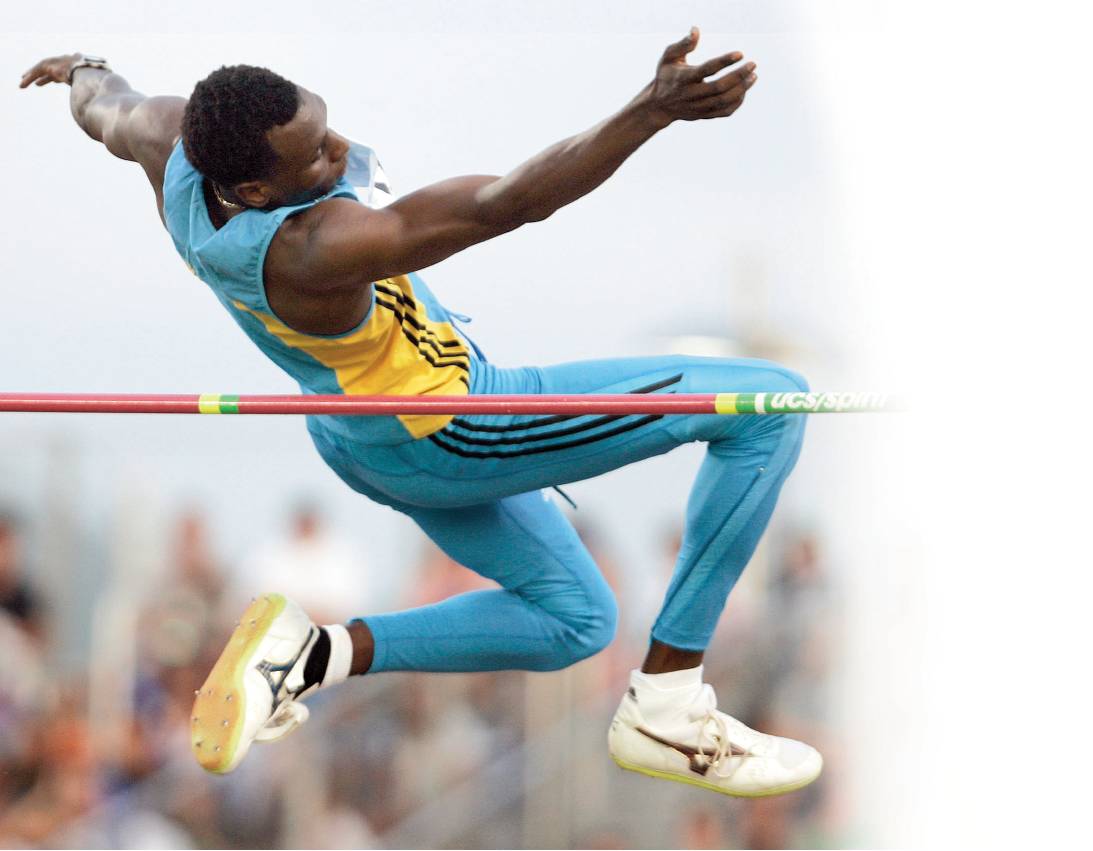

Steadily Soaring: After barely missing Beijing Olympics, Trevor Barry enters London as high jump favorite

Editor’s Note: This is the second in a three-part series previewing Dickinson State alumni who are competing for the Bahamas at the Summer Olympics in London.

One centimeter. It’s practically nothing.

But, one centimeter is all that kept Trevor Barry from qualifying for the Olympics four years ago.

One centimeter is also what has made Barry’s trip to the 2012 Summer Olympics in London so sweet.

“It’s kind of a redemption,” he said with a smile.

High jump is an athletic discipline that puts great importance on small increments and adjustments.

Little improvements, over a span of years, have helped the Dickinson State alumnus become one of the world’s best high jumpers.

He has reached 7 feet, 7 inches (2.31 meters) this season and hit 7-7¼ (2.32 meters) last September to win a bronze medal at the World Championships in Daegu, South Korea. Last year’s performance has Barry thinking big.

“I feel like I’m in good position to be a contender for a medal,” Barry said.

He has the right to feel good about his chances when the high jump qualifying begins Aug. 5. After all, he has come a long way in four years — even if all he has done is increase his personal-best jump by a seemingly meager 3 inches.

Still, it’s an amount DSU head track and field coach Pete Stanton said matters a great deal in the high jump.

“It’s a cliché: sports come down to inches,” Stanton said. “But it’s even more so in high jump. It comes down to centimeters.”

Barry, who helped DSU win NAIA national championships in 2004, 2005 and 2006, has been on the rise since barely missing the 2008 Olympics in Beijing.

He took a silver medal behind countryman Donald Thomas with a height of 7-6 (2.29 meters) at the 2010 Commonwealth Games in New Dehli. In 2011, less than two months before his bronze at the World Championships, Barry won gold at the Central American and Caribbean Championships by leaping 7-5¾ (2.28 meters). This year, the Mizuno-sponsored athlete ranks fourth in the Diamond League, a global competition for many of the top athletes in select disciplines.

“My story is not a Cinderella one,” Barry said. “It’s persistence and dedication.”

Getting to this point has been a steady climb, a journey Barry has done mostly on his own.

Living in Fargo, Barry generally works out alone.

He takes film of his practices and sends them to two coaches, world-renowned Bahamas track and field coach Keith Parker and Troy Kemp, an assistant coach at Northern Arizona who won the gold medal at the 1995 World Championships. Kemp helps Barry with his strength and training regimen while Parker keeps an eye on the technical aspects.

Training without any competition can be viewed as a drawback, but Barry said it works well for him.

“It’s kind of a mental thing,” he said. “Each athlete has their own preference. For me, I don’t have anyone to compete with. I don’t have anyone to set me back either. My limit is my limit.”

Since Barry arrived at DSU in 2003, Stanton said the eight-time NAIA champion — only two of which came in the high jump — has never lacked confidence.

That attitude, the coach believes, may play a major factor in London.

“The big thing Trevor has going for him is his consistency over the last year, and his confidence,” Stanton said. “He’s always been pretty confident, but now I think he knows the level that he’s at and where he’s going.”

If Barry has his way, he’s going to the medal stand after the high jump finals on Aug. 7.

“I have the confidence,” Barry said. “I know what it takes to compete at this level. Right now, anything is possible.”

Back on Track: After 2 years of setbacks, Atkins has returned to Olympics

Editor’s Note: This is the first in a three-part series previewing Dickinson State alumni who are competing for the Bahamas at the Summer Olympics in London.

There was a point, almost five years ago, when Derrick Atkins was sixth-hundredths of a second from being on top of the sprinting world. Somewhere along the line, though, he went missing in action.

Now, after four very quiet years, the Dickinson State graduate and Bahamas record holder in the 100 meters is back among the elite of a world he almost ruled.

His next stop is Olympic Stadium in London.

“A year or so ago, he was probably questioning whether or not he was going to be back,” DSU head track and field coach Pete Stanton said.

After failing to make the finals at the 2008 Beijing Olympics, Atkins stepped back from the limelight that found him after he won a silver medal at the 2007 World Championships. He raced a bit in 2009, clocking times far below what he was accustomed to.

Then, sometime in the middle of the 2010 season, Atkins disappeared from the international track scene altogether. He didn’t attend any major meets and sat out the entire 2011 season.

So what happened? Nagging knee injuries, Atkins said, were at the source of most of his problems.

“It took a while for me to get going again,” Atkins said. “It cost me the whole season.”

Now that he’s healthy again, Atkins has rediscovered the spark that nearly made him a world champion.

He punched his ticket to the Olympics with a 10.09-second run at a meet in Clermont, Fla., on June 9 and by winning the Bahamas national championship on June 22.

The 28-year-old returns to the games when the 100-meter heats begin Saturday, Aug. 4. “Basically, the focus was just trying to get back to competing and being competitive,” Atkins said.

Ramon Miller, a DSU alumnus who will race for the Bahamas in the 400 meters and 1,600 relay at London, was Atkins’ roommate during the Beijing games.

He said it’s inspiring to watch Atkins pick himself up when he could have easily hung up his cleats.

“This is a sport where injuries come,” Miller said. “Sometimes they knock you to the ground. It’s just how you pick up yourself. Everything takes time, but it heals up.”

Atkins said competition has always been his driving force.

It helped him claim seven NAIA national championships during his time at DSU and pushed him to new heights in 2007, the best year of his career.

Atkins’ career-best time in the 100 meters is 9.91 seconds, which came in the finals of the 2007 World Championships in Osaka, Japan.

American Tyson Gay passed Jamaican and former worldrecord holder Asafa Powell with roughly 30 meters remaining. As Powell slowed down, it allowed Atkins — who had been climbing toward the top of the sprinting world that entire summer — to move into second place and secure the silver medal.

Since then, Atkins’ career has been inconsistent to say the least.

He went to the Beijing Olympics the next summer with a season-best time of 10.02 seconds but could only muster a 10.13 to finish sixth in his semifinal heat.

While it has taken him four years, Atkins is finally back where he was before Beijing.

“It says a lot about his character,” said Trevor Barry, Atkins’ DSU teammate and an Olympic high jumper for the Bahamas. “If you want something, and have the determination and drive, you’ve just got to put in the work and effort.”

Though Atkins is treating these Olympics like they’ll be his last, he’s hoping they aren’t. With new focus on his health and training, Atkins is confident he can continue competing long enough to make a push for the 2016 Summer Olympics in Rio de Janeiro.

“Trying to stay healthy is the big thing,” Atkins said. “That’s half the battle right there.”

Chance for gold: 3 former DSU stars chasing Olympic glory for native Bahamas (Part 1)

What are the chances?

What are the chances three men raised on the small Caribbean island of the Bahamas would decide their best option for college athletics was at a small NAIA university in Dickinson?

What are the chances those men would become three of the best athletes to ever walk the halls of Dickinson State University?

What are the chances all three would find great success on the international track and field stage?

Over the next two weeks, DSU will have three alumni — Derrick Atkins, Trevor Barry and Ramon Miller — competing at the 2012 Summer Olympics in London.

“It’s quite a distinction,” Barry said. “It’s quite a feat in itself, to have three athletes from such a small school to be in the Olympics.”

Atkins runs in the 100 meters and Miller in the 400 meters beginning Saturday, Aug. 4. Barry’s Olympics begin with the high jump qualifying on Sunday, Aug. 5. Miller is also a member of the Bahamas 1,600 relay team that starts Thursday, Aug. 9.

Blue Hawks head track and field coach Pete Stanton said having three former athletes — who combined for 27 individual NAIA national titles and helped DSU win national championships in 2004, 2005 and 2006 — competing at the Olympics is a massive accomplishment for any school, let alone one of DSU’s size.

“It’s a pretty incredible achievement for those three guys to be former members of our team and now all three are competitive at the world level,” Stanton said. “It’s not just a thing that they’re there, but all three are in a situation where they have a chance to be in the finals and be very competitive at a world level.”

Atkins, 28, was at his peak in 2007 when he won a silver medal in the 100 meters at the World Championships. He went to the 2008 Olympics in Beijing but lost out in the semifinals.

After a couple of years beset by injuries, he made his Olympic return by running a qualifying time of 10.09 seconds June 9 in Clermont, Fla.

Barry, 29, won a bronze medal in the high jump at the 2011 World Championships with a leap of 7 feet, 7¼ inches (2.32 meters) and ranks among the best in the world in his event. He’s making his first Olympic trip after falling short of qualifying for Beijing by 1 centimeter.

Miller, 25, is back at the Olympics after leaving Beijing with a silver medal. He competed in the semifinals for the Bahamas 1,600 relay team that went on to place second in the finals. This year’s Bahamas mile relay team, on which Miller is a featured member, is ranked in the top five of the world standings.

Miller actually qualified in three events, but chose not to compete in the 200 meters.

Nonetheless, he will become the first DSU alumnus of the four who have been to the Olympics — Aaron Cleare was on the Bahamas mile relay team at the 2004 Athens Olympics — to compete in two different events.

Like many Olympians, the men haven’t been without their trials and tribulations.

Atkins and Miller fought off injuries and subpar years before bouncing back to reach London. Barry, meanwhile, has made a steady climb toward becoming one of the world’s best high jumpers.

The trio has even provided a point of pride for DSU, which could use some after a school year marred by the firing of President Richard McCallum following a devastating audit that found hundreds of international students received bogus degrees. There were also violations against the volleyball team for improper payments to students.

The school’s pride in their Olympians has been expressed through the “Team DSU” promotional campaign this summer and DSU President D.C. Coston said the trio, who are all graduates, are shining examples of what it means to be a successful student-athlete.

“We’re very excited that three Dickinson State alumni will be competing in the Olympics, that along with the great things that other graduates have done, it’s great to see that Dickinson State is also a place where athletic success can accompany academic success,” Coston said.

Miller said he is glad to have defied critics who questioned why he chose DSU — a place where some believe the weather is too cold to groom world-class track athletes, he said — and now points to himself, and his Bahamian Olympic teammates as examples of how an athlete can find success, even out of somewhere as small as DSU.

“It shows that if anybody goes there, they can do the same thing,” Miller said.

Miller, Atkins and Barry have proven there’s always a chance.

Accepting fame: Atkins adjusts to international track stardom


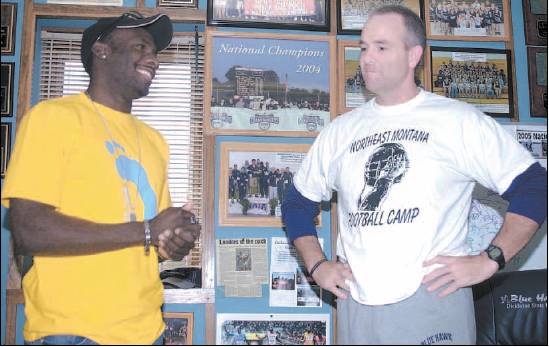
Derrick Atkins, left, and Dickinson State track and field coach Pete Stanton speak in Stanton’s office at the DSU athletic department. Photos of the Blue Hawks’ national track and field championships, along with photos of Atkins’ recent accomplishments, adorn Stanton’s wall.

There was a time when Derrick Atkins didn’t know if he was ready to compete in the international spotlight.

He didn’t know if the rewards that come with racing at the international level were worth being away from his girlfriend and daughter for months at a time. Atkins only knew he was prepared to hold his own against the fastest athletes on Earth.

“The emotional side of it, the mental approach, it takes a lot out of you,” Atkins said. “Midway in the season, I felt it. There was a point I had to take a break, regroup and come back.”

Atkins’ determination to compete at the highest level paid off significantly. He used the spring and summer of 2007 to cement his place as one of the world’s fastest men.

The Nassau, Bahamas, native capped his stunning 11-race summer with a silver medal in the 100-meter dash at the International Association of Athletic Federations World Championships in Osaka, Japan.

The seven-time Dickinson State national track and field champion is in town this week to take part in the school’s homecoming festivities. As a tribute to his recent accomplishments, DSU has made Atkins the honorary grand marshal of Saturday’s homecoming parade. He is also signing autographs at the Blue Hawks’ football game that afternoon.

Continue reading “Accepting fame: Atkins adjusts to international track stardom”