Back on the mat

Shane Bennett is one of Dickinson State’s top wrestlers. But, just 18 months ago, his life hung in the balance after a horrific accident.
Dickinson State’s Shane Bennett has returned to wrestling 18 months after an accident nearly claimed his life

Shane Bennett doesn’t believe he’s where he needs to be on the wrestling mat.

 He’s not competing at full strength and he’s nowhere near the conditioning level he was at when he took second place at the NAIA national tournament as a redshirt freshman.

 Still, the 21-year-old Dickinson State University fourth-year sophomore takes comfort knowing there was a time — not that long ago — when those close to him didn’t know if he would live to see the next day.

Continue reading “Back on the mat”

Shaped by war 

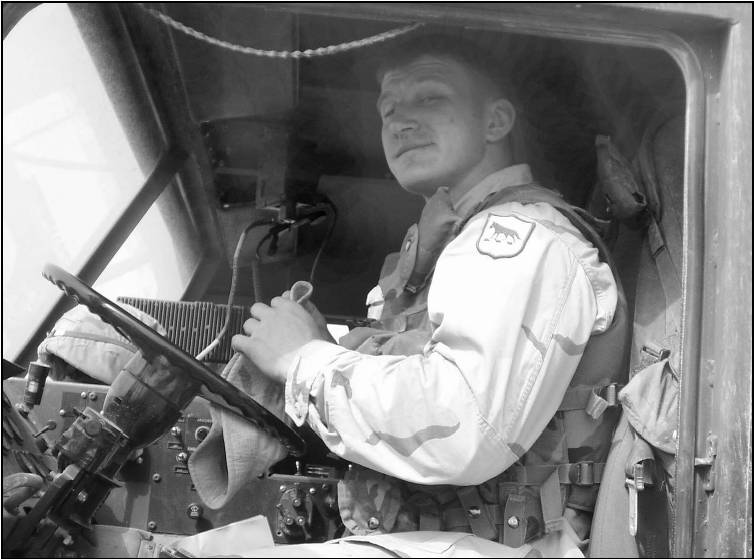
Courtesy Photos Justin Schlecht poses for a photo at the wheel of his Heavy Expanded Mobility Tactical Truck (HEMTT) in Iraq.

 War can change a man. It may affect him violently and physically, or it can come at him slowly, setting him on a path that will alter the way he lives out the rest of his days. In Justin Schlecht’s case, it was a little of both.

After Schlecht returned home from the war in Iraq, the Dickinson State wrestler had an epiphany. Schlecht knew then that he needed to start living for the big picture and relax the rigid stance he once had for his wrestling career.

“It (wrestling) wasn’t going to change the world,” Schlecht said. “It wasn’t going to have an effect on the world if I lost the match. … I was still going to have to pay the bills. It opened me up so I saw the bigger picture.”

Although the 23-year-old is quick to admit he doesn’t owe the 197-pound NAIA national championship he won last March to the time he spent in Iraq, he believes the war did its part to shape his persona.

“It’s hard to say who people are and where they come from,” Schlecht said.

Schlecht time at war did its part to shape his body and mind. He believes it’s the mindset he brought back from Iraq that has turned him into DSU’s most reliable wrestler.

“I went over there 19 years old physically and mentally. I came back … I was physically 21 and I feel like I’ve matured like an average 30-year-old,” Schlecht said.

Continue reading “Shaped by war “

Soaring to New Heights: F-M Acro Team Providing Halftime Fun Since ’70s

As the background music paces their steps, Maggie Orseth and Amanda Kankelfritz shake off nerves and one after the other, run full speed down the basketball court toward a nine-foot-high human pyramid.

The packed Shanley High School gymnasium braces for a big finale.

“Is she going to make it? She has to make it,” Orseth said, imagining what the crowd must be thinking.

The two girls bounce off a mini-trampoline and soar gracefully over the pyramid, sending the capacity crowd into a frenzy.

“In a way, it (the crowd) makes us go higher,” said Kankelfritz, a senior at Fargo South. “It gives us more energy.”

As the crowd offers a standing ovation, Kankelfritz, Orseth and the rest of the Fargo-Moorhead Acro Team smile and wave back enthusiastically.

Since the 1970s, the Acro Team has become one of the top halftime entertainment groups in the country, performing in small high school gyms and large professional sports arenas.

What separates the Acro Team from other acts?

While others merely fill a gap between two halves, the Acro Team prides itself in keeping fans in their seats throughout the performance with one objective.

“Our goal is to bring people to their feet,” assistant coach Mike Ceyner said. “Always leave them wanting more.”

For more than 36 years, that’s what Jim Simle’s innovation has done.

The former high school basketball coach started the Acro Team as an opportunity for girls, including his daughter Stacey, to have another extra curricular activity.

“At the time, there wasn’t a lot of opportunities for girls,” said Stacey Simle-Askew, now the team’s head coach.

At first, both the performances and the teams were small. But as the team’s reputation grew, so did invitations to perform.

The team regularly performs at the North Dakota boys basketball state tournament and has been to the Minnesota Gophers basketball games at Williams Arena since 1975.

This year, the Acro Team will perform in eight major sports arenas and showcase its talent for local fans at high school and college basketball games.

Although it receives money to perform at professional and collegiate games, and has several area corporate sponsors, the Acro Team won’t accept any money or donations from the fans at any small town it visits.

Simle sees the event as more of a way to bring the team’s talents somewhere it would rarely ever go.

“If they have more people in the stands, we’ve helped them,” said the 66-year-old Acro Team director.

After all, the team didn’t get its start performing for the Milwaukee Bucks or Wisconsin Badgers – whose arena’s the team will visit in January.

“We had some humble beginnings,” Simle said. “If you forget where you come from, you’ve lost it.”

It would be hard for Simle and the team to forget their roots. They’re surrounded by the team’s history on a daily basis.

Tucked away in the American Gold Gymnastics building in south Fargo is a spiral staircase leading to an office with more than 30 years of Acro Team history on its walls.

Nearly every girl – and one boy – lucky enough to be selected to the Acro Team’s top squad is immortalized by photographs on the walls.

The photos show how the Acro Team became the nationally known entertainment group it is today.

Of the hundreds of photos, there are four with Michael Jordan, another with Julius Erving after his final regularseason game, and several others with music and movie stars and politicians.

“You get to see things kids my age never see and go places you wouldn’t get to go,” said West Fargo senior Jenessa Olson.

That outlook has kept the Acro Team fresh over the years.

Even though many Acro Team members remain through their senior year of high school, for every one who leaves there are several junior members vying for the spot.

Assembling the team and choosing new members requires countless hours of scouting and decision making by the coaches. Much of it begins the day a child joins the Fargo-Moorhead gymnastics program. From there, a few are asked if they’d like to be a part of the team. Today, there are five Acro Teams for different age groups.

“Right now it’s so full, with each team it’s difficult to add people,” Simle said.

The meticulous process has paid off. Each squad has the opportunity to bring its own flavor and skill. The 2005-06 Acro Team is no different.

Orseth and her twin sister, Mary, have been involved in gymnastics since they were in the sixth grade, the gymnastics equivalent of jumping into high school football as a senior.

“I’ve done track,” said Maggie Orseth, a Fargo South senior. “You can’t compare it. It’s so much more time consuming. We do so much more.”

Kankelfritz started the gymnastics process when she was 3. By the time she was 6, she was on an Acro Team.

Mallory Griggs, a freshman at Minnesota State Moorhead, has been with the team for seven years. Simle-Askew was the only other member to stay with the team into college.

Griggs said although she loves the team, her commitment to classes and the team had to be weighed.

“You just get swamped,” she said. “This kind of gets you away from it all.”

Griggs is leaning toward this being her last year with the Acro Team, even though she knows she might regret stepping away.

“It’s just a big part of my life,” she said.

Every metro high school is represented on the Acro Team, but there is one who makes devotes the majority of her after-school time to the team.

Katie Jensen drives an hour from her home in Chaffee, N.D., to practice.

“In the winter it’s longer,” said the Central Cass High School freshman.

Jensen said the opportunity to be a part of the Acro Team is second-to-none, even if it interferes with friendships, school and social lives.

“It’s hard sometimes,” she said. “I want to go do something with my friends, but I have to go here instead.”

Despite logging more miles than any other team or activity group in North Dakota will this year, the team manages to keep up with school work.

“We’ve never had to hold a kid (out of a performance) for grades,” Simle-Askew said.

As a reward for the hard work, the team gets to perform on some of the biggest stages in professional sport.

Madison Square Garden, home of the New York Knicks – and some of the National Basketball Association’s rowdies, most vocal fans – is an every-other-year stop for the Acro Team.

When the team finished its last performance there – they’ve entertained at the Garden five times – the reputedly harsh New York fans showed a side no one on the Acro Team expected.

“We had people telling us we were better than the game,” Maggie Orseth said. “They were so warm and receptive.”

It’s not a bad place to spot and meet celebrities, either.

Team members said catching a glimpse of movie star Brad Pitt in the audience at the Garden and meeting country music star Toby Keith at a University of Oklahoma men’s basketball game are among the high points of traveling with the team.

Keeping some of the most famous entertainers in the world in their seats at halftime takes time, hard work and a great routine.

Although it often leaves fans breathless, the choreography has its limits.

The Acro Team performs with two 72-foot springfloor runways, five crash pads and five mini-trampolines. The runways and trampolines were specifically designed by Ceyner, who also works as an electrical engineer.

“There’s only so many ways you can put the equipment,” Ceyner said.

Each year, new handstands, backflips and jumps are worked into the routine.

“I still get the chills up my spine when I see them perform,” said Sharon Jackson, mother of 14-yearold Acro Team member Lexi Jackson, a West Fargo freshman.

The team also has taken advantage of technological advances to improve its choreography and coaching.

If a team member feels one of her moves isn’t up to par, she can check out the replay on a digital video recorder that runs during practice.

When Ceyner joined the team as a coach in 1979, music for performances was played on records. Now, Ceyner uses an MP3 disc jockey system on a laptop computer.

“In the last two years, the technology existed where we can plug a computer into an arena,” Ceyner said.

As the team matures technologically, coaches have taken steps to ensure they mature socially. An etiquette exercise takes place at nearly every practice.

It’s all in an effort to live up to the team’s title as official goodwill ambassadors for North Dakota, a title given to the team by Gov. Allen Olson in 1981.

“You’re trying to build a good athlete,” Simle said. “But moreso, you’re trying to build a good person.”

As the team gathered for a post-performance meeting in Shanley’s practice gym, three young members of the Acro Lites team – none taller than the waist of anyone in the room – practiced summersaults off to the side, laughing and critiquing each other.

It brought a smile to Simle.

“The thing that has never changed are the kids,” Simle said. “They lead you.”

 

Hunting Dogs Put to the Test

GLYNDON, Minn. – Quiver, a 2-year-old yellow labrador retriever, seemed to know what would impress the judges at the North Dakota Retriever Club hunt test Saturday.

The dog emerged from thick grass at the test grounds north of Glyndon, proudly displaying a recovered duck in his mouth and shrewdly slowing down to show judge Fran Smith.

Was it an attempt to impress the woman scoring him? Only Quiver knows. But it worked.

“I am impressed,” Smith enthusiastically said to the dog and his handler Lyle Steinman.

Just for bonus points, Quiver delicately dropped the duck and correctly heeled at Steinman’s side.

Steinman handled 19 of nearly 100 master-level dogs at the American Kennel Club certified tests. He said it’s difficult for even the best hunting dogs to make it to the master level.

“You have to have a good dog,” Steinman said. “But you have to have an animal who has a natural ability. The IQ, the brains, it all goes back to genetics.”

Dogs in the AKC tests begin as juniors, and then move on to the senior level.

After passing several tests, they can advance to the masters.

Once there, the dogs are put through far more challenging tests, including blind retrieval.

It means the dogs can’t see the birds go down and must rely on their senses to retrieve them.

Because of the level of difficulty, only 20 percent pass.

“The master dogs competing are better than 99 percent of the hunting dogs out there,” NDRC president Henry Van Offelen said. “It gives you a measure on which to gauge and see what dogs can do.”

The final tests continue today at the NDRC main grounds, two miles west of Glyndon.

Steinman, the owner of Castile Creek Kennels in Stewartsville, Mo., handles and trains master and senior hunting dogs.

“(Castile Creek trainer) Greg (Nelson) and I only train dogs we love,” Steinman said. “We don’t train ones we don’t like. It’s got to be a mutual respect.”

Trainers and handlers must teach a dog how, when and where to heel, react and retrieve.

“A big thing with all these dogs (is) the obedience,” Steinman said. “You need a lot of obedience.”

Every dog must heel at the handler’s side before beginning the test and after retrieving each bird.

“We’re not looking for the best athletes, we’re looking for the type of dog who wants to work with us,” Steinman said.

Max, a six-year-old labrador retriever Steinman handles, is believed to be the most accomplished master dog in the nation with 68 master test passes.

He’ll be going for No. 69 this weekend.

“The level of expectations of what we’re wanting is so tough, a very small percentage make it anymore,” Steinman said.

Tim Slattery, a former professional football player from Celina, Texas, has handled dogs professionally for 16 years. He has eight master dogs and two seniors competing at the tests.

“I’ve got a competitive edge in me,” Slattery said. “I like to get out there with the dogs and tear it up.”

Slattery and Steinman said they often trade tips and tricks about courses when testing.

“We’re constantly tuning each other in,” Slattery said.

Like Slattery and Steinman, several professional trainers from across the country used the tests to qualify dogs for nationals.

For Bob and Lynn Louiseau of Perham, Minn., the tests were the first step in training Delta, their 1-year-old yellow labrador retriever.

It was the first hunt test for Bob Louiseau, 53, who joined the NDRC in order to learn how to properly train Delta, who competes at the junior level.

“It’s kind of fun to be taught,” said the former peewee hockey coach. “I’m learning things from 20-year-olds who’ve been doing this longer than I have.”

Former Star Strawberry Discusses Battles With Dependency

Fargo’s Julie Brown gets an autograph from former baseball star Darryl Strawberry at Ramada Plaza Suites on Saturday. (AP)

Darryl Strawberry knows what it feels like to be on the edge.

“I went through hell,” the former Major League Baseball allstar said.

Strawberry spoke about his drug and alcohol dependency Saturday at the Sister’s Path Gala sponsored by Fargo’s Sharehouse at the Ramada Plaza Suites.

“A lot of people go to treatments, like myself, several times, and never can pinpoint where the problem is,” Strawberry said. “You don’t see it until your life is totally at the end.”

Strawberry, who said he has been drug-free for nearly four years, was scheduled to speak with his wife, Charisse, the President of the Tampa, Fla., chapter of the National Council on Alcoholism and Drug Dependence.

But the woman who stuck with Darryl through addiction and two battles with colon cancer was unable to attend the event due to food poisoning.

“She’s been through a lot. She’s very committed,” Strawberry said. “She’s saddened that she wasn’t able to make it.”

The Strawberrys have become regular inspirational speakers since Darryl’s retirement from baseball and his numerous recoveries.

“Basically, I like to share my life,” Strawberry said. “Where it all began. How I got through addiction. What it was like, the insanity of it.”

Rick Lopez, the executive director of Fargo’s Sharehouse, said Darryl’s message is powerful.

“He gives a message of hope and coverage for those facing addiction,” Lopez said.

Strawberry spoke primarily about the effect chemical dependency has on families while also promoting his and Charisse’s book, “Recovering Life.”

The Strawberrys co-authored the book, an autobiographical account of their struggles.

“Most of the time, people don’t understand,” Strawberry said. “They think the person who is using or drinking is the one being affected, but families are also being affected.”

Strawberry, who has three children with Charisse and two from his first marriage, said speaking to families of those affected is one of the most important things to him, especially since he knows what the problems meant to his children.

“She (Charisse) really wanted the kids to grow up knowing their dad,” Strawberry said. “They know their dad is around and is involved in things.”

Strawberry won three World Series titles during his 17-year career. His first came with the New York Mets in 1986. The other two came with the New York Yankees (1996, 1999).

He was named Rookie of the Year in the National League in 1983.

After being away from baseball for more than five years, Strawberry is back with the Mets, working in their farm system and helping groom rookies.

“It’s a great feeling to be back with the organization I started with,” Strawberry said. “They want me to work with them and guide them, hopefully teach them some things about baseball.”

With a new job and a new outlook on life, Strawberry’s next step is to literally take things one day at a time.

He lives up to it by wearing a wristband with the words, “Just For Today,” on it.

“Just for today. Each day that you wake up, you just thank God and pray you get through another 24 hours,” Strawberry said.