Whiting CEO: We believe in the Bakken

Volker says oil companies still profiting despite lower oil prices

BISMARCK — The chief executive of North Dakota’s largest oil producer said Wednesday that his company is still making big money on Bakken and Three Forks wells despite the industry’s economic downturn.

Whiting Petroleum Corp. President and CEO Jim Volker said during the second day of the Williston Basin Petroleum Conference that he foresees a gradual upturn for the state’s oil industry as crude prices steadily creep upward and more drilled but uncompleted wells are slowly brought into production.

“We’re a big believer in the Bakken, not only its future but even where we are today,” Volker said. “This is why we believe so much in the Bakken. We put our money where our mouth is here.”

Volker pointed to technological improvements for allowing production companies to operate with fewer rigs, allowing them to continue investing in the North Dakota Oil Patch — even if it’s not at the same rapid pace as years prior.

Volker said even at Wednesday’s price of about $50 a barrel — a comment that drew applause from the crowd — a Whiting well is still projected to produce a future net revenue of $27 million at a cost of about $7 million.

Whiting produced more than 4.1 million barrels of crude from nearly 1,500 active North Dakota wells in January 2016. In Stark County, the company had 131 wells that produced around 180,000 barrels.

“This is all happening with improvements in technology and improvements in the way we drill and complete,” Volker said. “Not only are we cleaner, we’re more efficient and we’re doing it for less money.”

Don Hrap, president of the Lower 48 states for ConocoPhillips, echoed that in his keynote address later in the day, as he said innovation and entrepreneurialism created out of necessity by the 2015-16 oil price downturn will make the industry “smarter, better and more efficient.”

“I think that technology innovation is what brought us this renaissance and also it’s what’s going to support us as we move forward,” Hrap said.

Hrap showed charts detailing the ups and downs of oil over the past 150 years, and said while this recent price drop is one of the most sustained in history, it could lead to more level and sustainable long-term prices.

“As we adapt and adjust, we have a tendency to provide the supply that’s needed that kind of moves us to a lower price,” he said. “That’s important to us, because it says we can’t count on $100 oil. We need an industry that’s supportive of a price that’s more moderate.”

Volker, meanwhile, wrapped up his speech with a summary of how Whiting recently paid down $500 million in debt.

Paul Steffes, CEO of Steffes Corp., a Dickinson manufacturing firm heavily invested in the production side of the oil business, said hearing that “certainly makes me feel good.”

“They’re a major player in the Bakken, so it’s an important piece for North Dakota to see Whiting be healthy,” Steffes said.

Lynn Helms, director of the state Department of Mineral Resources, said Volker’s optimism about pushing forward with a slow ramp-up is “consistent with what all the other operators are saying.”

Volker pointed out Whiting’s obligation to continue drilling wells, especially those on federal and tribal land, or risk losing their leases. Helms said those comments prove that rigs will continue to operate in the state, even if there’s only around 30. North Dakota had 28 drilling rigs as of Tuesday.

“I think that’s going to help the state to stay in this 30-rig paradigm that we’re in, because those drilling obligations are really expensive to walk away from,” Helms said.


Free kids books are back: Imagination Library program restarts in Stark County

Jessina Kary said she wasn’t sure what had happened when her son, Isaac, stopped receiving his monthly book through the mail from the Dolly Parton’s Imagination Library program.

She wondered if there had been a mixup in her address after her family had moved. It wasn’t until later that Kary and hundreds of others learned the program had lost its funding in Dickinson, leaving nearly 600 children ages 5 and under without the free book they’d come to expect and enjoy every month.

“He loved it,” Kary said of 4-year-old Isaac. “The first book he ever got was ‘Little Engine That Could’ and we still love that one because he still loves trains.”

Soon, Isaac Kary and kids across Stark County will start receiving their Imagination Library books again.

North Dakota First Lady Betsy Dalrymple helped announce the restart of the program Monday morning at the Dickinson Area Public Library and later read “Roar of a Snore” to a group of children.

“There’s nothing better that a community can do than to help give a gift to your children once a month,” Dalrymple said.

The Imagination Library program was brought back in large part because of a donation of $16,000 by WPX Energy, an oil and gas exploration company with a large stake in the Bakken. Their donation allows children in all Stark County cities except Belfield, which has its own Imagination Library program, the opportunity to sign up for the Imagination Library.

“I really want to tip my hat to them (WPX) for underlining the difference that this program can make in the lives of children,” Dalrymple said.

Imagination Library was launched in 1995 by Dolly Parton, a country music legend and actress, to benefit children ages 5 and under in her home state of Tennessee. It has since expanded to every state, Canada, Australia and the United Kingdom. Each month, children receive an age-appropriate book through the mail.

When Dickinson’s Imagination Library lost its funding, several interested parents and educators formed a committee to bring it back. With Dalrymple’s help and support from WPX, the program relaunched in April.

“There’s such a great need for this, so I’m glad we were able to get a committee together and get this going again,” said Lane Talkington, Dickinson’s children’s services librarian

Nearly 1,400 children in Stark County are eligible for the program, and the committee hopes to get every one of them signed up.

Chelsey Scherr, representing the Badlands Reading Council, works for the K.I.D.S. Program in Dickinson and said she sees the difference in children who are read to early and often in a world full of screens.

“What they really need is a parent who gets on the floor, plays with them and reads to them,” Scherr said.

Erica Crespo, part of the committee to help restart the Imagination Library in Stark County, held her 1-year-old son Vaile as they listed to Dalrymple and others speak.

She said she was disappointed when the program lost its funding around the time Vaile was born. Now that it’s back, they are signed up and awaiting his first book.

“It’s just an awesome program to promote literacy in our community,” Crespo said. “So many parents don’t know about this program.”


Cattlemen talk market volatility

Larry Schnell, owner of Stockmen’s Livestock Exchange in Dickinson, drew applause from his industry colleagues Friday when he said cattlemen are angered when traders use subtle deviations in the cattle markets and cause major price fluctuations that trickle down all the way to their operations.

“That’s why it’s so hard for us to accept that we should face the consequences of all the trading that takes place under the table, in the dark,” Schnell said. “That’s hard for us to accept. … These people here, they’re not a part of that. They only suffer the consequences of that trade.”

Many from the western North Dakota and South Dakota cattle industries gathered Friday morning at Stockmen’s to listen to Schnell and other industry leaders speak out on problems they see in the cattle markets at a forum hosted by U.S. Sen. Heidi Heitkamp, D-N.D.

Heitkamp, Schnell and five other panelists sat in the Stockmen’s sales ring — where cattle are typically showed for auction — as they discussed market concerns for more than two hours. Other panelists included Bowman rancher Steve Brooks, who is president of the North Dakota Stockmen’s Association; Justin Lumpkin, a U.S. Department of Agriculture marketing officer; Larry Kinev, president of the Independent Beef Association of North Dakota, and cattle buyer Fred Berger, of Mandan.

“What we were talking about here today isn’t, I think, about the high prices or the low prices,” Schnell said after the forum. “It’s about the volatility. It’s about the volatility where the market changes for what seems like no reason whatsoever.”

The managing director of commodity research for the CME Group, which operates the Chicago Mercantile Exchange, said the exchange is months away from fixing issues that cause excess volatility in cattle markets. David Lehman told cattlemen that the exchange, in the next couple of months, will implement market circuit breakers on live and feeder cattle to install limits on how cattle contracts are traded.

He said it should help ensure market integrity. The circuit breakers are intended to keep prices from skyrocketing or bottoming out based on volatile activity in the market regardless of the speed or way people are trading.

“Rather than a hard limit that stops the market, it halts the market,” Lehman said, adding it will trigger if live cattle prices move more than $1.50 during an hour, or $2.25 for feeder cattle.

Ron Volk, a rancher from the Sentinel Butte area, said he understands the reasoning for implementing the circuit breakers but told Lehman he doesn’t believe it’ll be a permanent fix for the market’s instability.

“It seems to me like we’ve got a broken leg and you’re trying to throw a couple Band-Aids on it,” Volk said. “I don’t see it changing anything. It’s prolonging the broken leg. Now instead of putting a cast on, you may have to cut the leg off.”

Lehman said he agreed that “the leg is broken,” but said circuit breakers already help deter volatility in many markets, including oil and precious metals.

He said the circuit breakers are being put in place to limit moments like one that happened last week when 175 feeder cattle contracts — nearly three times the average daily trades made — were traded on the Chicago Mercantile Exchange and caused cattle prices to drop significantly.

“That set off a cascade pushing the market down until it found the other bids or offers that could match this 175-lot order,” Lehman said.

The problem, the panel said, is the volume of electronic trading happening by hedge funds or others who normally wouldn’t trade cattle futures, but do so based solely on market deviations.

Schnell believes it’s “nerds writing programs who are looking for an advantage.”

“What some of those algorithms trade on is only the knowledge of the trade, not knowledge of information,” Schnell said. “To us, that’s insider trading.”

Mike Heaton, a McKenzie rancher and member of the Independent Beef Association of North Dakota, said those outside of the cattle and agriculture industries trading live and feeder cattle and causing volatile prices swings in the markets, are comparable to parasites.

“There’s a whole other world out there of people living off of our industry,” he said. “When we get no return on it, they’re like the parasite that I get rid of in my cattle.”

Heitkamp said the Senate Agriculture Committee — of which both she and Sen. John Hoeven, R-N.D., are members — is holding a hearing about the volatility in cattle markets Thursday in Washington. She said part of the reason for hosting Friday’s forum was so she could get an idea of what North Dakota cattlemen believe are the biggest issues.

“The more this marketplace does not work for the people in this room, the more difficult it’s going to be to manage it,” Heitkamp said. “The more people who pull out, the more irrelevant it is.”

Herman Schumacher, a cattleman from Herreid, S.D., challenged Lehman on the constant cattle market fluctuations and said he believes the issue comes back to hedge funds and the meat packing industry trying to build a greater stake in the market.

“We’re fighting to try and not chicken-ize the cattle industry,” Schumacher said, referring to the influence large corporations have on the poultry trade.

Schumacher said he thought the input cattlemen from the area had at the meeting was beneficial as Heitkamp and others take their issues back to Washington next week.

“The only thing that keeps us separate from them (the commercial meat packing industry) are these cowboys that you had sitting there,” Schumacher said, pointing to chairs behind him.

Quality-of-life factors determine if people choose to live in Dickinson

James Kramer told a group of Dickinson city leaders Tuesday that “individual factors” such as recreation, tourism, arts and culture are becoming the main influences in where people choose to live their lives.

The city’s Parks and Recreation director said he sees it almost daily when business leaders and Dickinson State University recruiters bring potential employees and students, respectively, to the West River Community Center in an effort to convince them to work, learn and live in Dickinson.

“In olden days, people moved to a place where there are job opportunities,” he said. “Nowadays, people may have two or three different employment opportunities, and they’re going to go look at those and base their decision on different individual factors. Does that community have what I’m looking for to live?”

Kramer’s comments kicked off the Quality of Life luncheon hosted by the Dickinson Area Chamber of Commerce at Lady J’s.

The luncheon featured short presentations on areas the influence Dickinson’s well-being by Terri Thiel, executive director of the Dickinson Convention and Visitor’s Bureau; Jim Kelly, interim CEO of the Theodore Roosevelt Presidential Library Foundation, and Ty Orton, executive director of the DSU Heritage Foundation.

Kramer said the parks department is turning its focus to improving long-neglected areas of its portfolio, such as the city’s trail system as well as possible improvements around the Patterson Lake Recreation Area.

He said trails are “an area where we’re lacking.”

“We definitely need to take a look at our trail system and expand it,” Kramer said. “We have begun working with the city to create a master plan and create some new opportunities in that area. We look forward to doing that in the future.”

He said opportunities exist for expansion of recreational opportunities near Patterson Lake, and pointed to the two-mile Crooked Crane Trail project that will be completed this summer as an example of that.

Like Kramer, Kelly also gave a taste of quality-of-life improvements that could be in Dickinson’s future.

Kelly spoke about the Theodore Roosevelt Presidential Library project on DSU’s campus and showed renderings of what the library would look like when completed. The project is likely to begin construction on the DSU rodeo grounds near the corner of State Avenue and Fairway Street this summer.

The first project, a replica of Roosevelt’s Elkhorn Ranch cabin made out of cottonwood trees found in the Badlands, could begin construction this summer after the final Roughrider Days Rodeo held in June.

The library — which renderings showed would be a large, sweeping structure complete with an all-glass great hall — would be years in the making and Kelly said would require “significant site preparation” as plans require vast landscaping improvements to the 26-acre site.

“As you go by the site now, it’s sort of flat as a pancake and as flat as the top or your table,” he said. “That’ll change significantly as we get into the building of the facility.”

If the library comes to fruition as planned, Thiel said Dickinson has more than enough hotels to give visitors a place to stay. She said the city has 1,773 rooms available at 21 lodging properties — a 135 percent increase from 2004.

However, the city’s hotel occupancy rate dropped 32.5 percent from 2014 to 2015 because of the decrease in the area’s oil activity. With that in mind, Thiel said the CVB’s advertising push in print, online and social media has been to promote Dickinson’s hotel availability.

“We really try to educate people in the state about that,” she said.

Orton, who closed the speeches by talking about the progress the new Heritage Foundation is making, said part of maintaining Dickinson’s quality of life is for the university to find and retain students who want to stay in the city after they graduate.

“We have students there right now that have stayed through some very hard times,” Orton said. “They stayed because of their true love of DSU and this city. They chose to stay in Dickinson because of their love for the community, because of the quality of life. Those are the people we need to make sure they can stay around, they can continue to build this community 20, 30, 40 years from now.”

Planting season well underway, though farmers hope precipitation is in future

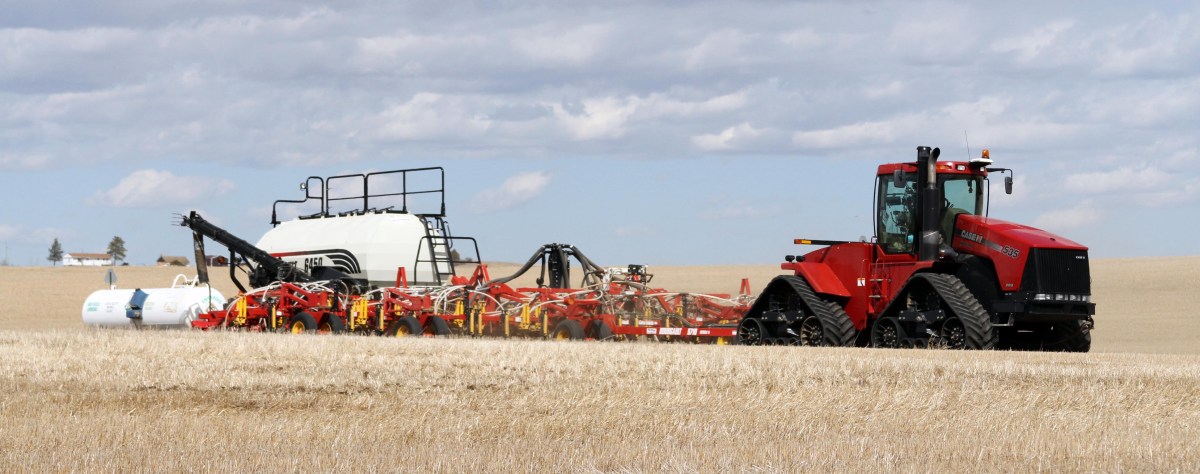
MOTT — After 23 years of farming, Mark Anderson is happy to stick to his “game plan.”

The Regent-area farmer said neither below-average precipitation nor low commodity prices have shaken him much this year. He’s still seeding the crops he’d planned for and said Monday that he’s more than halfway finished.

Though with much of western North Dakota in a moderately dry drought, according to the U.S. Department of Agriculture’s drought monitor, Anderson and others say they can’t help but hope for a little rain soon.

“It’d be nice to get a good rain to settle the dust,” he said. “I think everybody would have kind of a weight lifted off their shoulders if they’d get an inch of rain.”

Most southwest North Dakota farmers are in the same boat as Anderson — about half done with their spring planting while hoping for some moisture to give those seeded crops an early boost.

Garret Swindler, who farms east of Anderson in the Mott area, said the only benefit to the dry year so far is farmers were fighting wet and muddy fields just to get their crops seeded last spring.

He said the moisture left in the topsoil after winter is fine for seeding, but it’ll only be good if planting season if followed by some rain.

“There’s enough moisture there to get the crops started,” he said. “We’re definitely planting deep. … We just have to make sure that seed has enough moisture to germinate and get out of the ground. But you can’t really wait on rain either.”

Duaine Marxen, the Hettinger County Extension agent in Mott, said most farmers he works and speaks with on a regular basis have been in the field for the past couple of weeks, and like Anderson and Swindler, most are well on their way to wrapping up planting efforts. Contending with dry conditions and high winds, however, have made for some challenging days, he said.

“No one here will complain if it starts raining,” Marxen said with a laugh.

Farmers might get their wish this weekend.

The National Weather Service is forecasting some showers for southwest North Dakota this week, with chances increasing toward the weekend and into next week.

That could be a welcome relief, as Todd Hamilton, a meteorologist with the National Weather Service in Bismarck, said the Dickinson area is already 1 inch below average rainfall for the year.

“We haven’t really had any real significant precipitation in quite some time,” Hamilton said, adding it has been about six months since southwest North Dakota experienced a large precipitation event.

He said conditions are “abnormally dry” throughout the western and central parts of the state.

“We are still early in the growing season now, so there’s certainly potential for us to move out of this,” he said.

Anderson said he has wrapped up seeding his spring wheat and Swindler planned to be finished with it by today. After that, both said they’d move on to other crops such as flax, canola and corn.

Anderson said while some farmers might be trying to “outguess” the weather or the future of commodity prices in deciding what or where they plant certain crops, he’s happy to stay the course and stick to what has worked for more than two decades.

“What looks poor now may be your best moneymaker in the end,” he said. “… I’ve been through these times before. You just seed the crop and cross your fingers.”